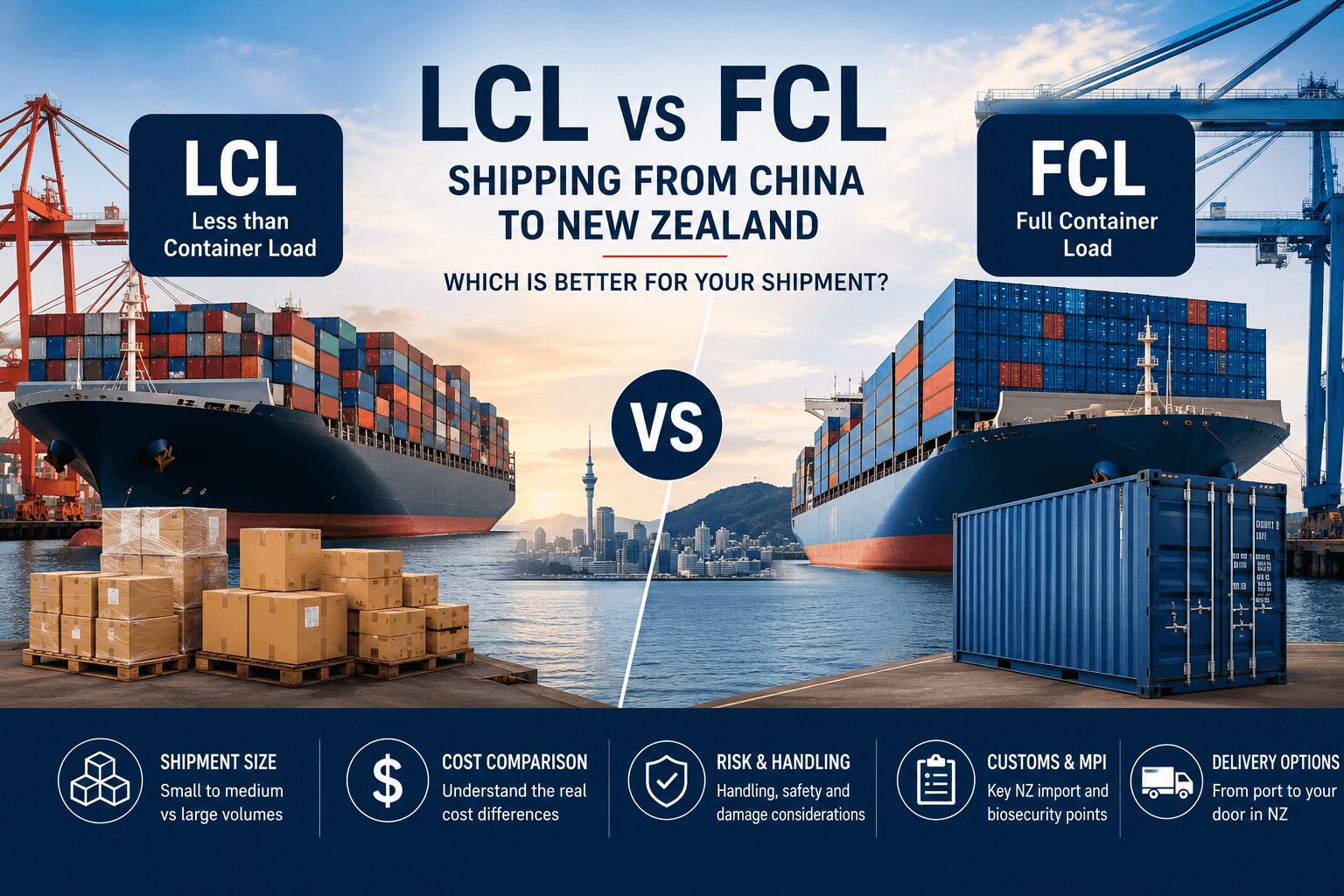
LCL vs FCL shipping from China to New Zealand is one of the first freight decisions importers need to make. LCL lets your goods share a container with other shipments, while FCL gives your cargo a dedicated container.
Both options can work well. However, the right choice depends on shipment volume, product type, packaging, handling risk, budget and the final delivery address in New Zealand.
Prestige Sourcing Group can help businesses source products and coordinate suppliers in China. For local buyers, our China sourcing support for New Zealand businesses can connect supplier coordination, consolidation and freight planning before goods leave China.
What Is LCL Shipping?
LCL means “less than container load”. It is used when your goods do not fill an entire shipping container.
A warehouse in China combines your cargo with shipments from other importers. The warehouse then loads the shared container for shipping to New Zealand. After arrival, a destination depot unloads the container and separates each shipment before clearance and delivery.
LCL often suits smaller importers, eCommerce sellers, retailers, builders and businesses testing new products. For example, a shipment of 2 CBM, 5 CBM or 10 CBM may not justify paying for a complete container.
In that situation, LCL sea freight from China to New Zealand may provide a more practical option.
What Is FCL Shipping?
FCL means “full container load”. Your shipment travels in a dedicated container rather than sharing space with other cargo.
Common container sizes include 20ft, 40ft and 40ft high cube containers. The supplier, factory or loading warehouse usually packs the container in China. It then moves to New Zealand for clearance and delivery.
FCL often suits wholesale stock, machinery, furniture, building materials, bulky goods and regular commercial imports. It can also suit fragile or valuable cargo when the importer wants more control over loading and handling.
Prestige Sourcing can assist with FCL sea freight from China to New Zealand when the shipment volume justifies dedicated container space.
LCL vs FCL Shipping from China to New Zealand: Main Differences
The main difference between LCL and FCL is how the container space is used.
With LCL, your shipment shares space with other cargo. Therefore, you only pay for part of the container. This can reduce costs for smaller shipments, although the goods will normally pass through more handling points.
In contrast, FCL keeps your shipment inside its own container. This usually gives you more control and reduces handling. It can also lower the freight cost per unit when the shipment is large enough.
The cheapest freight quote is not always the best option. Instead, compare the complete landed cost, handling risk, delivery requirements and likely additional charges.
When LCL Shipping Is Usually Better
LCL is usually better when the shipment is not large enough to justify a dedicated container.
Choose LCL when:
- Your shipment is small to medium-sized.
- You are testing a new product or supplier.
- This is your first commercial import.
- Paying for unused container space would not make sense.
- Several supplier orders need to be consolidated.
- The cargo is not urgent enough to justify air freight.
- Its size or weight makes courier shipping unsuitable.
LCL gives smaller importers access to sea freight without requiring them to fill a whole container.
However, very small shipments may suit a different service. If your goods are below 1 CBM and timing is flexible, compare LCL with a China to New Zealand sea parcel service.
When FCL Shipping Is Usually Better
FCL becomes more attractive when the shipment volume is large enough to justify a complete container.
Choose FCL when:
- Your shipment is large or bulky.
- There is enough cargo to justify a 20ft or 40ft container.
- You want to reduce handling during transit.
- The goods are fragile, valuable or difficult to repack.
- Full-container imports are a regular requirement.
- Greater control over loading is important.
- The total FCL price is close to the equivalent LCL price.
FCL can reduce the freight cost per unit for larger orders. In addition, the cargo stays together rather than moving through a shared-container consolidation process.
Cost Differences Between LCL and FCL
LCL charges usually depend on shipment volume in cubic metres. Heavy cargo may instead attract charges based on weight or shipment-specific pricing rules.
FCL pricing normally depends on the container type. However, the container freight rate is only one part of the total cost.
An LCL quote may include:
- Collection from the supplier in China
- Export handling and documentation
- Warehouse receiving and consolidation
- Ocean freight
- New Zealand destination charges
- Customs-clearance costs
- MPI charges where applicable
- Depot handling and final delivery
An FCL quote may include:
- Container collection and positioning
- Supplier or warehouse loading
- China export handling
- Ocean freight
- New Zealand port charges
- Customs and MPI-related costs
- Container delivery or depot unpacking
- Container return, waiting time or detention charges
When comparing LCL vs FCL shipping from China to New Zealand, request a clear list of inclusions and exclusions. A low ocean-freight figure can become expensive after origin, destination and delivery charges are added.
Before requesting a quote, use the freight volume calculator to estimate the total CBM.
Is LCL Cheaper Than FCL?
LCL is generally cheaper for smaller shipments because you only pay for the space your goods use.
However, LCL becomes less cost-effective as volume increases. At some point, an FCL quote may offer better value, even when the goods do not completely fill the container.
There is no fixed CBM figure that makes FCL the best option for every shipment. The result depends on the route, cargo type, container availability, destination charges and final delivery requirements.
Therefore, larger shipments should be quoted as both LCL and FCL before you make a decision.
Handling and Damage Risk
LCL cargo usually passes through more handling points than FCL cargo.
Warehouse teams receive the goods, combine them with other shipments and load the shared container. At the destination, another team unloads the container and separates each shipment.
More handling does not guarantee damage. However, it makes strong packaging more important. Suppliers should use suitable export cartons, internal protection, clear carton markings and pallets or crates where required.
FCL normally involves less cargo handling because the goods remain together inside one container. Even so, poor loading can still cause damage. Heavy items can move during transit, while badly stacked cartons may collapse under pressure.
Do not assume that packaging designed for domestic delivery inside China will survive international sea freight.
Customs, GST and MPI Requirements
New Zealand import requirements apply to both LCL and FCL shipments.
Commercial imports valued at NZ$1,000 or more generally require a client code and supplier code for entry processing. Importers can review the current New Zealand Customs client-code requirements before shipping.
Customs may collect GST, import duty and border levies. GST is 15%, while duty depends on the product classification, origin and applicable tariff treatment.
MPI may inspect goods, packaging or containers that present a biosecurity risk. Products containing wood, bamboo, natural fibres, soil residue or used outdoor components may require extra attention.
Wooden pallets, crates and dunnage should meet the applicable treatment and marking requirements. Check the current MPI requirements for imported wood packaging before the goods leave China.
You can also use the New Zealand Customs fee calculator for an initial estimate. Final charges depend on the shipment details and official assessment, so confirm the position with a customs broker or relevant authority.
Delivery Differences Between LCL and FCL
A destination depot normally separates LCL cargo before final delivery. The shipment may arrive as cartons, pallets or loose cargo, depending on how the supplier packed it.
FCL cargo may travel to the final address inside the container. Alternatively, a depot can unpack the container before local delivery.
Before arranging direct container delivery, confirm that the site can receive it. Consider the following:
- Is there enough space for the container truck?
- Can a forklift or loading dock handle the goods?
- Will the site unload the container within the allowed time?
- Does the delivery require a sideloader?
- Would a depot unpack be safer or easier?
- Are there steep driveways, rural roads or access restrictions?
For LCL deliveries, check whether the quote includes residential delivery, rural delivery, a tail lift, waiting time, hand unloading and redelivery.
Prestige Sourcing can help coordinate door-to-door freight from China to New Zealand when the shipment details allow it.
LCL vs FCL for Multiple Suppliers
LCL often works well when you are buying from several Chinese suppliers. Each supplier can send its goods to one warehouse for consolidation.
This process can simplify the international freight booking. However, it still requires accurate packing lists, carton labels, commercial invoices and delivery timing from every supplier.
For multiple-supplier orders, warehousing and consolidation in China can help identify missing cartons, damaged packaging or document problems before export.
For larger consolidated orders, FCL may become more economical. Therefore, LCL vs FCL shipping from China to New Zealand should be assessed after all suppliers confirm their final carton dimensions and weights.
Common LCL and FCL Shipping Mistakes
Common LCL mistakes include:
- Comparing ocean freight without checking destination charges
- Using weak cartons for heavy or fragile goods
- Providing inaccurate carton dimensions or weights
- Ignoring possible MPI or biosecurity requirements
- Assuming the supplier’s freight quote includes every cost
- Using vague product descriptions on shipping documents
Common FCL mistakes include:
- Booking a container before confirming the final cargo volume
- Choosing the wrong container size
- Failing to check access at the delivery address
- Forgetting about unloading equipment or depot unpacking
- Using untreated or non-compliant wooden packaging
- Ignoring container waiting time, return or detention risk
Should You Choose LCL or FCL?
For smaller shipments, LCL is usually the sensible starting point. It provides access to sea freight without the cost of a complete container.
For larger, regular, bulky, fragile or higher-value shipments, FCL often provides more control and a lower cost per unit.
The right choice for LCL vs FCL shipping from China to New Zealand depends on the final packing details. Before deciding, confirm the supplier location, product type, carton count, dimensions, gross weight, total CBM, shipment value, trade terms and New Zealand delivery address.
If timing matters more than cost, compare sea freight with air freight from China to New Zealand.
Need Help Shipping from China to New Zealand?
As a Shenzhen sourcing agent, Prestige Sourcing Group can represent the buyer on the ground in China, communicate with suppliers, coordinate warehouse receiving and compare suitable freight options.
Send us the supplier location, product details, carton count, dimensions, gross weight, shipment value, trade terms and final delivery address. We can then assess whether LCL, FCL or another freight method makes the most sense.
Frequently Asked Questions
Is LCL or FCL cheaper from China to New Zealand?
LCL is usually cheaper for smaller shipments because you only pay for part of the container. FCL may become more cost-effective as shipment volume increases.
What does LCL mean in shipping?
LCL means “less than container load”. Your goods share a shipping container with cargo from other importers.
What does FCL mean in shipping?
FCL means “full container load”. Your goods travel inside a dedicated container, such as a 20ft or 40ft container.
Can goods from several suppliers use one shipment?
Yes. Suppliers can send their goods to a warehouse in China for consolidation. However, each supplier must provide accurate quantities, packing details and documents.
Do both LCL and FCL shipments require Customs clearance?
Both methods remain subject to New Zealand Customs and MPI requirements. The exact process and charges depend on the goods, shipment value, packaging and supporting documents.