DDP shipping from China to New Zealand can be legitimate and convenient. However, not every service sold as DDP follows a transparent import process. You should know who imports the goods, what value appears on the Customs entry, how GST is handled, and what Customs paperwork your business will receive.
For a long-term importing business, those details matter. A cheap freight quote has little value if your stock, GST records, or Customs position become difficult to explain later.
DDP shipping from China to New Zealand is legitimate
DDP means Delivered Duty Paid. It is a recognised Incoterm. Under DDP, the seller accepts a high level of responsibility. This includes import clearance and applicable import duties and taxes before delivery to the agreed destination.
Proper DDP is not automatically suspicious. It can work well when the seller, freight provider, and Customs broker handle the import transparently.
However, the seller accepts more responsibility and more clearance risk. Proper DDP will therefore often cost more than a structure where the New Zealand buyer handles import clearance directly.
The problem is that suppliers and freight agents also use DDP to describe all-inclusive freight services. Some are transparent and legitimate. Others fall into what the freight industry often calls grey DDP.
What is grey DDP?
Grey DDP is not an official Incoterm. It is an informal industry term for an all-inclusive freight service where the buyer has limited visibility over the import process.
The forwarder may collect your goods in China and combine them with other cargo. It may then use another company as the importer before delivering your cartons for one fixed price.
Your company may not appear as the importer of record. You may not receive the Customs entry. You may also have no clear record of the Customs value, GST, duty, or other charges actually paid.
Not every grey DDP arrangement involves wrongdoing. However, some arrangements can involve deliberate undervaluation, inaccurate product descriptions, or false declarations.
Some grey DDP can involve serious Customs risk
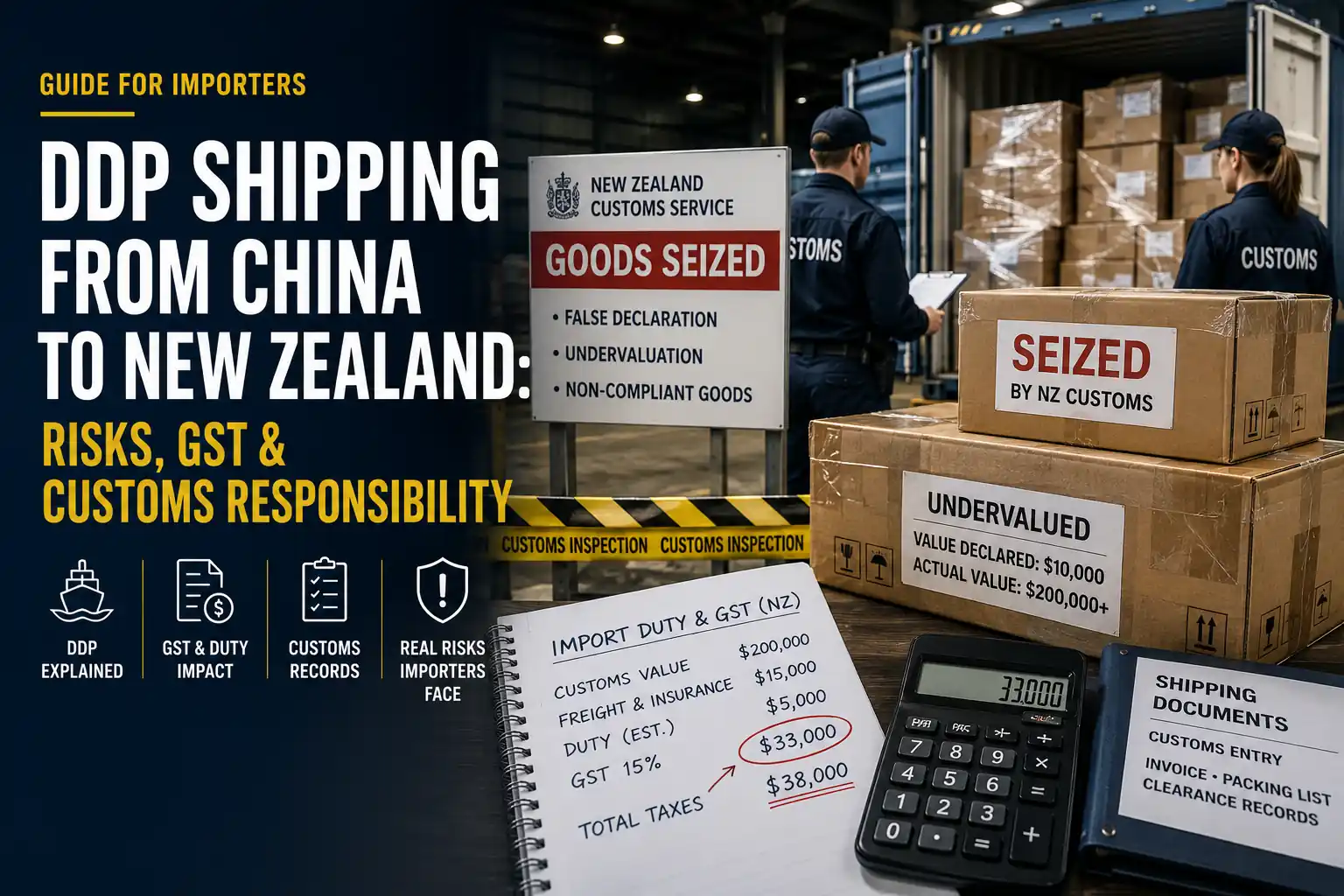
Consider a simple example. A commercial shipment actually worth NZ$200,000 is intentionally declared at only NZ$10,000.
Another example is mixed cargo declared as one inaccurate product type to reduce GST, duty, or clearance requirements.
That is not simply a cheap freight method.
New Zealand Customs explains that transaction value is normally the main valuation method for goods sold for export to New Zealand. Customs also says importers cannot use arbitrary or made-up Customs values.
"Your item could be delayed and investigated. In some cases, we may seize your item."– New Zealand Customs Service
Customs also warns that knowingly making a false declaration can lead to criminal charges.
Deliberate false declarations or concealment can become serious Customs offending. A commercial importer should not knowingly take part in that process.
Compare the DAP and DDP price
One practical check is to ask the supplier for both a DAP and DDP quote.
If the price difference does not even cover the expected New Zealand import GST, something needs to be explained. The same applies if the difference barely covers GST and leaves nothing for brokerage, levies, or duty.
New Zealand import GST is generally 15%. Customs calculates it using the Customs value, plus freight, insurance, and any applicable duty.
Use the New Zealand Customs Fee Calculator to estimate likely GST, duty, and common Customs or MPI levies.
Then compare that estimate with the DAP and DDP prices from the supplier.
A small difference does not prove fraud. There may be a legitimate explanation. However, if the numbers do not make sense, ask exactly how the shipment will clear Customs.
If you are not the importer of record, you lose control
If another company imports the goods in its own name, your company does not control that import entry.
You can contact New Zealand Customs and ask for general assistance. However, if your company is not the importer of record or an authorised agent for the entry, Customs may not be able to discuss or change the import declaration with you.
If Customs flags the shipment, you may therefore depend on the importer of record and its Customs broker to respond. They may need to provide documents, correct the entry, or answer questions about the declared value or goods.
If those parties cannot provide the required records or do not respond promptly, your stock may remain on hold while the issue is resolved. Storage and other costs may also continue during that time.
Using another importer does not remove Customs scrutiny. Your goods still remain subject to Customs, MPI, and any product-specific requirements. The difference is that you may have less visibility and less direct control over the clearance process.
You cannot claim Customs GST paid by another importer
This point matters for GST-registered New Zealand businesses.
Inland Revenue explains how GST-registered businesses can claim GST charged by Customs when they import goods for taxable supplies.
If an unrelated third party imports the goods and Customs charges that party the import GST, your company cannot claim that import GST as its own.
A supplier stating that GST is included does not change which company imported the goods.
With some grey DDP services, you may receive little useful paperwork beyond the supplier invoice and delivery record. You may never receive the Customs entry, GST breakdown, duty information, or other clearance records.
That creates a weaker audit trail. It also makes it harder for your accountant to confirm the true landed cost.
Your risk may include other cargo in the container
Grey DDP services often use consolidation. Your cartons may sit inside a shared 40-foot container with goods from many other customers.
Now imagine that the same container also contains undeclared cigarettes, prohibited goods, or cargo that another party deliberately misdeclared.
This is not purely hypothetical.
In 2024, New Zealand Customs reported finding about two million undeclared cigarettes in two sea freight containers. The cigarettes were hidden among ordinary goods, including cat litter, face towels, and face masks.
That does not mean Customs will automatically seize your legitimate goods. However, Customs can detain cargo while it examines or investigates a shipment.
Your stock may therefore face delays because of cargo belonging to somebody else.
Sharing a container is not the problem. Standard LCL sea freight from China to New Zealand is normal. The concern is the opaque importer and declaration structure.
Our preferred structure for commercial importers
For many customers, Prestige Sourcing prefers the Chinese supplier to quote FOB or EXW. We then coordinate the international freight separately.
Prestige Sourcing can coordinate freight from China to New Zealand. This can include supplier pickup, China-side handling, international freight, Customs brokerage through our agents, and final delivery.
A common structure is DAP-style or door-to-door freight from China to New Zealand.
Under this structure, the New Zealand company acts as the importer. The appointed broker then lodges the Customs entry on behalf of that company.
This gives buyers many of the conveniences they want from DDP. However, the import remains transparent.
Your business receives the relevant records. You can also see the actual GST, duty, and government charges.
You may still hear the older term DDU in freight conversations. DDU is no longer a current Incoterm. DAP is the modern term.
Why we prefer the customer to be the importer
When your own company is the importer, you gain more control and better records.
- You know the value declared to Customs.
- You can review the commercial invoice and product descriptions.
- Your broker can deal with Customs on your behalf.
- You receive the relevant import paperwork.
- You can see the GST, duty, and government charges.
- Your accountant has a clearer audit trail.
- You depend less on an unknown third-party importer.
This matters if Customs, Inland Revenue, or your accountant later reviews the transaction.
A transparent process cannot prevent an inspection. However, it gives you a much clearer commercial trail. It also helps protect the money you have invested in your goods.
Build a freight process that stands up to scrutiny
Whether your company imports directly or another party handles the import, your goods still face border scrutiny.
For a long-term importing business, use a structure you would be comfortable explaining later. You should know what Customs was told and keep records that support the declaration.
Using another importer does not make the compliance risk disappear. In many cases, it simply gives you less visibility and less control.
The goal should not be to get one container through Customs as cheaply as possible. Instead, build a repeatable process that protects your business and your investment.
Before accepting a DDP quote, ask these questions
- Who will be the importer of record?
- What value will be declared to Customs?
- What product descriptions and HS codes will be used?
- Who will pay the import GST and duty?
- Will my company receive the Customs entry and clearance paperwork?
- What happens if Customs or MPI holds the shipment?
- Does the DDP price make sense compared with the likely GST and clearance costs?
- How does it compare with FOB or EXW plus independently coordinated freight?
You can also use the Freight Volume Calculator before comparing supplier freight with an independently coordinated option.
Use DDP shipping from China to New Zealand when it is transparent
DDP shipping from China to New Zealand can be completely legitimate. The concern is not the Incoterm itself.
The higher-risk option is grey DDP where you cannot establish who imports the goods, what value appears on the declaration, how GST is handled, or what records exist.
For a long-term importing business, transparency matters more than saving a small amount on one shipment.
Prestige Sourcing coordinates supplier pickup, China-side handling, international freight, Customs brokerage through our agents, and final New Zealand delivery.
If you already have a supplier-arranged DDP quote, we can compare it with a transparent freight option before you commit your stock.
Important disclaimer
This guide reflects the practical experience of Prestige Sourcing with Chinese suppliers, freight providers, importers, and Customs-clearance agents.
Grey DDP is an informal industry term. It is not an official Incoterm.
This article provides general commercial information. It is not legal, tax, Customs, or regulatory advice.
The correct import structure depends on the product, transaction, importer, Customs classification, and other factors. Where there is uncertainty, check with your Customs broker, accountant, New Zealand Customs, MPI, or another relevant professional before the goods leave China.
Request a Quote before accepting a supplier-arranged DDP freight offer.