Planning Christmas stock from China in 2026 means working backwards from the date your inventory must actually be ready to sell. Production finishing is only one milestone. Inspection, freight handover, international shipping, clearance and final delivery all need to happen before stock reaches your warehouse, store or fulfilment centre. For NZ importers, leaving these final stages out of the plan can turn an apparently comfortable schedule into a very tight one.
The same principle applies to retailers, wholesalers and eCommerce sellers in Australia, Europe, North America and other markets. There is no universal “last date” to order Christmas inventory from China because the answer depends on the product, supplier, production lead time, freight method and destination.
Christmas stock from China needs a shelf-ready deadline
Do not use Christmas Day as the deadline. Most businesses need stock available weeks earlier for promotions, wholesale deliveries, marketplace fulfilment and customer orders.
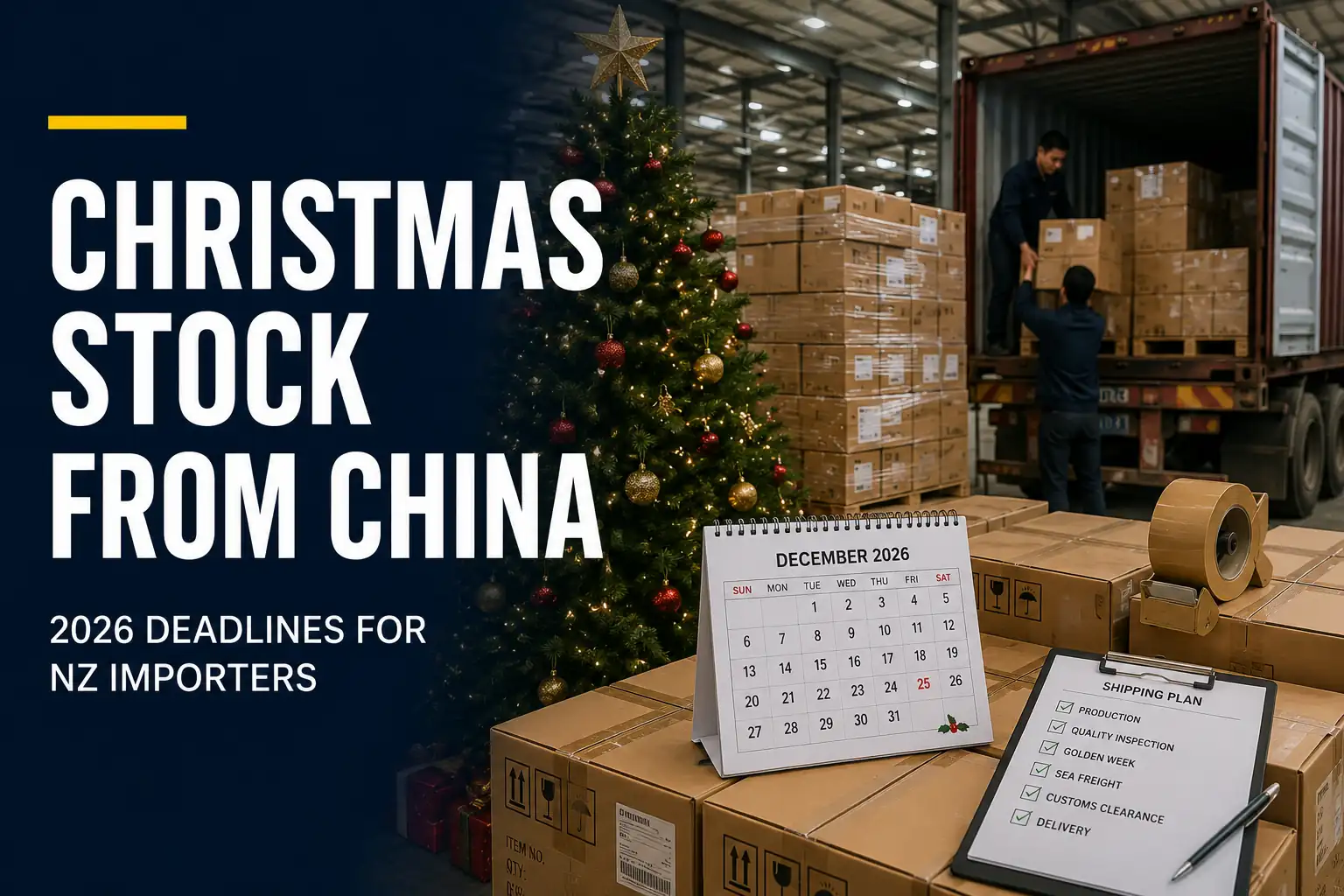
Start with the date the goods must be physically available for sale. Then work backwards through four separate milestones:
- Production complete: the full order is manufactured, packed and ready for inspection.
- Inspection passed: any required quality checks are complete and problems have been resolved.
- Cargo handed over: the freight forwarder has received the shipment and it is ready for export.
- Shelf-ready: the goods are cleared, delivered, received and available to sell.
A supplier saying “we can finish in October” does not tell you whether the goods will be ready for your Christmas sales period. The gap between factory completion and shelf-ready stock is where many importers underestimate the timeline.
How far ahead should you order Christmas inventory?
The earlier stages depend heavily on what you are buying. A repeat order using an existing specification, packaging and supplier may move relatively quickly. A new private-label product can require supplier selection, samples, packaging development, testing, artwork changes and several rounds of approval before production even starts.
For Christmas 2026 inventory, buyers ordering in September should already have a clear understanding of the remaining production work. Ideally, the supplier, specification, pricing, packaging and sample approvals are already settled, with production either underway or scheduled to begin.
If you are still comparing factories, changing the product or waiting for the first custom sample, you have much less room for delays. The order may still arrive in time, but your options become increasingly dependent on the factory meeting its schedule and using faster freight if something slips.
Instead of relying on a generic month-by-month rule, ask what still has to happen before the goods can leave China. That gives you a much more useful timeline than simply asking whether it is “too late” to order.
Samples can use up more time than expected
A sample should confirm what the factory is expected to reproduce during mass production. However, the first version is not always the version you approve.
Materials may need changing. Colours may be wrong. Packaging can require another revision. A logo may need to move, a component may need replacing or the dimensions may not match the agreed specification.
Each revision creates another approval cycle. If testing, labelling or packaging artwork also needs to change, production may not be able to start immediately.
Our guide to product samples from China explains what buyers should check before approving a sample for mass production.
For seasonal inventory, rushing an unsuitable sample into production to save a few days is usually a poor trade-off. A quality problem discovered after thousands of units are finished can cost far more time.
Golden Week creates a major 2026 planning risk
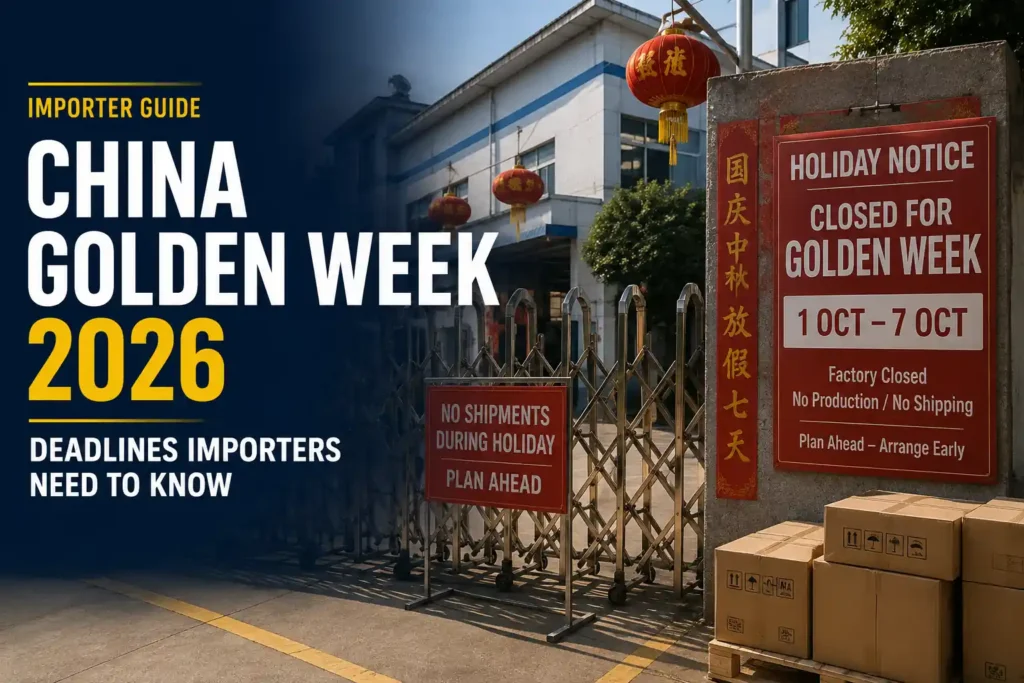
China’s 2026 Mid-Autumn Festival holiday runs from 25 to 27 September, followed shortly afterwards by the National Day holiday from 1 to 7 October.
Those are the official holiday dates. The practical effect on an individual factory can be different. Some workers may take additional leave, suppliers can push orders towards the pre-holiday deadline and unfinished production may face a backlog when operations resume.
Christmas importers should therefore confirm the supplier’s actual schedule rather than assuming that only the official closed days matter.
Ask the supplier:
- What dates will your factory actually close?
- Will our complete order be finished before the holiday?
- Will the cartons and final packaging also be ready?
- When can an inspection take place?
- What is the realistic cargo-ready date?
If completion is expected immediately before a shutdown, there also needs to be enough time for inspection and freight handover. Finishing production at the last minute is not the same as successfully shipping before the holiday.
Track production before the deadline becomes urgent
Seasonal orders should be managed against production milestones, not repeated assurances that everything is “on schedule”.
Useful checkpoints can include raw materials received, production started, percentage of units completed, assembly progress, packaging availability and final packing.
Prestige Sourcing’s production monitoring in China can help buyers follow supplier progress and identify changing timelines before the planned freight date has already been missed.
Production monitoring does not replace inspection. An order can be finished on time and still contain defects. If a pre-shipment inspection finds a problem, the supplier may need time to sort, repair, rework or remake goods.
That correction period should be part of your Christmas planning buffer rather than treated as something that can always be fixed immediately.
Christmas stock from China to New Zealand needs extra arrival time
For buyers moving Christmas stock from China to New Zealand, do not treat arrival at the port or airport as the final deadline.
The shipment may still need customs clearance, biosecurity processing where applicable, depot handling and final delivery to your warehouse or 3PL. Your own team may then need to receive the cartons, check quantities, apply local labels or transfer inventory into an eCommerce fulfilment system.
Commercial importers should also make sure their importer setup is organised before the shipment arrives. New Zealand Customs requires a client code for imports and exports valued at NZ$1,000 or more, while some categories can require one regardless of value.
Product-specific rules may also apply. Depending on what you import, Customs, MPI or other regulatory requirements can affect clearance. If you are unsure about tariff classification, duty, import GST, permits, biosecurity or product compliance, confirm the requirements with your customs broker, freight forwarder or the relevant authority before shipment.
Prestige Sourcing provides China to New Zealand freight forwarding and can help plan freight around the supplier’s actual cargo-ready date rather than an assumed production date.
For NZ Christmas stock, the useful question is not simply, “How long does shipping take?” It is, “When does this cargo realistically need to leave China so we still have enough margin if something takes longer than expected?”
What if your Christmas order is already running late?
If production has slipped, do not automatically move the entire order to the fastest freight method.
First identify which SKUs and quantities need to arrive earliest. In some cases, part of an order can move using a faster service while the remaining quantity travels by sea. That can protect the first part of the selling period without applying premium freight costs to every carton.
However, faster freight cannot fix a production problem. If the factory has not finished the goods, packaging is incomplete or an inspection has failed, changing the shipping method does not solve the underlying delay.
As Christmas gets closer, compare the options commercially. The extra cost of faster freight may be justified for a profitable seasonal product. For another SKU, paying substantially more to rescue the shipment may make little sense.
Build the Christmas plan backwards from the customer
The safest way to manage Christmas stock from China is to start with the date customers need the inventory and work backwards through every stage that must happen first.
Allow for samples, production, inspection, China’s late-September and October holiday disruption, freight handover, international transport, clearance and final delivery. Then add enough buffer that one ordinary delay does not destroy the entire plan.
For NZ importers, include local clearance and delivery in that calculation rather than treating arrival in New Zealand as the finish line.
If your Christmas 2026 order is already in production, confirm the supplier’s genuine completion date now and prepare the freight plan around it. Prestige Sourcing can coordinate with suppliers in China, follow production progress and assist with freight planning for New Zealand-bound orders. Request a Quote before the remaining Christmas shipping window becomes unnecessarily tight.