China Golden Week 2026 will affect importers well beyond China. The biggest risk is not simply that factories close for a week. It is the pressure that builds before the holiday as factories rush to finish orders, inspection capacity tightens, trucks and warehouses become busier, and exporters compete for freight space.
For importers planning September or October production, the safest approach is to work backwards from the date the goods must arrive, not from the date a supplier says production should finish.
China Golden Week 2026 dates importers need to plan around
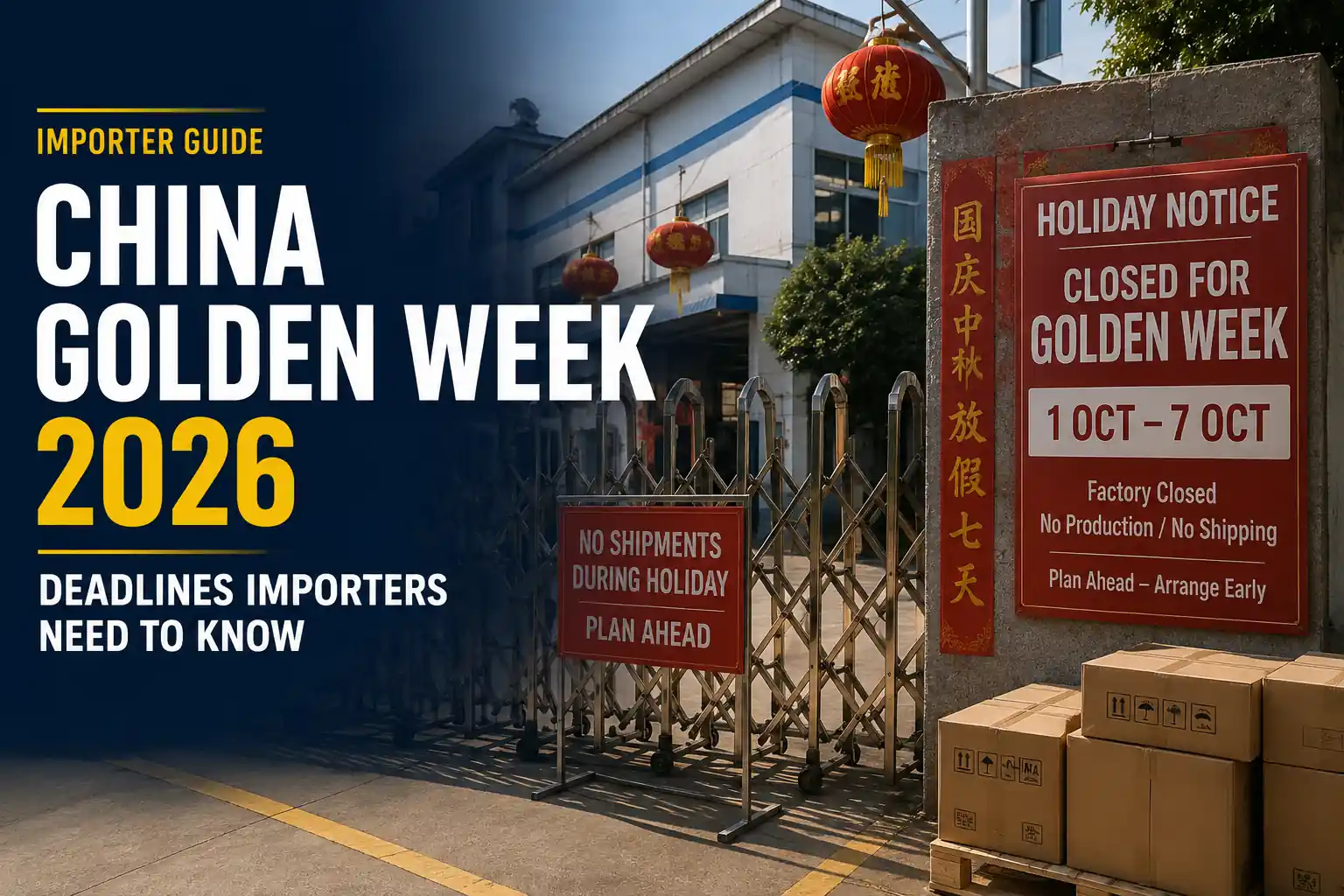
The official 2026 National Day holiday runs from 1 October to 7 October. China also has the Mid-Autumn Festival holiday from 25 September to 27 September.
That makes late September particularly important in 2026. There are only a few normal working days between the Mid-Autumn Festival break and the start of National Day Golden Week. The official schedule also includes adjusted working days on Sunday 20 September and Saturday 10 October.
However, importers should not assume every factory, subcontractor, warehouse or transport company will follow the official dates exactly. Some factories may reduce staffing earlier, while some workers may return later. Suppliers that rely on outside processes such as plating, printing, moulding, packaging or assembly can also be affected even if their own factory remains open.
Why Golden Week disruption starts before 1 October
A common mistake is to treat 1 October as the deadline. In practice, the useful deadline is earlier.
Factories often have multiple customers pushing for completion before China Golden Week 2026. At the same time, component suppliers and subcontractors are dealing with the same pressure. This can create delays even when the main supplier says production is “on schedule”.
The risk is not limited to production. Finished goods may still need final inspection, rework, export packing, trucking, warehouse receiving, customs documentation and freight handover. If one step slips, the shipment can miss the intended departure.
For this reason, a production completion date of 29 or 30 September may be technically before Golden Week but commercially too late for a shipment that needs to move before the holiday.
Golden Week 2026 deadlines to work backwards from
There is no single universal freight cut-off because it depends on the factory location, port, shipping method, carrier, warehouse and destination. However, importers can use the following planning approach.
- Production completion: For time-sensitive orders, aim to have production genuinely finished well before the final days of September. Build in time for inspection, corrections and freight handover.
- Final inspection: Do not schedule inspection for the same day the supplier claims the goods will be finished. Allow room for defects, missing quantities, packaging problems or rework.
- Freight booking: Book earlier than usual if the cargo needs to depart before the holiday. Space, trucking and warehouse capacity can tighten as other exporters rush to ship.
- Documents: Confirm the commercial invoice, packing list, product details and shipping instructions before the final rush. Documentation problems can hold up cargo even when the goods are ready.
- Buffer: If the arrival date matters commercially, add contingency time. A plan with no spare days is vulnerable to a single supplier or logistics delay.
The right buffer depends on the product and shipping method. A simple finished product from one factory is different from an order involving custom packaging, multiple suppliers, consolidation or several subcontracted production processes.
Do not let the pre-holiday rush weaken quality control
One of the more expensive mistakes importers make is accepting rushed production because a supplier says the order must be completed before the holiday.
A late order can create pressure to approve goods quickly, skip an inspection or accept minor issues with the idea that they can be dealt with later. That is exactly when buyers should be more careful.
If production is running behind, ask what is actually complete. “90% finished” can mean very different things depending on whether the remaining work is final packing or a critical production process.
Production monitoring in China can help buyers get a clearer picture of actual progress before the final inspection stage. This is particularly useful when the required shipment date is fixed and there is little room for a supplier to quietly lose several days.
For critical orders, the priority should be to know early that production is slipping. Finding out on 29 September that the factory still needs three more days is far less useful than identifying the problem a week or two earlier.
What New Zealand importers should consider
For New Zealand buyers, China Golden Week 2026 can be especially awkward when stock is intended for the final quarter of the year.
A shipment that misses its planned late-September movement may not simply be delayed by the seven-day public holiday. The practical delay can be longer if the factory needs time to restart, the cargo joins a post-holiday freight backlog, or the intended sailing or consolidation cut-off has already passed.
This matters for retailers, wholesalers and eCommerce businesses working towards Christmas, summer promotions or other fixed sales periods. The key question is not “Will the factory finish before Golden Week?” It is “Can the goods be completed, checked, handed over and booked onto the required freight service with enough buffer?”
If you are importing into New Zealand, our China to NZ logistics page explains how Prestige Sourcing can assist with freight planning and coordination from China.
What if your order will not be ready before Golden Week?
If the order is already running late, pushing the factory harder is not always the best answer. First establish what is unfinished, what processes remain, and whether rushing them creates a quality risk.
In some cases, waiting until after the holiday is safer than forcing completion immediately before shutdown. This is especially true if the supplier still needs to complete finishing, electrical testing, assembly, printing or final packaging.
You should also confirm the supplier’s actual reopening plan. The official holiday ends on 7 October, but individual factories and supporting suppliers may not return to full output at exactly the same time.
October is also a busy sourcing period in China. Buyers travelling for the autumn trade show season should factor China Golden Week 2026 into supplier meetings and factory visits. If you are attending Guangzhou, see our guide to Canton Fair sourcing in October 2026.
A practical Golden Week checklist for importers
- Confirm the supplier’s planned holiday closure and reopening dates.
- Ask for an updated production schedule, not just a promised completion date.
- Check whether any subcontractors or packaging suppliers have different holiday dates.
- Schedule final inspection with enough time for rework if something fails.
- Confirm freight space and warehouse cut-offs before production is complete.
- Check export documents and shipping instructions before the final week.
- Allow extra time if several suppliers need to be consolidated into one shipment.
- Do not approve rushed goods simply to meet a pre-holiday shipping target.
Plan around the real deadline, not the holiday date
China Golden Week 2026 officially starts on 1 October, but importers should treat the second half of September as the critical planning period. In 2026, the Mid-Autumn Festival break immediately beforehand makes that window even tighter.
The best protection is visibility. Know what has actually been produced, what still needs to happen, when inspection can take place, and when the freight provider needs the cargo.
Prestige Sourcing can represent buyers on the ground in China, communicate with suppliers, monitor production progress and help coordinate inspection and freight planning before key shipping deadlines.
Request a Quote if you have September or October production underway and need clearer oversig