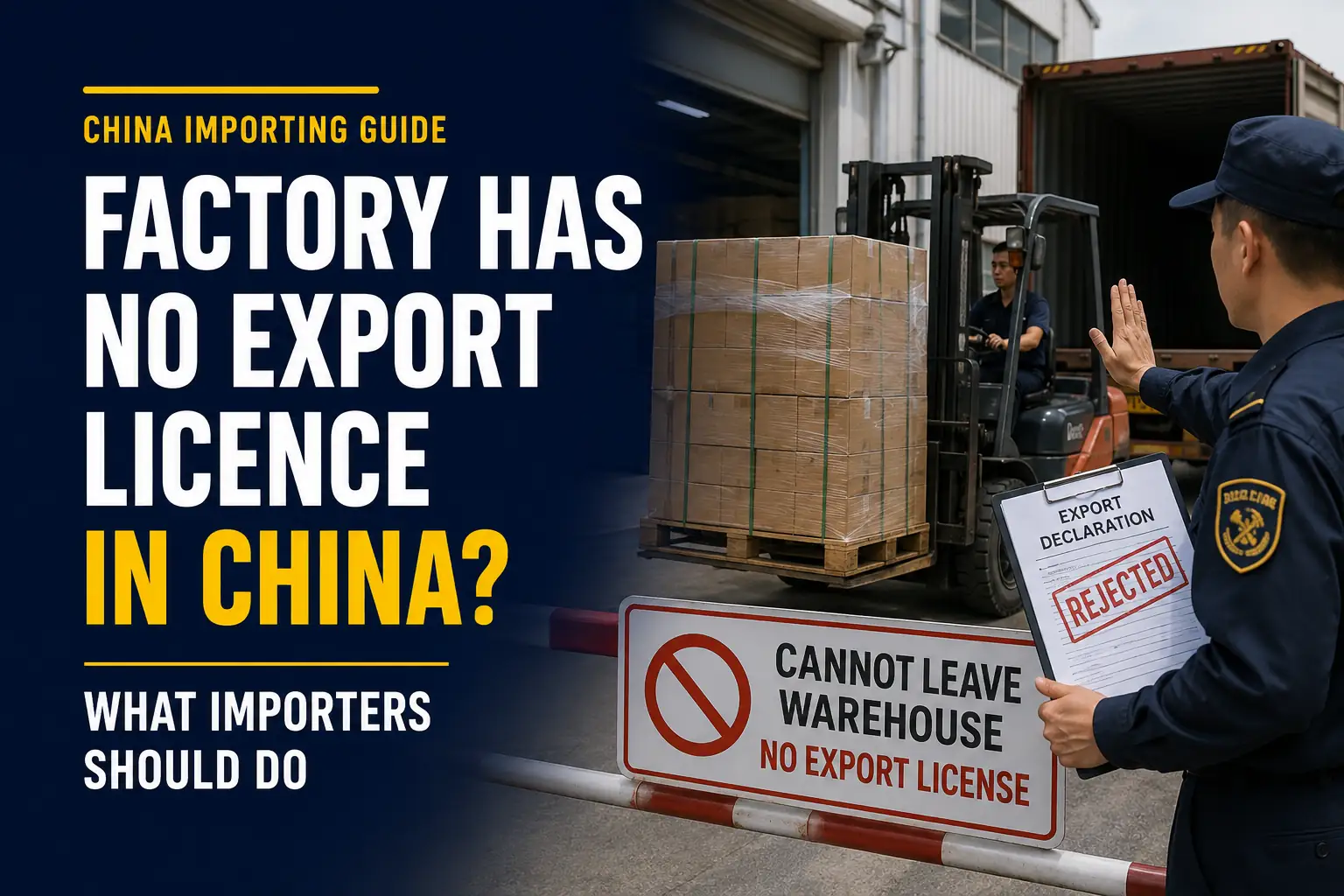
If a factory has no export licence in China, do not immediately assume you need to find another supplier. This situation comes up regularly, particularly with smaller manufacturers, domestic suppliers and businesses selling through markets such as Huaqiangbei in Shenzhen.
In many cases, the factory can still manufacture your order. The real question is how the goods will be purchased, paid for and legally exported from China.
Before sending a deposit, you need to understand exactly which company is doing each part of the transaction.
What Does It Mean When a Factory Has No Export Licence in China?
The first problem is that “export licence” can mean different things depending on who you are speaking with.
A supplier may simply mean that its company is not set up to export goods directly. Another supplier may mean that it does not handle its own customs declarations. In other cases, the product itself may be subject to a specific export licence or export-control requirement.
These are not the same situation.
Chinese customs guidance allows export consignors to make customs declarations themselves or entrust a customs broker to handle the declaration process. However, some controlled products are subject to separate export licensing or control requirements.
Therefore, your first question should be:
“When you say you cannot export, what exactly do you mean?”
Do not build your shipping plan around a vague answer.
Why Would a Chinese Factory Not Export Directly?
There are plenty of legitimate reasons.
Some factories are primarily domestic businesses. They may manufacture products for Chinese trading companies, distributors or other factories and have little reason to deal directly with overseas customers.
This is particularly common when you move away from large export-focused manufacturers and start dealing with smaller factories, specialist workshops or suppliers in domestic wholesale markets.
There can also be accounting and administrative reasons. Direct international sales create a clearer chain involving company banking, commercial documentation, customs declarations and accounting records. Some smaller businesses simply prefer to sell domestically to another Chinese company and let that business handle the international transaction.
You may also find that the manufacturing company and the export company are related. One entity operates the factory while another handles trading and international business.
That arrangement is not automatically a problem. However, you should understand it before paying.
Option 1: Use a Chinese Trading or Export Company
One common solution is for an export-capable Chinese company to sit between you and the factory.
The structure may look like this:
Factory -> Chinese export company -> overseas buyer
The export company purchases the goods from the factory domestically and then handles the international transaction and export process.
This can be a perfectly workable structure. In fact, many Chinese manufacturers already operate this way.
The important part is knowing who the export company is and what its relationship is with the factory.
If your factory suddenly tells you to send USD 20,000 to a completely different company, do not simply accept the new bank details because they say, “This is our export company.”
Verify it.
China supplier verification can help check the companies, payment information and inconsistencies behind a proposed transaction before you pay a deposit.
Option 2: Ask Your Freight Forwarder About the Export Arrangement
Many freight forwarders in China can help arrange exports where the actual factory does not export directly.
However, be precise about what is happening.
The freight forwarder may handle the customs declaration as an agent. Alternatively, it may arrange for another Chinese company to become involved in the export transaction.
Those are different arrangements.
Ask:
- Which company will be shown as the Chinese exporter?
- Who will complete the export customs declaration?
- Who issues the commercial invoice used for the export?
- Does the payment recipient match the contractual seller?
- Are there additional export handling or service charges?
- Does the proposed structure affect the Incoterm?
A freight forwarder saying, “No problem, we can export it”, is useful, but it is not the end of the discussion.
Option 3: Use Your Own China-Side Purchasing Company
Another option is to separate the factory from the international sale completely.
For example, a China-based purchasing or sourcing company can purchase the goods from the manufacturer locally and then coordinate the export transaction.
This can be particularly useful when dealing with factories that are good at making the product but have little experience with overseas buyers.
Prestige Sourcing has a Mainland China entity with import and export capability. Where appropriate, we can purchase goods from a Chinese supplier domestically and coordinate the export process rather than requiring the original factory to become the direct exporter.
Our China purchasing support service can also help coordinate the supplier, payment, order information and shipping handover.
Check Who You Are Paying Before Anything Else
This is where a normal export arrangement can turn into a risky one.
Suppose you received a quotation from Shenzhen ABC Electronics Co., Ltd. You agree on the product and price. Then, when you are ready to pay the deposit, the supplier sends bank details for XYZ Trading Co., Ltd.
That does not automatically mean something is wrong.
But you need an explanation.
Ask why XYZ Trading is receiving the payment, what its relationship is with the factory and which company is contractually selling the goods to you.
Be particularly careful if you are asked to pay a personal account or an apparently unrelated company without supporting documentation.
The fact that a factory cannot export directly is not a good reason to stop checking where your money is going.
Do Not Let DDP Hide the Export Arrangement
Another common response is:
“Don’t worry. We can ship DDP directly to your door.”
That sounds convenient, but it does not answer the original question.
You still need to understand who is exporting the shipment from China and, particularly for commercial cargo, how the destination customs clearance is being handled.
A door-to-door freight price can sometimes hide important details about the exporter, declared customs value, importer, taxes and documentation.
Our guide on supplier-arranged freight from China explains why importers should understand the shipping structure rather than choosing a freight offer purely because it looks convenient.
Watch for These Warning Signs
A factory without its own export capability is not automatically a warning sign. The behaviour around it can be.
Be cautious if:
- The supplier cannot tell you which company will export the goods.
- The payment company changes without a clear explanation.
- You are asked to pay a personal bank account.
- The supplier tells you the shipment will be declared as a different product.
- The supplier suggests declaring an artificially low customs value.
- Several unrelated company names appear across the quotation, invoice and payment details.
- The supplier insists that you do not need to understand the customs arrangement.
- The goods may be controlled or restricted but nobody has checked the export requirements.
Any of these deserve further investigation before payment.
Do You Need the Factory to Get Its Own Export Capability?
Usually, forcing the factory to change its business structure purely for your order is not the first solution I would look at.
If the factory is reliable, the product is right and there is a legitimate export route available, it may be easier to work with the way the supplier already operates.
This is particularly true for a one-off or relatively small order.
For ongoing high-volume business, however, it may be worth discussing a more direct structure. Extra companies between you and the manufacturer can mean additional cost, paperwork and communication.
There is no universal answer. It depends on the factory, product, order volume, tax treatment, destination and how you want the supply chain structured.
The Factory Does Not Need to Do Everything
One of the biggest mistakes importers make is assuming the company manufacturing the product also needs to source the materials, receive the international payment, export the cargo and organise the freight.
It does not.
China’s manufacturing ecosystem often involves multiple specialised companies. A factory can be excellent at manufacturing while having very little international trading experience.
The important thing is that the structure is transparent.
Before paying a factory that cannot export directly, confirm:
- Who manufactures the goods.
- Who you are buying the goods from.
- Who receives your payment.
- Who will act as the Chinese exporter.
- Who handles the customs declaration.
- Which Incoterm applies.
- Who controls the freight booking.
- Whether your product has any special export or import restrictions.
If those answers make sense, a factory having no direct export capability may be little more than an administrative issue.
If nobody can give you a straight answer, that is the bigger problem.
Need Help With a Factory That Cannot Export?
Prestige Sourcing is based in Shenzhen and works with overseas buyers sourcing and purchasing from factories across China.
We can help communicate with the supplier, check the companies involved, review payment details, arrange China-side purchasing where appropriate and coordinate the handover into freight.
This can be particularly useful when you have already found the right product or factory but the export structure is unclear.
Contact us and send the supplier details, product information and proposed shipping arrangement. We can help you work out the practical next step before you pay.