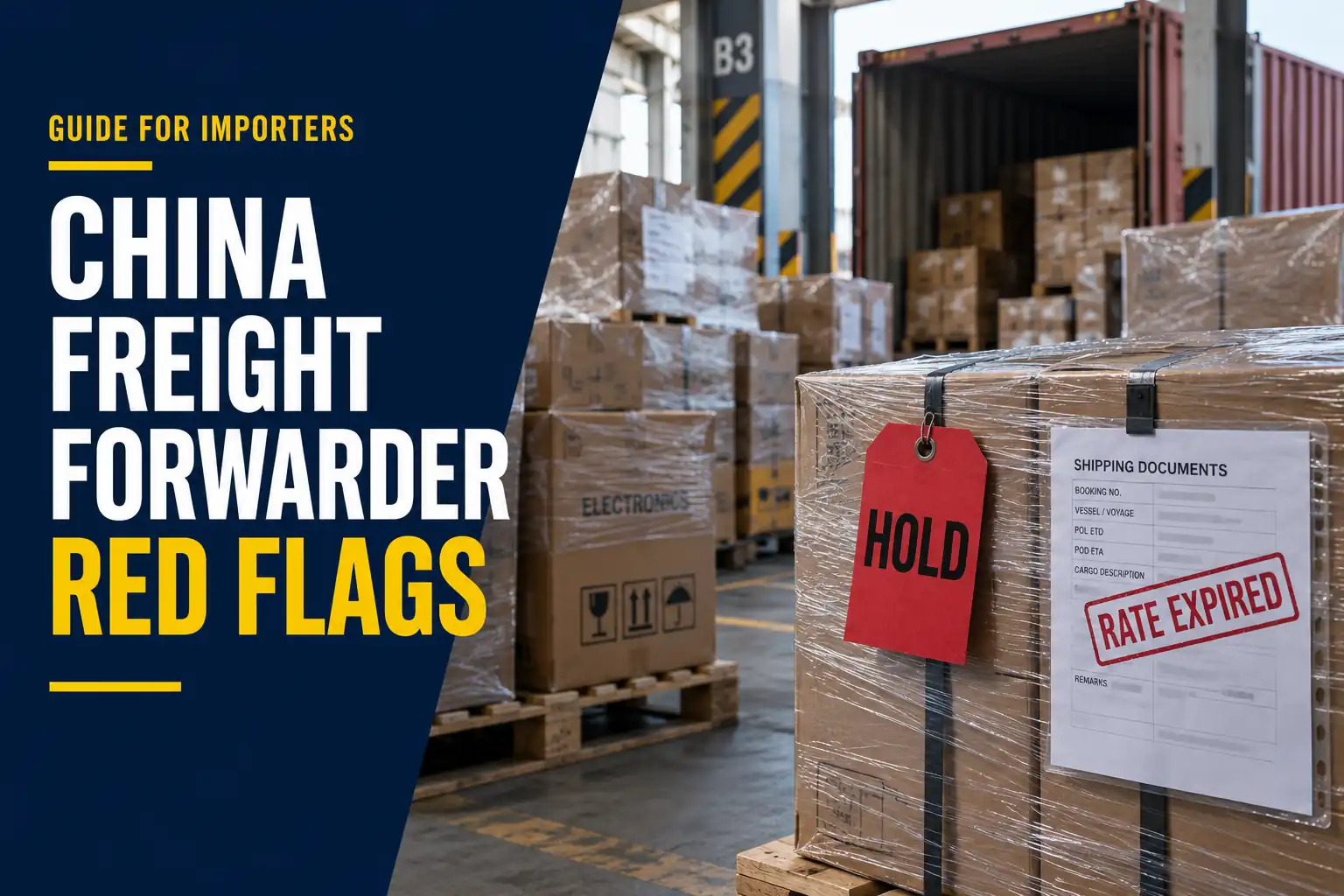
China freight forwarder red flags to check before releasing cargo
China freight forwarder red flags matter most while your goods are still sitting with the supplier. Once a forwarder has collected the cargo or received it into a warehouse, changing provider can become harder, slower and more expensive.
This applies whether you found the provider through Alibaba, WeChat, a supplier recommendation, an online freight marketplace or your own network. A cheap freight quote is not enough. Before releasing commercial stock, you need to know what has actually been agreed, how long the rate is valid and what happens if you decide not to proceed.
One of the biggest risks is a very low quote that changes after the forwarder controls the goods. At that point, the importer may be asked for additional freight, warehouse, handling or cargo release payments before the shipment will move or be transferred elsewhere.
1. The freight quote is dramatically cheaper than everyone else
Freight pricing varies, so the cheapest quote is not automatically suspicious. A forwarder may have a better carrier rate, a different consolidation arrangement or another routing option.
However, if several comparable providers are quoting within a similar range and one China shipping agent is dramatically cheaper, find out why before releasing the goods.
A very low rate can be used to win the booking. The problem begins if the forwarder then takes control of the cargo and advises that the original price is no longer available.
Your negotiating position is much stronger while the stock is still at the factory. Once it has been delivered to somebody else’s warehouse, rejecting a revised price can mean paying additional handling, storage or transfer charges to recover the goods.
2. Alibaba freight forwarder red flags: cheap quotes that change later
Alibaba freight forwarders and shipping agents can be legitimate businesses, and using Alibaba to find a logistics provider is not itself a red flag.
The problem is treating a cheap advertised rate, marketplace listing or salesperson’s message as though it were a complete freight agreement.
Importer communities regularly discuss bait-and-switch freight situations where a low initial quote changes after the goods reach the forwarder’s warehouse. In some disputes, buyers say they then face additional warehouse, handling, transfer or release charges if they try to move the cargo to another provider.
That does not mean every later price increase is dishonest. Final packed dimensions can change. Cargo information can be incomplete. Carrier rates can expire. Restricted products can require a different service.
The red flag is when the provider cannot clearly explain what changed, how the new amount was calculated or why the original quote no longer applies.
An Alibaba badge or review score is not a freight agreement
Marketplace history, reviews and verification can form part of your due diligence, but they do not tell you the commercial terms of your shipment.
Before handing valuable stock to an Alibaba freight forwarder, get the actual freight arrangement in writing. You should know the quoted basis, validity period, inclusions, exclusions and what happens if you choose not to continue with that provider.
3. They want the goods before confirming the commercial terms
Be cautious if a forwarder tells you to send the cargo to its warehouse first and says the freight price will be worked out afterwards.
Sometimes final warehouse measurements are needed before an exact chargeable weight can be confirmed. That can be normal. However, the charging basis should still be understood before release.
The forwarder should be able to explain the rate being used, what measurements can change the final amount and what warehouse costs apply if you decide not to proceed.
The safer sequence is straightforward: confirm the cargo details, confirm the freight basis, confirm the receiving instructions, then release the goods.
4. You do not have a written freight summary, quote or agreement
Do not release a commercial shipment based only on scattered WeChat, WhatsApp or Alibaba messages saying the rate is “confirmed”.
Before the supplier hands over the cargo, get a written freight summary, quotation or service agreement that records the commercial basis of the shipment.
At minimum, it should confirm:
- The origin and destination.
- The cargo description.
- The package or carton count.
- The gross weight and dimensions used for the quote.
- The freight method or agreed service.
- The quoted price and currency.
- What the price includes.
- Known exclusions.
- Payment terms.
- The freight quote validity period.
- What circumstances can cause the price to change.
- Warehouse receiving, handling and storage charges where relevant.
- What happens if you cancel or nominate another forwarder.
- Any transfer or cargo release fees.
If you need to understand the details that can sit behind a freight quotation, our China to NZ freight quote guide covers common quote information and excluded costs in more detail.
5. The freight quote has no validity period
Always check how long the freight rate is valid.
International freight prices can change, and a quotation issued while your goods are still in production may not remain available when the shipment is finally ready.
If the quote has expired, get the rate reconfirmed before the supplier releases the cargo.
That is very different from allowing a forwarder to collect the goods first and only then discovering what the current price will be.
A clear validity period also gives both parties a reference point. If the provider later says the rate changed, you can check whether the original quotation was still valid at the time of release.
6. New charges appear after the forwarder controls the goods
Additional charges are not automatically illegitimate. For example, a shipment may measure larger than the supplier estimated, require extra handling or miss the validity period of the original freight rate.
However, substantial new charges appearing only after the forwarder has possession of your inventory deserve close attention.
This can include warehouse receiving fees, storage, handling, transfer charges or a payment demanded before the goods will be released to another freight forwarder.
Before booking, ask what happens if you decide not to proceed after the cargo reaches the warehouse. Confirm any receiving, storage, handling, transfer and outbound release costs in advance.
You do not want to discover those terms for the first time when the goods are already under somebody else’s control.
7. The forwarder refuses to release the cargo unless you make another payment
This is one of the most serious freight forwarder red flags.
There is a difference between a provider requesting a legitimate outstanding charge and effectively using possession of the cargo to force acceptance of a new price that was never agreed.
If a dispute develops, ask for an itemised statement showing what is owed, why it is owed and where the charge appears in the quotation or agreed terms.
If you want the cargo transferred to another forwarder, ask for the warehouse release process and charges in writing.
This is another reason the original freight summary matters. Without a written record of the price, validity period, warehouse terms and release conditions, it becomes much harder to establish what was actually agreed.
8. They cannot explain why the price changed
A credible price adjustment should have a clear reason.
If the freight cost increases, ask:
- Which part of the price changed?
- Why did it change?
- How was the new amount calculated?
- Did the final weight or dimensions differ from the quotation?
- Did the original freight rate expire?
- Was an undisclosed cargo characteristic discovered?
- Was the additional charge included in the original terms?
If the only explanation is that the old rate is “not possible now” after the provider already has the cargo, investigate further before paying.
9. They quoted without properly understanding the cargo
A freight provider should know what it is being asked to move.
Before quoting commercial cargo, they should have enough information to understand the product, supplier location, destination, package count, dimensions, gross weight and cargo value.
Batteries, liquids, powders, magnets, chemicals, pressurised products and other restricted or sensitive goods should also be disclosed.
If a provider gives a confident freight price while showing almost no interest in what the goods actually are, that is a warning sign. They cannot properly assess shipping requirements they have never asked about.
10. The service scope is still vague
Phrases such as “door to door”, “all included” and “we handle everything” are not a complete freight scope.
You should be able to identify where the service begins, where it ends and what charges may still be payable separately.
You should also know whether the forwarder is handling supplier collection, China-side warehouse receiving, export arrangements, destination clearance and final delivery itself or through other parties.
Using warehouses, truckers, consolidators, carriers, customs brokers and overseas agents is normal. The red flag is when your main contact cannot explain who is responsible for important stages of the shipment.
11. Warehouse or collection instructions keep changing
A warehouse change is not automatically suspicious. Freight routes and consolidation arrangements can change.
However, changes should have a clear reason.
Be cautious if your supplier is suddenly told to send valuable cargo to a different warehouse, company or individual without an explanation.
Before release, confirm the receiving address, contact person, shipment reference and any carton or pallet markings required by the warehouse.
Your supplier should also keep evidence showing when and where the goods were handed over.
12. Commercial paperwork is treated as something to fix later
The commercial invoice and packing list should reflect the real shipment.
Be careful if the forwarder appears relaxed about inaccurate product descriptions, artificial values or incomplete documents because they say everything can be sorted out later.
The paperwork used for a commercial import needs to make sense for the actual goods and transaction.
Product classification, permits, GST, duty, biosecurity and other requirements depend on the destination and product. Where the position is uncertain, confirm it with the relevant customs broker, freight professional, accountant or authority before shipment.
13. Nobody can explain how import clearance will work
If the freight service includes destination customs clearance, you should understand the basic structure.
Ask who is making the import declaration and what commercial or customs records your business will receive after clearance.
You do not need to understand every technical part of customs processing. However, “don’t worry, customs is included” is not enough when the provider cannot explain how the goods are being imported.
This deserves particular attention with opaque DDP arrangements. Our guide to DDP shipping risks from China to New Zealand covers that issue separately.
14. The payment recipient suddenly changes
A freight company may legitimately use related operating companies, warehouses or overseas agents. However, you should understand who you are paying and why.
If you negotiated with one company and are suddenly instructed to send a substantial payment to an unrelated business or personal account, stop and ask for an explanation.
The payment recipient should make commercial sense, and you should be able to obtain appropriate records for the transaction.
15. Different staff give conflicting instructions
Freight companies commonly have separate sales, operations, warehouse and customs teams. Multiple contacts are normal.
What is not normal is receiving different warehouse addresses, different prices or conflicting explanations of the service from different staff.
Before cargo release, get the final booking instructions confirmed in writing and make sure your supplier is working from the same information.
A pre-release checklist for commercial cargo
Before telling your supplier to hand the goods over, confirm the following:
- You have a written freight quote, freight summary or service agreement.
- The freight quote is still within its stated validity period.
- The correct cargo description, dimensions, gross weight and package count have been supplied.
- Any restricted or sensitive cargo has been disclosed.
- The quoted price, currency and payment terms are clear.
- You understand what the rate includes and what can still vary.
- You know the warehouse receiving and storage terms.
- You know what happens if you cancel the shipment after warehouse receipt.
- You know what it costs to transfer or release the cargo to another freight forwarder.
- The receiving warehouse and shipment reference are confirmed.
- The commercial invoice and packing list reflect the actual shipment.
- You understand the basic import clearance structure.
- You know who will handle the problem if something goes wrong.
If several of those points remain unclear, do not release valuable stock simply because the quoted freight price looks attractive.
Cheap Alibaba freight is not necessarily cheap freight
The purpose of checking China freight forwarder red flags is not to assume that every low-cost provider is dishonest.
It is to protect your position before another company controls your stock.
An Alibaba freight forwarder, China shipping agent or independent logistics provider should be able to explain what they are quoting, how long the price is valid, what can change and what happens if you choose not to proceed.
The safest time to challenge a freight quote is while the goods are still sitting at your supplier’s factory. Once the cargo is inside somebody else’s warehouse, changing your mind can become considerably more expensive.
Prestige Sourcing can assist with China to New Zealand freight forwarding and China-side coordination with suppliers before cargo is released. This can include checking shipment information, coordinating handover and helping make sure the freight arrangement is understood before the supplier gives up control of the goods.
If you already have commercial cargo in China and want the freight arrangement checked before release, Request a Quote.
This guide provides general commercial information only. It is not legal, tax, customs or regulatory advice. Product-specific requirements and import obligations should be confirmed with the appropriate broker, adviser or authority.