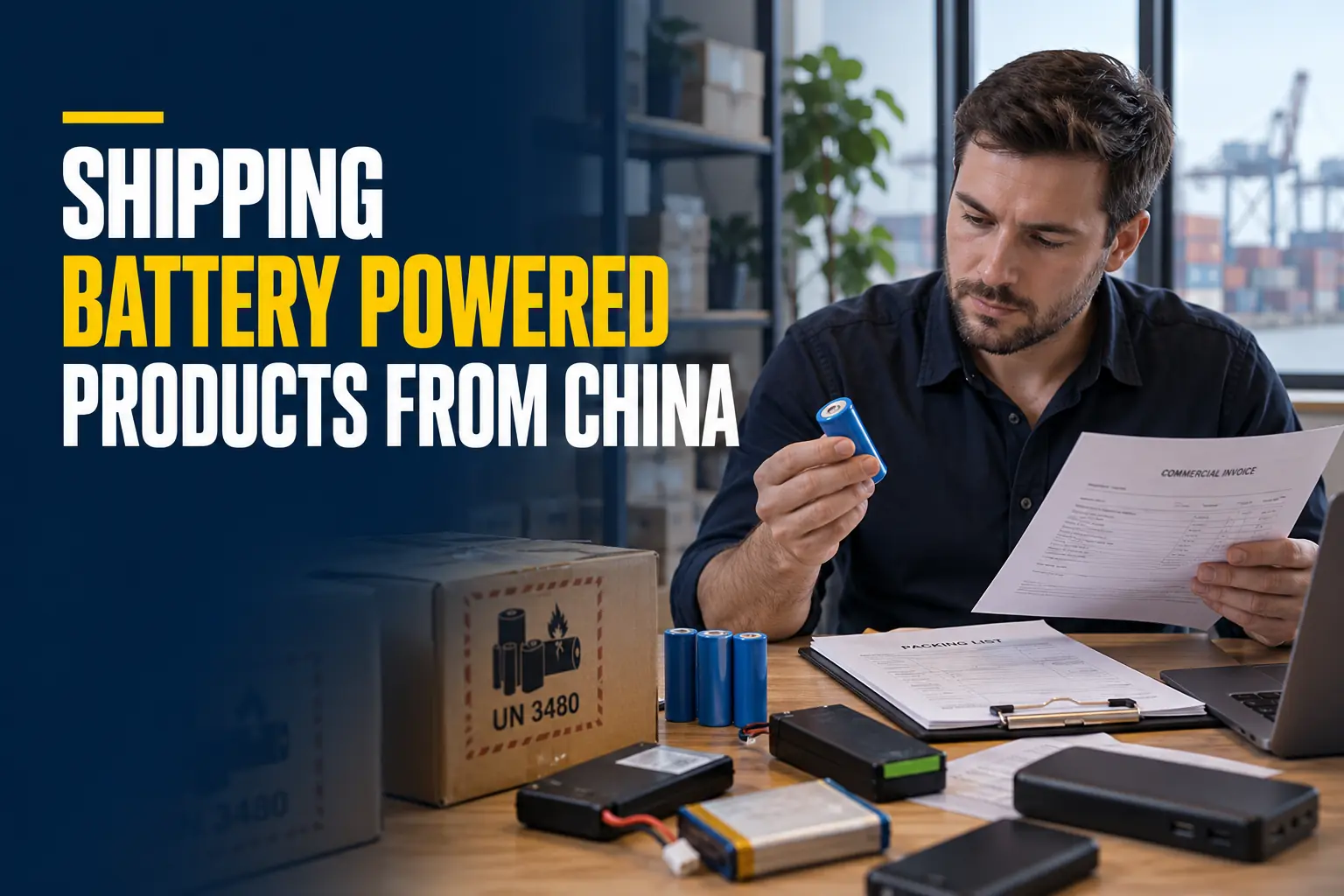
Shipping battery powered products from China requires more information than a normal freight booking. Before you arrange collection, ask your supplier for the battery model, chemistry, capacity and relevant transport documents.
The battery configuration matters. A lithium-ion battery installed inside a product can have different shipping requirements from the same battery packed separately. Air and sea freight also follow different dangerous-goods rules.
For lithium batteries, the UN 38.3 test summary is an important starting point. However, it does not guarantee carrier acceptance. Your freight provider must also confirm the classification, packaging and route.
Documents needed when shipping battery powered products from China
Start by asking the factory for the following information. Ideally, collect it before mass production finishes.
- Battery identification: Manufacturer, model number and chemistry.
- Battery specifications: Voltage, capacity and watt-hour rating for lithium-ion batteries, or lithium content for lithium metal batteries.
- UN 38.3 test summary: The applicable summary for the lithium battery design.
- SDS or MSDS: Supply this when the freight provider requests it. It does not replace a UN 38.3 test summary.
- Battery configuration: Confirm whether the batteries are installed inside equipment, packed alongside equipment or shipped separately.
- Quantity details: Number of cells or batteries per product, package and shipment.
- Packing information: Carton dimensions, gross weight, package count and any relevant packaging details.
- Commercial documents: Commercial invoice and packing list matching the shipment.
Other paperwork may be required after the freight provider confirms the classification. This can include dangerous-goods declarations and specific packing documentation.
Do not assume every shipment needs the same document set. The exact requirements depend on the battery and transport arrangements.
Check the battery configuration before requesting a quote
One of the first questions is whether the batteries travel separately or with a product.
Batteries shipped separately
Standalone lithium batteries have specific classifications and transport restrictions.
For example, standalone lithium-ion batteries generally fall under UN 3480. Standalone lithium metal batteries generally fall under UN 3090.
Power banks are also classified as batteries for transport purposes. They do not automatically count as equipment containing a battery.
Batteries packed with equipment
This means the battery and equipment share a package, but the battery is not installed in the equipment.
Lithium-ion batteries packed with equipment generally fall under UN 3481. Lithium metal batteries packed with equipment generally fall under UN 3091.
The packing instructions differ from those for standalone batteries. Therefore, tell the forwarder exactly how the factory intends to pack the goods.
Batteries contained in equipment
These batteries are installed inside the product.
Lithium-ion batteries contained in equipment generally use UN 3481. Lithium metal batteries contained in equipment generally use UN 3091.
Although the UN numbers overlap with batteries packed alongside equipment, the applicable packing instructions differ.
Do not select the UN classification yourself based only on a product description. Ask the dangerous-goods provider to confirm it against the actual product and battery.
What is a UN 38.3 test summary?
UN 38.3 refers to battery transport testing under the United Nations Manual of Tests and Criteria.
Manufacturers and subsequent distributors must make applicable lithium battery test summaries available. The summary connects the battery design to the relevant transport testing.
A typical summary identifies:
- Battery manufacturer and contact details.
- Testing laboratory.
- Test report reference and date.
- Battery description and model.
- Applicable test results.
- Relevant UN testing requirements.
The full laboratory report and the test summary are different documents. A test summary also does not necessarily need to travel physically with every shipment.
However, your forwarder may request a copy during booking. It is sensible to collect the document before collection so you can provide it quickly.
See the US Department of Transportation’s lithium battery test summary guidance for an explanation of the document and its required contents.
Check that the summary matches the actual battery
A common point to investigate is a mismatch between the battery paperwork and the finished product.
For example, the factory may change its battery supplier between sampling and production. The finished product could then contain a different battery model.
Compare the summary with the battery specifications and production details. If the model numbers differ, ask the supplier to explain the difference before arranging freight.
Do not assume that paperwork for one battery covers every alternative that the factory might install.
Is an SDS enough to ship lithium batteries?
No. An SDS or MSDS does not replace the applicable UN 38.3 test summary.
An SDS provides safety information about a substance or product. A UN 38.3 summary addresses the battery’s specified transport testing.
Some forwarders ask for both documents. Others may request further information depending on the battery and service.
Likewise, product compliance documents such as CE or RCM reports do not establish dangerous-goods transport eligibility.
Keep your battery transport documents separate from the documents needed to sell the product in your destination market.
Air freight requirements for lithium batteries in 2026
Air freight needs particular attention because lithium battery restrictions depend on configuration, capacity and packing instructions.
The 2026 IATA Dangerous Goods Regulations include important state-of-charge requirements.
Standalone lithium-ion batteries
Under Packing Instruction 965, standalone lithium-ion batteries generally must travel at no more than 30% state of charge.
They are also prohibited on passenger aircraft unless the relevant authorities grant an applicable approval.
Ask your forwarder whether the proposed service accepts the batteries and whether the factory must adjust their charge level.
Lithium-ion batteries packed with equipment
From 1 January 2026, Packing Instruction 966 introduced or strengthened state-of-charge requirements.
Section I requires lithium-ion cells and batteries to travel at no more than 30% state of charge, unless the relevant authorities approve an exception.
Under Section II, that limit applies to cells and batteries rated above 2.7 Wh. Higher charge levels require compliance with the applicable approval provisions.
Lithium-ion batteries contained in equipment
Packing Instruction 967 treats batteries installed in equipment differently.
IATA strongly recommends shipping these batteries at no more than 30% state of charge, or with an indicated battery capacity of no more than 25%.
However, this is a recommendation rather than a general mandatory state-of-charge limit under PI 967.
Airline-specific restrictions may still apply. Therefore, check with the intended carrier before confirming the booking.
You can review the IATA 2026 Battery Guidance Document for further detail.
Sea freight requirements for battery-powered products
Sea freight follows the International Maritime Dangerous Goods Code, known as the IMDG Code.
The 2024 edition, including Amendment 42-24, became mandatory on 1 January 2026.
The Code covers dangerous-goods classification, packaging, marking and documentation requirements for maritime transport.
Consequently, a battery shipment that can travel by sea still needs the correct classification and applicable documentation.
Do not assume a sea freight booking is acceptable simply because air freight is unavailable.
Check LCL warehouse acceptance
Less-than-container-load freight presents another practical question. Your cartons may pass through a consolidation warehouse before loading into a shared container.
Ask whether the warehouse and consolidator accept the specific dangerous-goods classification.
Get that confirmation before instructing the factory to deliver the cartons. Otherwise, you may need to arrange a different receiving location or service.
For further information about the maritime rules, see the International Maritime Organization’s IMDG Code information.
What to confirm with your freight forwarder before collection
Once the supplier provides the battery documents, send the complete information to your forwarder.
Ask these questions before you approve collection:
- What UN number and proper shipping name apply to this product?
- Can the proposed carrier accept the battery configuration?
- What packing instruction applies?
- Does the shipment need a dangerous-goods declaration?
- What marks or labels must appear on the cartons?
- Are there battery quantity, weight or state-of-charge limits?
- Can the nominated warehouse receive the cargo?
- Are dangerous-goods handling charges included in the freight quote?
The forwarder may need additional details before answering. However, this process gives both parties a clearer basis for the booking.
Keep the carrier’s acceptance conditions with the order records. Then provide the confirmed packing requirements to the supplier before it seals the cartons.
Shipping battery-powered products from China to New Zealand
For New Zealand importers, dangerous-goods transport acceptance and Customs clearance are separate processes.
The carrier must accept the cargo under the relevant air or maritime requirements. Meanwhile, New Zealand Customs assesses the import declaration and applicable border requirements.
Commercial goods require Customs clearance. The importer or their agent must submit the appropriate electronic import information and pay any applicable duties, GST, charges and levies.
Goods may also need separate approvals or checks depending on their nature. Therefore, do not treat a successful freight booking as confirmation that all New Zealand import requirements are satisfied.
See New Zealand Customs’ guidance on starting to import for the border clearance requirements.
Confirm the full freight cost
Battery cargo may attract additional carrier or handling charges. The amount depends on the service and shipment.
Ask the forwarder to identify any dangerous-goods charges separately. Also confirm the pickup, destination and delivery services included in the quote.
Our guide to China to NZ freight quote information and excluded costs explains what else to check before comparing offers.
Keep the supplier and freight documents consistent
Before releasing the goods, compare the final order against the information supplied for the freight booking.
Check that the battery model, configuration, quantity and packaging have not changed.
Then confirm that the commercial invoice and packing list reflect the actual cargo.
If the supplier changes a battery or packing arrangement, tell the forwarder before collection. Do not assume the original booking approval still applies.
This is especially important for repeat orders. A product may look unchanged even when the manufacturer has substituted a battery component.
How Prestige Sourcing can help with battery shipment preparation
Battery shipments become difficult when the supplier and freight provider work from different information.
The supplier understands the product and its components. The freight provider needs accurate details to assess transport requirements. Someone must make sure those details match before the goods leave the factory.
Prestige Sourcing’s Supply Chain Consulting service helps importers organise supplier information, clarify shipment preparation and coordinate China-side handovers.
We can help identify missing information and work through practical next steps with your supplier and freight partners. Specialist dangerous-goods classification and carrier acceptance remain the responsibility of appropriately qualified providers.
Planning to ship battery-powered products from China? Send us the product details, battery specifications, available documents and intended destination through our Supply Chain Consulting page. We can help you work out what needs clarification before the supplier releases the order.