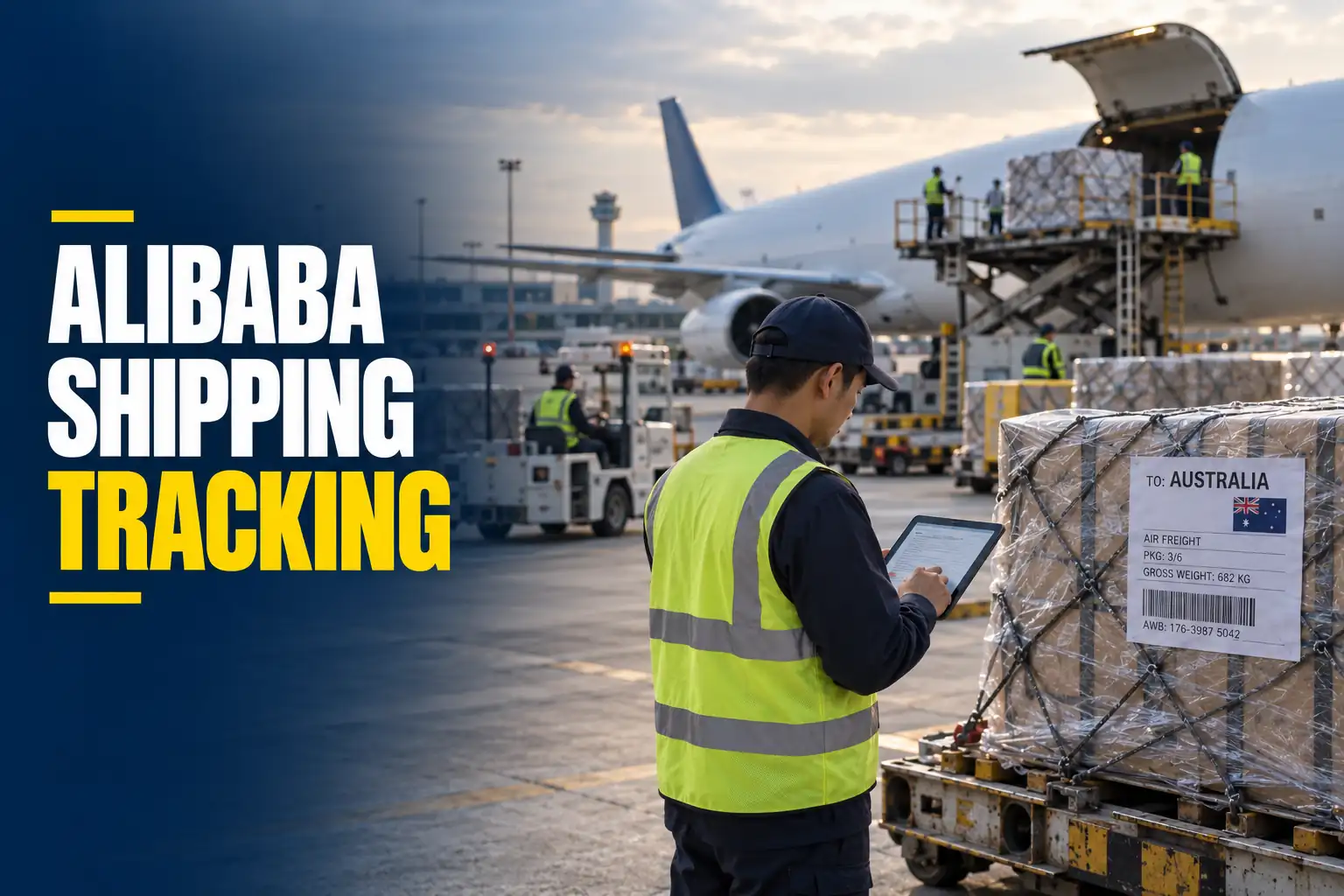
Alibaba shipping tracking stages can look straightforward until an order stops moving for several days. A supplier may say the goods have shipped, while the tracking only shows collection in China. Later, the cargo may reach the destination port without being ready for delivery.
The problem usually comes from treating every tracking update as the same type of milestone. It is not. Each stage confirms a different handover between the supplier, warehouse, forwarder, carrier, customs process and local delivery network.
Once you understand those handovers, tracking becomes much easier to interpret. You can also ask for the right evidence when an update looks vague or stops changing.
Alibaba shipping tracking stages at a glance
Alibaba orders can move through different logistics providers, so the exact wording varies. However, most international shipments follow a similar physical sequence.
| Tracking stage | What it usually means | What it does not prove |
|---|---|---|
| Supplier dispatch | The supplier says the order has left its premises or is ready for collection. | The cargo has not necessarily entered the international freight network. |
| Collected in China | A courier, trucker or forwarder has taken possession of the cargo. | The goods have not necessarily left China. |
| Origin warehouse received | The freight company has received or processed the shipment. | The shipment may still be waiting for consolidation or booking. |
| Export handling | The forwarder is preparing the cargo for international departure. | A booking or customs step does not mean the vessel or aircraft has departed. |
| International departure | The shipment has entered the main international transport leg. | The displayed delivery date is not guaranteed. |
| Destination arrival | The vessel, aircraft or line-haul service has reached the destination country or terminal. | The goods are not necessarily customs cleared or ready for delivery. |
| Clearance and local handling | Customs, biosecurity, terminal and local freight processes are underway. | The cargo may still need release, unpacking or depot transfer. |
| Out for delivery | The local delivery provider has the shipment for the final movement. | Delivery is not complete until the receiver accepts the cargo. |
1. Supplier dispatch is not the same as export departure
The first tracking confusion often starts before the shipment reaches a port or airport. A supplier may mark an order as shipped once it leaves the factory. In practice, the cargo might only be travelling to a warehouse elsewhere in China.
That domestic movement can involve a local courier, trucking company or freight agent. The supplier may therefore have a valid collection record even though the goods remain hundreds of kilometres from the export terminal.
For small orders, you may see a domestic tracking number first. Larger freight shipments may instead have a collection receipt or warehouse reference.
So, when a supplier says the goods have shipped, ask what that statement means. Confirm whether the cargo has only left the factory or has actually started its international journey.
2. Domestic collection in China can take several forms
China-side collection depends on the shipment size and service. A parcel may enter a courier network immediately. Commercial freight often travels to a forwarder’s warehouse first.
That warehouse might be in Shenzhen, Guangzhou, Yiwu, Shanghai, Ningbo or another freight hub. The location does not need to match the factory city.
Once collected, useful evidence can include:
- a domestic courier or trucking number;
- a pickup receipt;
- the receiving warehouse address;
- a warehouse receipt or inbound reference;
- the date and quantity received; and
- photos of the labelled cartons or pallets.
This evidence helps separate a genuine freight handover from a simple supplier status update.
If the real issue is that production has not finished, tracking will not solve it. A structured production monitoring process in China can help identify delays before the expected dispatch date.
3. Arrival at the origin warehouse still does not mean the goods have left China
International freight often spends time at an origin warehouse. The forwarder may need to check dimensions, confirm chargeable weight, prepare labels or combine several shipments.
For less-than-container-load sea freight, consolidation is a normal part of the process. Your cartons may wait while the forwarder builds a larger consolidated shipment.
Air freight can also involve origin handling before the airline accepts the cargo. Therefore, a warehouse scan only confirms that the forwarder has received the shipment.
If tracking sits at this stage, ask for the next physical milestone. For example, request the planned vessel, flight, container loading date or export booking reference.
4. A booking is different from a confirmed departure
A forwarder can book space before the cargo physically departs. Schedules can also change after the booking.
For sea freight, useful details may include the vessel name, voyage number, container number and bill of lading reference. For air freight, the forwarder may provide an air waybill reference and flight details.
However, documents and booking details still need context. A bill of lading draft does not by itself prove that a vessel has sailed.
When departure matters, ask a simple question: Has the main international transport leg actually departed China?
That distinction matters because buyers sometimes count transit time from the factory collection date. In reality, several days may pass before the international leg begins.
5. International transit can include long gaps between tracking updates
Once the shipment leaves China, tracking may become less detailed. That does not automatically mean something has gone wrong.
Sea freight may show the departure and then little activity until the vessel approaches the destination. Air freight can update more frequently, although that depends on the carrier and routing.
Some services also move through intermediate hubs. In those cases, the shipment can transfer between carriers or transport modes.
If you need to verify progress, ask for the underlying transport reference rather than another screenshot. A vessel, flight or carrier reference gives you a clearer basis for checking the movement.
6. Destination port arrival does not mean delivery is next
This is one of the most important Alibaba shipping tracking stages to understand. An arrival scan only confirms that the international transport leg has reached its destination area.
Several steps may still remain. These can include terminal handling, document processing, customs clearance, biosecurity checks, deconsolidation and depot transfer.
For sea freight, the cargo may also remain inside a consolidated container. The local operator must unpack that container before individual shipments become available.
Therefore, avoid treating “arrived at port” as “ready for delivery”. They describe very different points in the process.
7. What happens when an Alibaba shipment reaches New Zealand?
For New Zealand imports, Customs and biosecurity requirements can affect the next stage. The exact process depends on the goods, shipment type and import documentation.
Your customs broker or freight provider may need the commercial invoice, packing list and transport documents. They may also need further product information if the goods raise classification or biosecurity questions.
New Zealand Customs Service can assess import requirements, GST and any applicable duty. Meanwhile, the Ministry for Primary Industries may have a role when cargo presents a biosecurity risk.
MPI involvement depends on the shipment. Wood packaging, plant material, food, used machinery and other risk goods can require extra attention.
As a result, a New Zealand arrival scan does not confirm customs or MPI release.
Clearance status questions worth asking
Instead of asking whether the shipment has “arrived”, ask more specific questions:
- Has the cargo physically arrived in New Zealand?
- Has the import entry been lodged?
- Has Customs released the shipment?
- Does MPI require any action?
- Has the container or consolidated freight been unpacked?
- Is the shipment available at the local depot?
- Has final delivery been booked?
Each answer identifies a different handover. That makes delays much easier to locate.
Importers can also use the New Zealand customs fee calculator when estimating possible import charges. Actual charges still depend on the specific shipment and customs treatment.
8. Clearance and destination charges can sit outside the tracking page
Tracking systems focus on physical movement. They do not always explain the commercial reason behind a delay.
For example, the destination agent might need payment before releasing the cargo. A broker may also need missing documents from the importer.
Likewise, the quoted freight price may not include every destination cost. This is why buyers should understand what a China-to-New Zealand freight quote includes and excludes before the shipment leaves China.
If tracking shows arrival but nothing happens afterwards, check both the physical status and any outstanding paperwork or charges.
9. Deconsolidation can create another tracking gap
Consolidated freight introduces an extra stage after arrival. Your shipment may share a container or master consignment with cargo from other importers.
The operator first receives the master shipment. Next, the depot separates the individual consignments.
Your local tracking number may not become active until that process finishes. Therefore, a gap between port arrival and local tracking can be normal.
Ask whether the shipment is still inside the master consignment or has already reached the delivery depot.
10. Final-mile tracking may use a completely different reference
The international freight reference does not always continue through to your door. A local courier or trucking company may issue a new tracking number.
This handover often happens after clearance and depot processing. The new carrier then manages the final delivery.
For larger freight, there may be no consumer-style live tracking page at all. Instead, the local carrier may provide a scheduled delivery date or booking window.
Before delivery, confirm any site requirements. Heavy pallets or oversized cargo may need a forklift, tail-lift truck or suitable unloading area.
Why Alibaba tracking sometimes appears to stop
A tracking gap does not tell you the cause by itself. Several different situations can produce the same blank screen.
Common reasons include:
- your supplier created a shipment reference before physical collection;
- the cargo is moving domestically in China under another reference;
- a forwarder is waiting for consolidation;
- the international carrier has not yet departed;
- goods are moving between transport hubs;
- the carrier provides limited updates during the main transit;
- cargo has arrived but awaits customs or biosecurity processing;
- the shipment is waiting for deconsolidation;
- a local carrier has issued a different delivery reference; or
- a tracking feed has not received the latest carrier data.
Because these causes are different, repeatedly refreshing the same page rarely solves the problem. Instead, identify the last confirmed physical handover.
What to request when tracking is unclear
Ask for evidence that matches the stage you are trying to confirm. Avoid broad questions such as “Where is my order?”
A practical request might include one or more of the following:
- Before collection: packed quantity, carton details and collection date.
- After factory pickup: pickup receipt or domestic tracking reference.
- At the origin warehouse: warehouse receipt or inbound confirmation.
- Before international departure: booking details and expected departure.
- After departure: vessel, voyage, flight or carrier reference.
- Before destination arrival: transport document and local agent details.
- During clearance: Customs and MPI status where relevant.
- After clearance: depot availability and local delivery reference.
- Before final delivery: booked date, carrier and unloading requirements.
A screenshot can help, but source documents and transport references usually provide stronger evidence.
Do not confuse an estimated delivery date with a confirmed milestone
Online tracking platforms often display estimated dates. These can be useful for planning, but they remain estimates.
Shipping schedules can move because of carrier changes, congestion, weather, customs processes or operational delays. Therefore, use estimates as a planning range rather than proof of a completed stage.
Physical milestones matter more. Collection, international departure, destination arrival, customs release and local delivery booking each confirm something specific.
Who should control the shipment information?
Ideally, one party should maintain a clear view of the shipment from China through to delivery. Otherwise, the supplier, forwarder and buyer can each hold different pieces of information.
This becomes more important when several suppliers feed into one shipment. Consolidation adds warehouse receipts, packing checks and additional handovers.
Prestige Sourcing provides Worldwide Logistics from China for businesses that want freight managed through a more coordinated process. The service can cover international shipping and the handovers around the shipment, depending on the cargo and destination.
The goal is not to create more tracking numbers. It is to know which party currently controls the cargo and what must happen next.
A simple Alibaba shipping tracking checklist
When you check an order, work through the shipment in sequence:
- Has the supplier actually finished packing the order?
- Who collected the cargo from the supplier?
- Has the China warehouse received it?
- Has the forwarder confirmed the international booking?
- Has the vessel, aircraft or main transport actually departed?
- What reference proves the international movement?
- Has the shipment physically arrived in the destination country?
- Has Customs released it?
- Does MPI or another border agency require further action?
- Has consolidated cargo been unpacked?
- Has a local carrier received the shipment?
- Is final delivery booked?
This approach turns a vague tracking page into a chain of verifiable transport events.
Follow the handover, not just the tracking status
Alibaba shipping tracking becomes much easier once you separate domestic collection, international departure, destination arrival, clearance and final delivery.
A collection scan does not prove that the goods have left China. Likewise, port arrival does not mean a truck will arrive at your door next.
When an update looks unclear, find the last confirmed physical handover. Then ask for the document, carrier reference or status that proves the next stage.
For businesses shipping from China to New Zealand, Australia or other markets, Prestige Sourcing can coordinate freight through its Worldwide Logistics service. Clear shipment information makes it easier to see where the cargo is, who controls it and what needs to happen next.