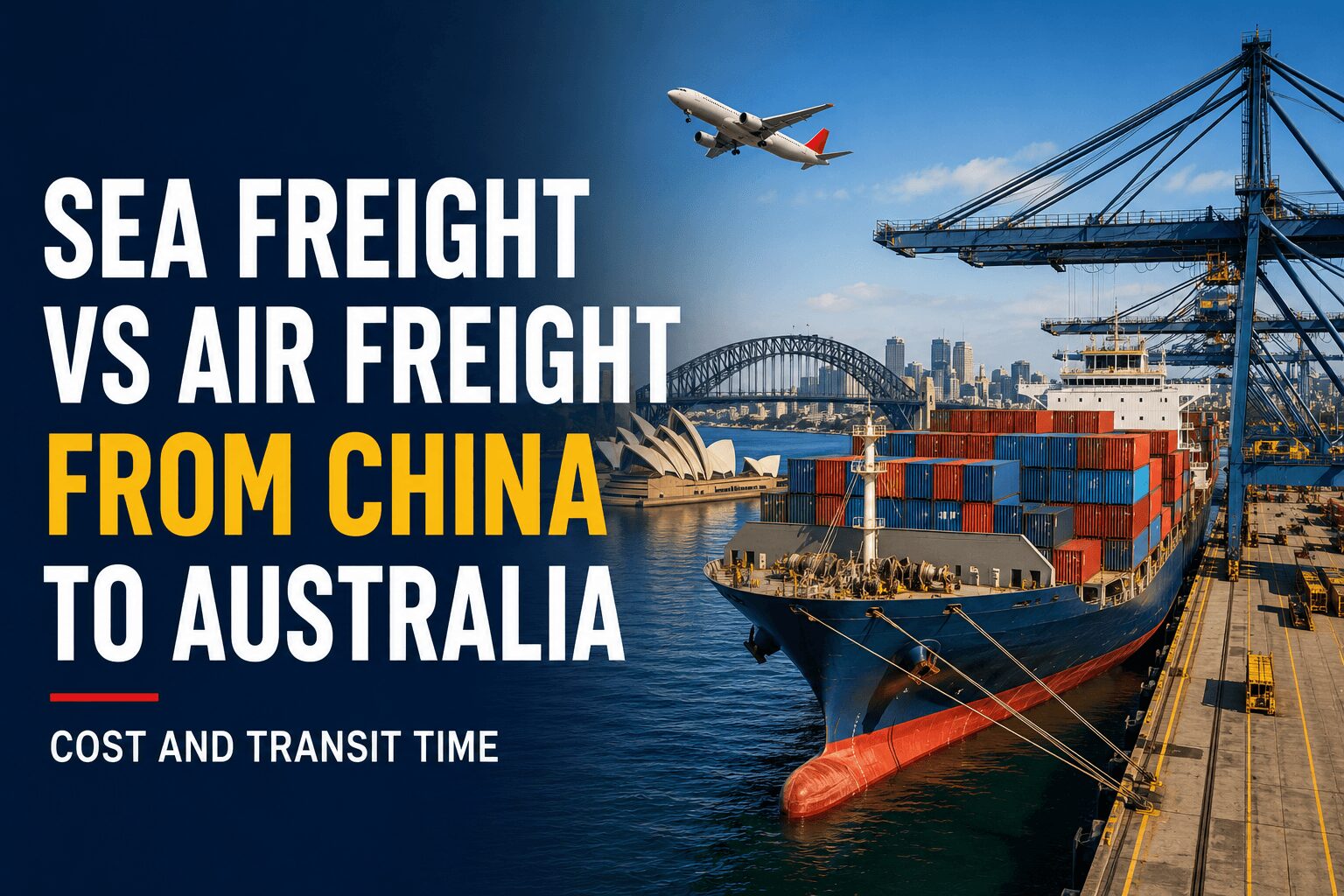
Sea vs air freight from China to Australia is mainly a trade-off between landed cost, delivery speed and inventory risk. Sea freight is usually the economical choice for larger or heavier orders. Air freight costs more, but it can make sense when stock is urgent, compact or valuable enough to justify the faster service.
Do not compare an ocean rate with an air rate in isolation. A useful comparison must include the full shipment journey: supplier pickup, export handling, international freight, Australian clearance, biosecurity processing and final delivery.
Sea vs air freight from China to Australia: cost and transit time
Transit times vary by origin city, destination, routing, carrier capacity and the type of service booked. As an indicative planning range, Maersk’s general route guide states that sea freight from China to Australia can take around 25–35 days. Freightos uses a broader door-to-door rule of thumb of about 30–40 days for ocean freight and 8–10 days for standard air freight under regular conditions.
These ranges are not delivery guarantees. LCL consolidation, vessel cut-off dates, transhipment, port congestion, airline capacity, Australian customs and biosecurity intervention can all extend the schedule. Always confirm the current routing before committing stock to a launch date or customer deadline.
- Sea freight: normally lower cost for bulky, heavy or higher-volume cargo, but measured in weeks rather than days.
- Air freight: normally faster and more expensive, with pricing strongly affected by carton dimensions and chargeable weight.
When comparing sea vs air freight from China to Australia, make sure both quotes cover the same pickup point, delivery postcode and service level. A port-to-port sea quote cannot be fairly compared with a door-to-door air quote.
How sea freight costs work
Sea freight from China to Australia generally moves as LCL or FCL. The cheaper option depends on the packed volume, weight, origin, destination and local handling charges.
LCL sea freight
LCL sea freight from China to Australia means your goods share container space with other consignments. It suits cartons, crates and pallets that do not justify a full container.
LCL is usually calculated using shipment volume and weight. However, smaller shipments can attract a high cost per cubic metre because origin handling, documentation, consolidation, destination deconsolidation and delivery include fixed charges. Therefore, the lowest ocean-freight line does not necessarily produce the lowest landed cost.
FCL sea freight
FCL sea freight from China to Australia gives one importer exclusive use of a container. It is generally better suited to larger commercial volumes, machinery, palletised products and repeat bulk orders.
FCL can reduce the freight cost per unit when the container is used efficiently. It also avoids the consolidation and deconsolidation stages required for LCL. However, you must still account for China transport, port charges, customs clearance, Australian delivery, unloading requirements and possible detention or demurrage.
How air freight costs work
Air freight from China to Australia is normally charged using chargeable weight. The carrier compares the shipment’s actual weight with its volumetric weight and charges whichever is higher.
This matters for lightweight products packed in large cartons. A shipment may weigh only 80 kg on a scale but take up enough aircraft space to be charged at a much higher volumetric weight. Oversized cartons, unused packaging space and poor carton design can quickly damage the economics of air freight.
Use the freight volume calculator to estimate total CBM, actual weight and volumetric weight. Final pricing still requires confirmed packed measurements because supplier estimates often change after production and packing.
When sea freight is the better option
- The goods are heavy, bulky or relatively low value for their size.
- You are importing a wholesale, retail or private-label production order.
- Your margins cannot absorb the air-freight premium.
- You have enough stock or lead time to wait several weeks.
- You want to consolidate orders from several Chinese suppliers.
Warehousing and consolidation in China can help combine supplier orders into one planned shipment. This may reduce repeated fixed shipment charges, but the Incoterms, domestic transport and export documents for each supplier still need to be checked.
When air freight is the better option
- You need urgent stock replenishment to avoid lost sales.
- The product is compact, higher value or carries a strong margin.
- A launch, promotion or customer order has a firm deadline.
- You are shipping samples, replacement parts or a smaller order.
- The cost of running out of stock is greater than the extra freight cost.
Air freight can be the stronger commercial decision even when the freight invoice is higher. For example, restoring a best-selling product quickly may protect revenue, advertising performance and customer confidence.
Consider splitting the shipment
The choice does not have to be entirely sea or entirely air. You can send a smaller urgent quantity by air and move the balance by sea. This approach can support a launch or stock shortage without paying air-freight rates for the full order.
Plan the split before the supplier finishes packing. The air and sea quantities need separate carton markings, packing lists and commercial documents. Last-minute changes can cause counting errors, documentation mismatches and warehouse delays.
Check what the freight quote includes
- Supplier pickup or delivery to the China warehouse
- Export handling, consolidation and documentation
- International sea or air freight
- Australian terminal, port or airport charges
- Customs-broker and clearance costs
- Duty, GST and government charges where applicable
- Biosecurity inspection, treatment or storage if required
- Final delivery, depot collection or remote-area charges
- Tail-lift, residential or difficult-access delivery fees
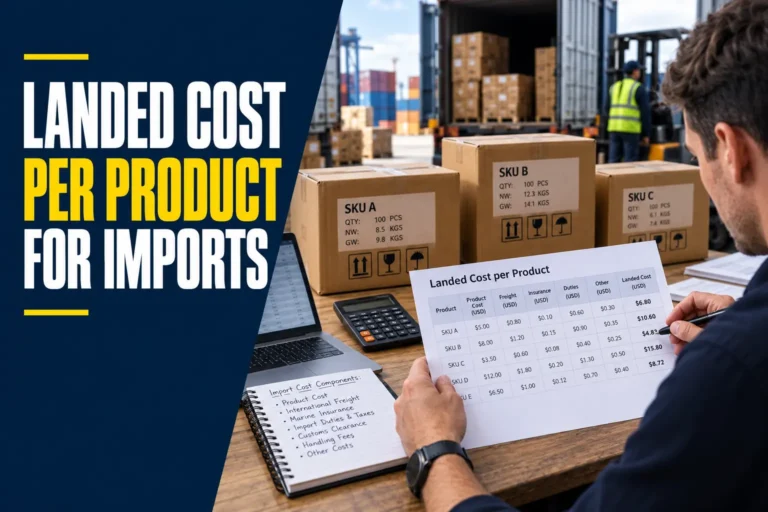
- Cargo insurance
Australian duty, GST and other import costs depend on the goods, customs value, tariff classification and available concessions. The Australian Border Force import-cost guidance explains the general framework. Confirm the shipment with a licensed customs broker or other qualified adviser before dispatch.
Australia also applies strict biosecurity controls. Use the Australian Government’s BICON system to check whether the goods, timber packaging or other materials require documents, treatment or an import permit.
Which freight method should you choose?
Choose sea freight when cost control matters more than speed and the order is large enough to use LCL or FCL efficiently. Choose air freight when timing has a clear commercial value and the shipment’s weight, dimensions and margin can support the higher rate.
Prestige Sourcing is NZ-owned and based in Shenzhen. We can communicate with suppliers, obtain packed shipment details, coordinate supplier pickup, consolidate cargo and compare China-to-Australia freight options. We can also arrange door-to-door freight from China to Australia, subject to the cargo, destination and quotation.
Send the product description, carton dimensions, total weight, China pickup location, Australian postcode and target delivery date. We will assess the practical options before you approve dispatch.