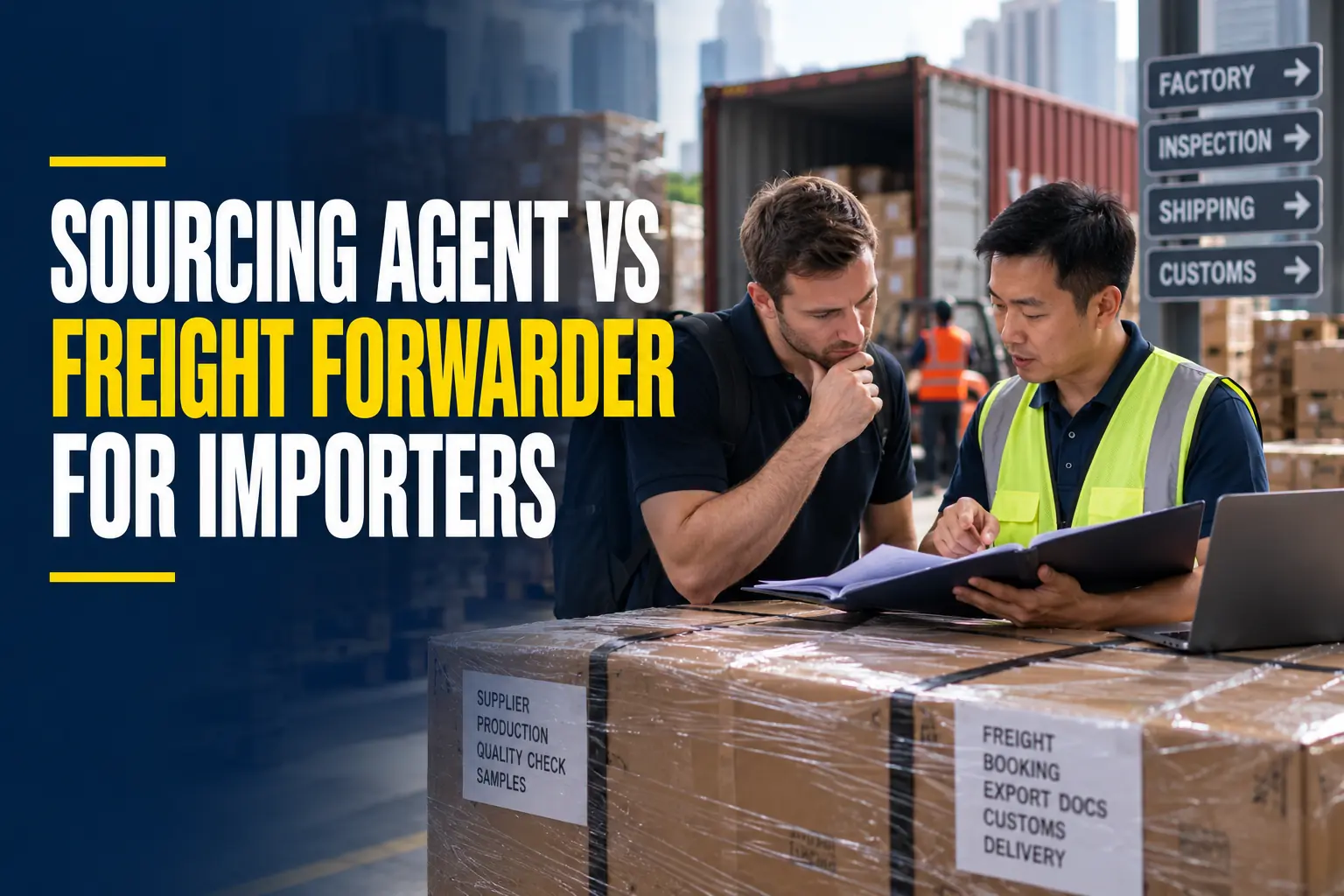
Choosing between a sourcing agent vs freight forwarder depends on where your risk sits. A sourcing agent manages the supplier and order before shipment. A freight forwarder manages the transport once the cargo is ready. However, some providers cover parts of both roles.
Short answer: use a sourcing agent when you need help controlling the product, supplier or production process. Use a freight forwarder when you mainly need cargo moved from origin to destination. In practice, many importers need both functions on the same order.
Sourcing agent vs freight forwarder: the practical difference
The clearest difference is what each provider manages. A sourcing agent works upstream, around the supplier and purchase order. A freight forwarder works downstream, around the shipment and transport plan.
| Task | Sourcing agent | Freight forwarder |
|---|---|---|
| Find and compare suppliers | Usually | Usually not |
| Clarify product specifications | Usually | Usually not |
| Manage samples and production follow-up | Often | Usually not |
| Coordinate quality checks | Often | Sometimes as an added service |
| Collect cargo from the factory | Sometimes | Usually |
| Book sea, air or courier transport | Sometimes through logistics partners | Core role |
| Coordinate export shipping documents | May help with supplier handover | Usually manages the shipping side |
| Coordinate customs clearance | Sometimes through logistics partners | Often through its own network or a broker |
| Arrange final delivery | Sometimes | Usually, when included in the quote |
These are typical responsibilities, not fixed definitions. Therefore, compare the written scope rather than relying on the provider’s job title.
What a sourcing agent usually handles
A sourcing agent focuses on the commercial relationship with the supplier. That work can start before you know which factory will make the product. It can also continue until the order leaves China.
Typical sourcing work can include:
- turning your product brief into supplier questions and quote requirements;
- finding and comparing factories or trading companies;
- checking supplier information and commercial suitability;
- coordinating samples, revisions and approvals;
- negotiating specifications, quantities, packaging and order terms;
- following production progress and supplier communication;
- arranging inspections or other quality-control work; and
- preparing the supplier for the freight handover.
The value sits in order control rather than transport alone. For example, a forwarder can collect 20 cartons from a factory. It will not normally decide whether those cartons contain the product you approved.
For New Zealand businesses that need supplier-side support, Prestige explains its broader China sourcing agent service for New Zealand businesses. That service can extend from sourcing through supplier management and shipment coordination.
What a freight forwarder usually handles
A freight forwarder focuses on moving cargo. Once the factory can provide cargo details, the forwarder can build the transport plan. That plan depends on the shipment, trade terms and destination.
Typical forwarding work can include:
- reviewing carton counts, weights, dimensions and cargo type;
- arranging collection from the factory or nominated warehouse;
- booking sea freight, air freight or another suitable service;
- coordinating origin handling and export shipping paperwork;
- issuing or coordinating transport documents;
- working with destination agents or customs brokers;
- tracking the shipment; and
- arranging depot release or final delivery when quoted.
A good forwarder needs accurate information from the supplier and importer. For example, it needs the correct cargo description and packing details. It also needs to know who controls the export handover.
Shipment size affects the available freight options. You can use the freight volume calculator to work out CBM before requesting a quote.
Where the two roles overlap
The overlap causes most of the confusion. Some sourcing agents arrange freight as part of a wider service. Meanwhile, some forwarders offer warehouses, inspections or limited supplier coordination.
That overlap is not a problem by itself. Problems start when nobody knows who owns a task. For example, one party may assume the other has confirmed the factory pickup date.
Another common grey area is export readiness. A factory may quote EXW, FOB or another trade term. However, the commercial term does not tell you who will chase missing documents or resolve a supplier-side delay.
If your supplier wants to control the international shipment, compare that arrangement carefully. Our guide on whether a Chinese supplier should arrange international freight covers that decision in more detail.
A simple importer decision framework
Instead of starting with provider labels, start with the problem you need solved. The following framework makes the decision much clearer.
1. Do you still need to control the supplier or product?
If the answer is yes, you need sourcing support. This applies when you are still comparing factories, approving samples or refining specifications. It also applies when you want someone to monitor production or arrange quality checks.
If the supplier relationship is already stable, move to the next question.
2. Are the goods genuinely ready for shipment?
If production is complete and the order has passed your required checks, the job may now be mainly logistical. At that point, a freight forwarder can usually take over transport planning.
However, “finished production” does not always mean “ready to ship”. Confirm the final quantity, packaging, carton dimensions and documents first.
3. Who will solve a factory-side problem before pickup?
This question often decides whether freight-only support is enough. Imagine the factory finishes late, changes the packaging or provides incorrect carton information. Someone still needs to deal with the supplier.
If you can manage that directly, a forwarder may be sufficient. If you need someone in China to handle the supplier, keep a sourcing or purchasing function involved.
4. Who will own the handover into freight?
Every order needs a clear point where supplier management ends and logistics begins. That handover should include cargo details, documents, pickup instructions and an agreed release date.
If nobody owns that step, the order can sit between the factory and forwarder while each waits for the other.
| Your situation | Likely support needed |
|---|---|
| You have no supplier yet | Sourcing agent |
| You have suppliers but still need samples, negotiation or production management | Sourcing agent |
| You have approved finished goods and only need transport | Freight forwarder |
| You need inspections plus international shipping | Sourcing support plus freight forwarding |
| You buy from several factories and need one coordinated export | Integrated sourcing/logistics support or clearly coordinated providers |
| You manage the factory yourself but want independent freight control | Freight forwarder |
| You are a first-time importer and do not know where sourcing ends and freight begins | A provider that can define and coordinate both scopes |
The key question is therefore not simply, “Do I need a sourcing agent or forwarder?” Instead, ask, “Which parts of this order can I manage myself, and who owns everything else?”
The handover between sourcing and freight matters most
A smooth handover needs more than a message saying the goods are finished. Before collection, the parties should agree what information the forwarder will receive. They should also agree who will supply it.
At minimum, confirm:
- factory or warehouse pickup address;
- contact person and collection hours;
- carton or pallet count;
- gross weight and dimensions;
- cargo description;
- commercial invoice and packing list details;
- trade term and agreed handover point;
- whether quality checks have finished;
- whether the supplier can complete the required export process; and
- the required destination and delivery arrangement.
Once the forwarder has reliable cargo data, it can confirm routing and booking details. Before that point, estimates may change because the shipment itself can still change.
Who handles customs?
Neither label gives a complete answer. A forwarder often coordinates customs through its own network or an appointed broker. However, the importer still needs to provide accurate product and commercial information.
At origin, the supplier, exporter, forwarder or another authorised party may take part in the export process. The exact setup depends on the transaction. Therefore, confirm this before the cargo leaves the factory.
At destination, a customs broker may lodge the entry while the forwarder coordinates the shipment. New Zealand importers can also use Prestige’s New Zealand Customs Fee Calculator for an estimate of common import charges.
Which provider should you appoint?
If you already have a reliable supplier and the order is ready to move, a freight forwarder may be enough. You still need clear documents, cargo details and delivery instructions.
By contrast, use a sourcing agent when the main risk sits before shipment. That includes supplier selection, product development, samples, production follow-up or quality control.
You may need both when one company manages the order and another manages transport. That arrangement can work well because each provider has a clear role. However, write down the handover responsibilities before production finishes.
An integrated provider can also cover both functions. In that case, confirm where the sourcing scope ends and the freight scope begins. One contact does not automatically mean one party handles every task.
Questions to ask before appointing either provider
Ask practical questions that expose responsibility gaps before you place the order. In particular, confirm:
- Who communicates with the factory about production and readiness?
- Which party checks that the order matches the approved specifications?
- Who arranges any inspection, and who acts on the result?
- Where do the final packing list and commercial invoice go?
- Who confirms the pickup date with the factory?
- Which party makes the international freight booking?
- Who coordinates export and destination customs processes?
- Which party arranges final delivery or depot release?
- Who tells you when information or documents are missing?
Also separate responsibility from price. A cheaper quote can cover a smaller scope, so compare what each provider will actually do. If you are specifically comparing sourcing charges, see our guide to China sourcing agent fees.
Define the roles before the order moves
The sourcing agent vs freight forwarder decision is not always either-or. The important point is to assign ownership for every stage. That includes supplier control, quality release, export handover, transport, customs coordination and delivery.
For importers buying from China, the biggest gaps often appear between production and shipment. Clear responsibilities reduce those gaps and make problems easier to resolve.
Prestige Sourcing is New Zealand-owned and based in Shenzhen. We can support New Zealand importers with supplier-side sourcing work and coordinate the China-to-shipping handover. Learn more about our China sourcing support for New Zealand businesses.