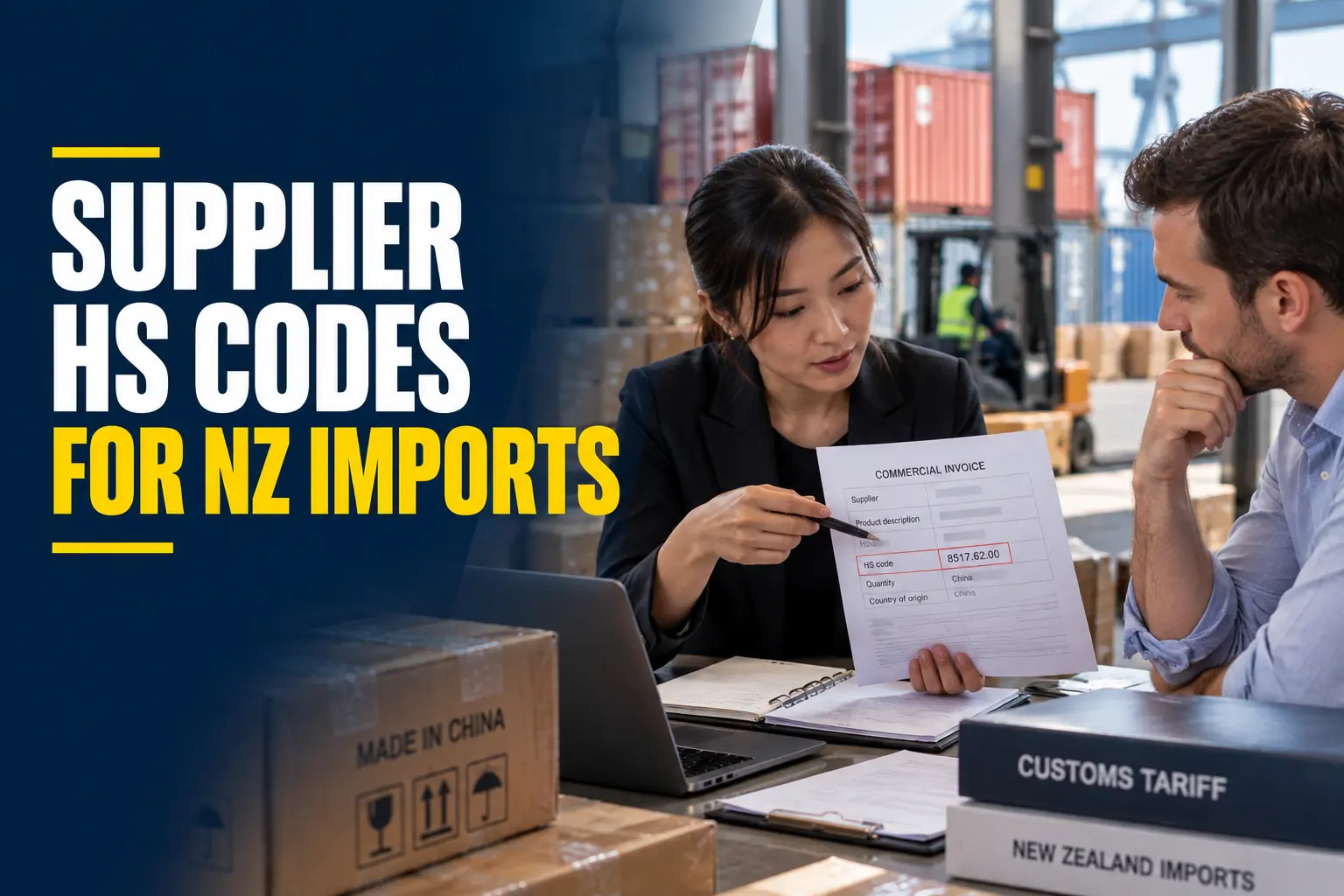
A supplier HS code for NZ imports is a starting point, not an answer. However, plenty of buyers copy it straight onto the entry and assume the duty follows.
The supplier may use a code that suits its China export declaration. New Zealand still needs the goods classified under the New Zealand tariff. Before relying on a duty estimate, give your broker enough product detail to check the code properly.
This matters because two products can look similar while falling under different tariff headings. Materials, function, construction and how the product is presented can all change the result.
Supplier HS code NZ imports: what actually needs checking
The Harmonized System gives countries a common structure for classifying traded goods. Codes can therefore look similar across China and New Zealand.
However, each country can add its own national tariff detail beyond the international HS level. Authorities can also reach different conclusions when a product sits close to a classification boundary.
That means the code on a Chinese commercial invoice is evidence to review, not a code to copy automatically.
Why a Chinese supplier’s HS code may not be enough
Factories and trading companies often reuse codes from earlier shipments. In many cases, that works because the product has not changed. Problems start when the supplier uses the same code for a different model, material or configuration.
A supplier may also choose a broad code because it is easier for its export paperwork. That does not prove the same classification suits a New Zealand import entry.
Watch for these situations:
- The supplier uses one HS code for several different products.
- The invoice description is vague, such as “accessories” or “parts”.
- The code changes between the quotation, invoice and packing documents.
- The supplier cannot explain what product description sits behind the code.
- A material, component or function changed after the original quotation.
- The supplier says the code was chosen mainly to reduce tax or simplify clearance.
None of these points automatically means the supplier has done something wrong. They do mean the importer should check the classification before shipping.
Start with the actual product, not the invoice code
Your New Zealand broker needs to classify the goods that will actually arrive. So begin with the product specifications, not the supplier’s existing number.
Useful information can include:
- Clear product name and model number
- Main function and intended use
- Material composition
- Photos of the finished product
- Technical specifications or drawings
- Major components
- Power source, voltage or motor details where relevant
- Whether the product arrives assembled, unassembled or as a kit
- Whether an item is a complete product, part or accessory
- Packaging and retail-set configuration where classification may depend on it
For mixed shipments, provide this information for each product line. Do not assume one supplier code covers an entire order.
If you are still organising the shipment, our guide to importing from China to New Zealand explains the wider document and clearance process.
Ask the supplier for the code, but also ask what it describes
Do not stop at “Please send the HS code.” Ask the supplier which exact product, model and material the code relates to.
Where useful, request the full code the supplier normally uses for China export. Also ask whether that code comes from previous exports of the same finished product.
If the product changed, make that clear to your broker. A code used for an older model may no longer fit.
The supplier may have useful experience with the product. However, your New Zealand import classification should not depend on the supplier’s confidence alone.
Check the New Zealand classification before using a duty estimate
The tariff classification can affect the duty treatment and other customs requirements. Therefore, confirm the classification before you build the final landed cost around it.
Give the broker the supplier’s suggested code and the supporting product information. The broker can then check whether the New Zealand tariff treatment matches the actual goods.
Once the classification is checked, you can use the New Zealand Customs Fee Calculator for an initial estimate. Treat the result as a planning figure rather than a substitute for broker advice.
This order matters. Entering an unverified supplier code into a calculator can produce a precise-looking number based on the wrong classification.
Do not confuse HS classification with origin
An HS code and a product’s origin answer different questions. The code identifies the type of goods. Origin rules determine whether the goods qualify for any available preferential tariff treatment.
Goods leaving China are not automatically entitled to a particular duty rate just because the supplier is Chinese. Your broker may need origin information and supporting documents as well.
Keep the two checks separate. First confirm what the goods are for tariff purposes. Then confirm how origin rules apply to that shipment.
What if the classification is genuinely unclear?
Some products sit between headings or combine several functions. New technology can also make classification less obvious.
For a repeated, high-value or commercially important import, ask your broker whether a formal New Zealand Customs tariff ruling makes sense. A ruling can provide a clear classification position for the specific goods covered by the application.
Do this before the shipment becomes urgent. Classification questions are easier to resolve while the factory still holds the goods and documents remain easy to collect.
Be careful when a DDP supplier controls the customs details
A DDP quote can make the classification less visible to the buyer. The supplier or overseas logistics provider may control the declaration process and choose the code used for clearance.
That does not make DDP wrong. However, a New Zealand business should still understand how its goods are described and classified.
Our guide to DDP shipping from China to New Zealand explains the wider documentation and importer risks.
A practical supplier HS code checklist for NZ importers
Before the supplier releases the cargo, check the following:
- Get the supplier’s suggested HS code.
- Confirm which exact model the code covers.
- Collect product photos and specifications.
- Record the main materials and product function.
- Flag any changes from the sample or earlier model.
- Give the information to your New Zealand broker.
- Ask the broker to confirm the New Zealand classification.
- Only then rely on duty and landed-cost estimates.
- Keep the confirmed classification with your shipment records.
This process takes more effort than copying a number from an invoice. However, it gives the broker evidence to work from and reduces unsupported assumptions.
China to New Zealand freight support
HS classification is only one part of getting a shipment ready. The supplier also needs to provide accurate invoice details, packing information, cargo dimensions and product descriptions.
Prestige Sourcing can help coordinate your China to New Zealand freight forwarding, collect shipment information from suppliers and coordinate the clearance process with the New Zealand side.
We can also help identify missing product details before collection. However, the tariff classification still needs to match the actual goods rather than an unsupported supplier code.
For help with a China to New Zealand shipment, send us the supplier invoice, product details, packed dimensions, gross weight and delivery address before the cargo leaves China.