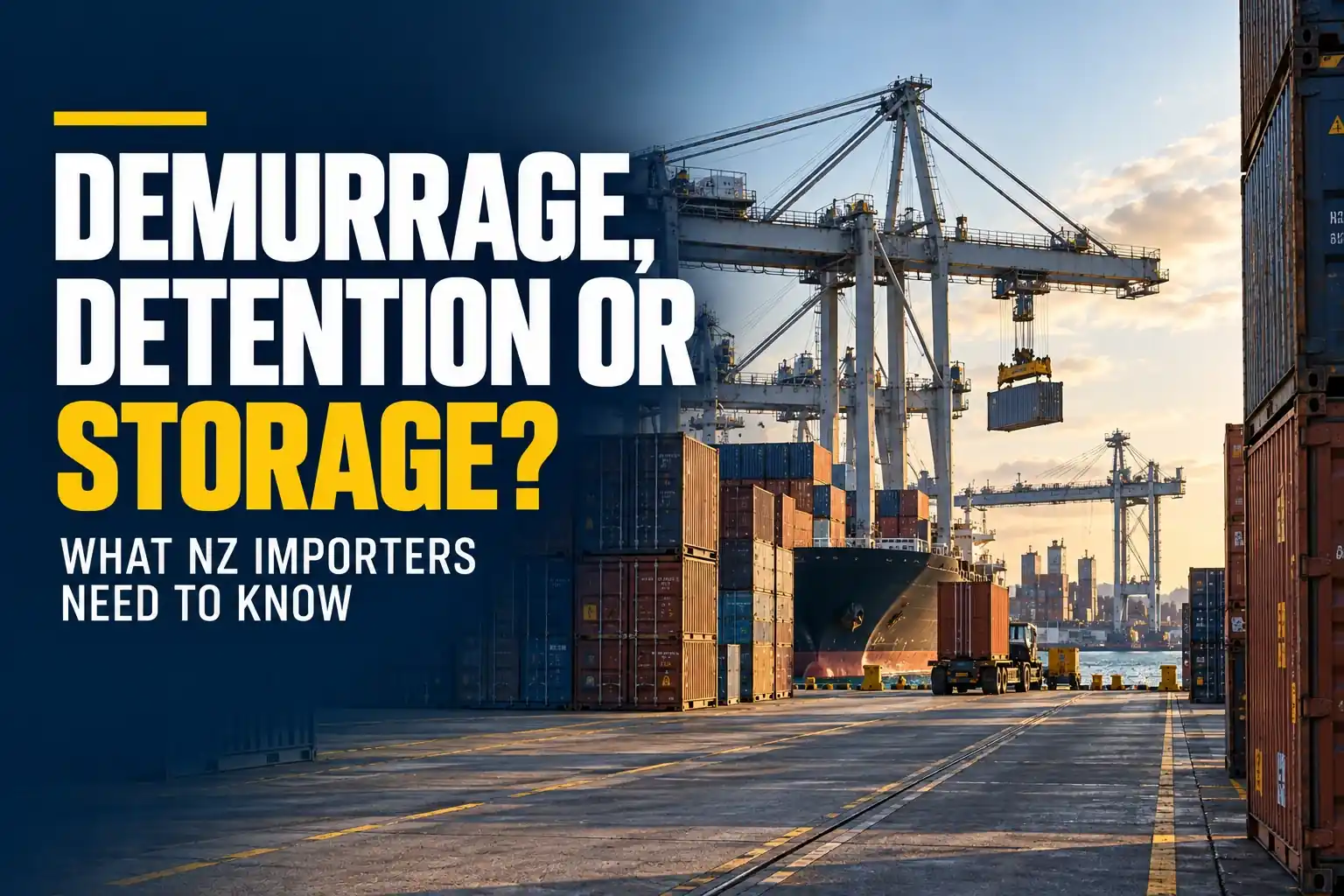
If you import by sea, demurrage detention storage NZ charges are three terms worth understanding before your cargo arrives. They all relate to time, but they do not necessarily cover the same thing. A container that sits too long at a terminal, cargo left at an LCL depot, or an empty container returned late can each create a different charge.
The difficult part is that terminology is not completely consistent between ports, shipping lines and depots. Some carriers separate demurrage and detention. Others use combined demurrage and detention free time. Some terminals also use demurrage terminology for container dwell at the port. The safest approach is to check the actual free-time rules applying to your shipment rather than relying on the name of the charge alone.
Demurrage Detention Storage NZ: What Does Each Charge Mean?
The easiest way to understand the difference is to ask two questions: where is the cargo or container sitting, and whose equipment or space is being used?
Demurrage
Demurrage commonly relates to a shipping container remaining at a port or terminal beyond the permitted free period.
For example, an FCL container is discharged from the vessel but cannot be collected before its last free day. Depending on the terminal and carrier terms, demurrage or another terminal dwell charge may begin.
Some New Zealand terminal tariffs also use the term demurrage for containers that remain on the terminal beyond free time. This is one reason importers should check the actual tariff rather than assuming every provider uses the term in exactly the same way.
Detention
Detention generally relates to keeping the shipping line’s container outside the terminal for longer than allowed.
Once an FCL container is collected, it may be delivered to your warehouse, unloaded and then returned empty to the carrier’s nominated depot. If the container is not returned within the applicable equipment free time, detention may apply.
That means getting the container out of the port is only part of the job. The shipping line still needs its equipment returned on time.
Storage
Storage is usually charged for cargo or containers occupying physical space at a terminal, container freight station or depot beyond the permitted free period.
For LCL imports, this is often the main time-based risk after arrival. Once the shared container has been unpacked, your cartons or pallets may sit at the destination depot awaiting collection. If they remain there beyond the depot’s free storage period, storage charges can begin.
Storage can also be separate from a shipping-line equipment charge. As a result, more than one time-based charge can sometimes apply to the same shipment.
Why Demurrage and Storage Can Apply at the Same Time
Importers sometimes assume one delayed container can only create one charge. That is not always the case.
A full container may be sitting inside a terminal and occupying terminal space while also tying up carrier-owned equipment. Depending on the commercial terms, the terminal, shipping line or both may have their own free-time rules.
Once the container leaves the terminal, the terminal-related charge may stop. However, the carrier’s equipment clock may continue until the empty container is returned.
This is why the useful question is not simply, “What is the demurrage rate?” Instead, ask which clocks are running, when each one started and what action stops each charge.
Combined Demurrage and Detention Changes the Calculation
Some shipping lines offer separate demurrage and detention periods. Others use combined demurrage and detention, often shortened to D&D.
Under a combined arrangement, one free-time allowance may cover the period from container discharge through to the return of the empty equipment. Taking longer at the port can therefore leave less time to unload and return the container afterwards.
Do not assume a familiar number of free days applies to every booking. The allowance can depend on the carrier, equipment type, service, destination and negotiated terms.
FCL and LCL Importers Face Different Delay Risks
For an FCL shipment, you control the use of the full container after it leaves the port. That makes both collection timing and empty-container return important.
For an LCL shipment, the consolidator normally controls the shared ocean container. Your exposure is more likely to be cargo storage after your pallets or cartons have been unpacked and made available at the destination depot.
In both cases, the problem usually starts when cargo is available but the next step has not been organised.
Common Reasons Time-Based Charges Start Building
- Delivery is booked too late. The importer waits until the container is already available before trying to secure transport.
- The receiving site is not ready. There is no forklift, labour, access or suitable unloading window when the container arrives.
- Release requirements are incomplete. The cargo has arrived, but the shipment cannot yet move.
- The last free day is misunderstood. Different parties assume someone else is tracking the deadline.
- The empty return is overlooked. An FCL container is unloaded, but nobody has confirmed the correct depot or return deadline.
- LCL cargo is not collected promptly. Pallets or cartons remain at the destination depot after they are available.
Weekends and public holidays also need attention. How they are treated can vary between the relevant port, depot and carrier terms. Confirm the calculation for the shipment rather than assuming non-working days do not count.
What to Confirm Before the Vessel Arrives
For time-based destination charges, preparation matters more than trying to dispute an invoice afterwards.
- Confirm the cargo availability process. Know who will advise when the container or LCL cargo is ready for collection.
- Ask for the last free day. Get the applicable deadline in writing where possible.
- Check whether D&D is separate or combined. This affects how much time you may have after the container leaves the terminal.
- Book transport early. Do not make the final free day your planned collection day unless you have no alternative.
- Prepare the delivery site. Make sure access, labour and unloading equipment are available.
- Confirm the empty return instructions. For FCL, know where the empty container must go and by when.
If you are still comparing freight arrangements before booking, our China to NZ Freight Quote Guide explains how to check what is and is not included in a freight quotation. This guide is focused specifically on the time-based charges that can arise after cargo reaches New Zealand.
What to Do if Charges Have Already Started
If your shipment is already delayed, find out exactly what is being charged before focusing on who is responsible.
Ask for the charge name, charging party, free-time allowance, first chargeable day, current daily rate and what event will stop further charges. Also ask whether another storage or equipment charge is running separately.
Then deal with the operational problem first. If a container can be collected, unloaded or returned, stopping further chargeable days may be more important than arguing about the first invoice while the amount continues to grow.
If you believe the delay was caused by another party, keep the booking terms, arrival notices, release messages, transport records and any written instructions. Whether a charge can be challenged or passed on depends on the contracts and circumstances involved.
Plan the New Zealand Side Before the Container Lands
The simplest way to reduce demurrage, detention and storage risk is to have the destination process organised before arrival. That means knowing who is handling release, who is arranging delivery, when the receiving site is ready and, for FCL, how the empty container will get back to the nominated depot.
For importers shipping from China, Prestige Sourcing can help coordinate China to New Zealand Freight Forwarding and the destination delivery process. If you prefer an end-to-end arrangement, see our China to New Zealand door-to-door freight service.
Free time, tariffs and carrier rules can change, so always confirm the current terms applying to the specific booking with your freight forwarder, shipping line, terminal or depot.
Request a Quote if you have an upcoming China to New Zealand shipment and want the destination process planned before the cargo arrives.