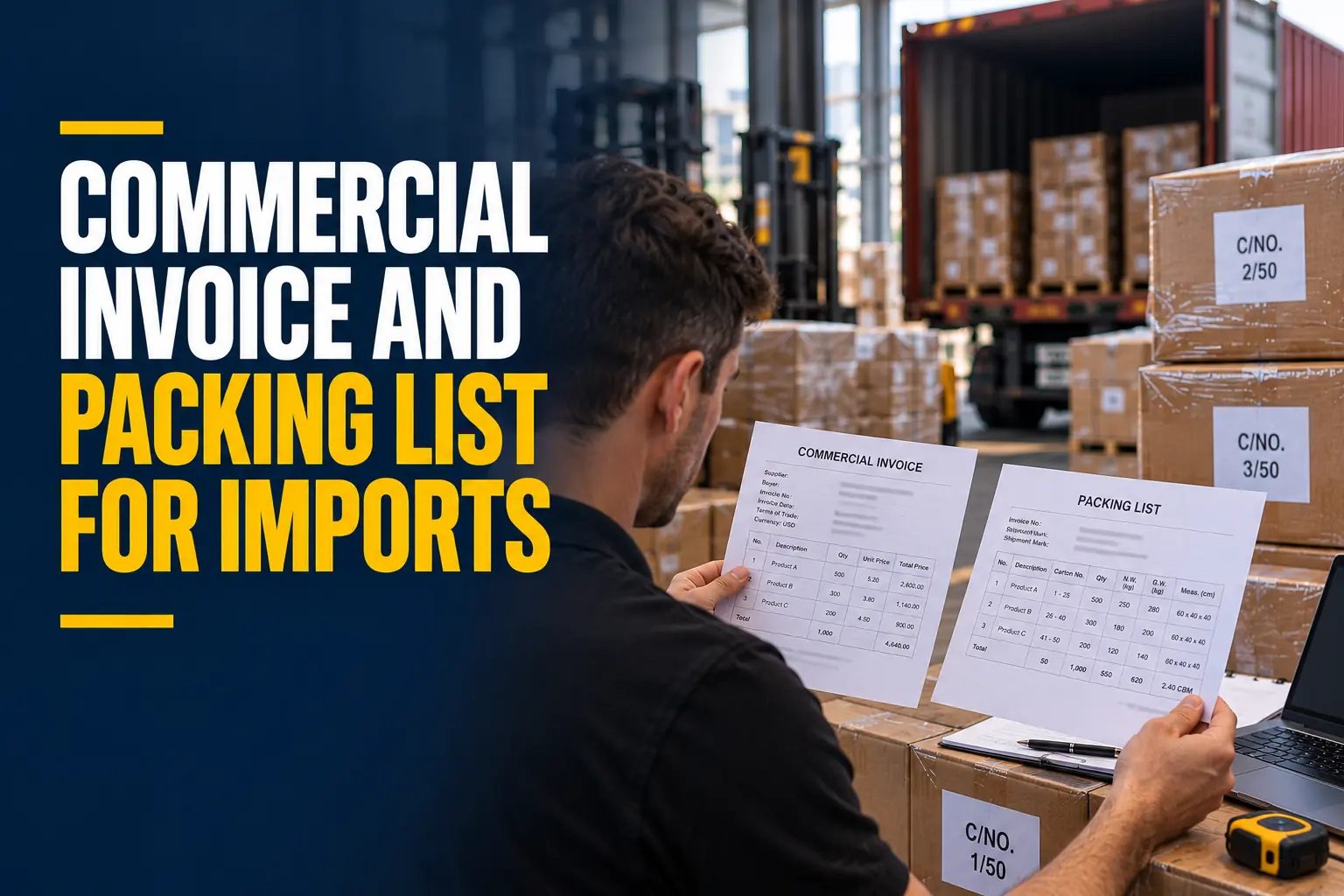
Commercial invoice packing list imports can look straightforward until two documents describe the same shipment differently. A quantity changes, carton numbers do not match, or the final weight differs from the supplier’s earlier estimate. These issues are easier to fix while the cargo is still in China.
The commercial invoice and packing list serve different purposes. However, they should describe the same physical shipment. Before cargo release, the buyer should reconcile both documents against what the factory actually packed.
Commercial invoice packing list imports: what should match?
The commercial invoice records the commercial transaction. The packing list explains how the goods sit inside the shipment.
Because the documents have different jobs, not every field will appear on both. However, the core shipment details should agree.
- Product descriptions should identify the same goods.
- Quantities should reconcile across both documents.
- Model numbers, SKUs or item references should match where used.
- The packing list carton count should match the physical cargo.
- Shipment references should not point to different orders.
- Supplier and buyer details should remain consistent.
Small wording differences do not automatically mean something is wrong. The problem starts when the documents describe materially different shipments.
What should you check on the commercial invoice?
A commercial invoice normally identifies the seller, buyer, goods and transaction value. It also gives the importer, broker and freight team important supporting information.
Before shipment, check the invoice against the purchase order and the final packed quantity. Key fields commonly include:
- supplier name and address;
- buyer or importer details;
- invoice number and date;
- clear product descriptions;
- model, SKU or product references where relevant;
- quantity and unit of measure;
- unit price and total price;
- currency; and
- agreed trade terms where shown.
Do not let the supplier reuse an old invoice without checking it. In practice, factories sometimes copy previous paperwork and change only part of the information.
New Zealand Customs notes that a commercial invoice, contract or purchase order can provide evidence of a sale for export to New Zealand. You can read its current guidance on Customs import value.
What should you check on the packing list?
The packing list should describe the physical shipment rather than the sale value. It helps the freight team understand how many cartons, pallets or crates they need to handle.
A useful packing list commonly shows:
- product or SKU details;
- quantity per carton or package;
- total quantity;
- number of cartons, pallets or crates;
- gross and net weights;
- package dimensions;
- total shipment volume;
- carton or pallet numbers; and
- shipping marks where used.
Once the factory finishes packing, compare these figures with the warehouse or final packing information. Earlier estimates may no longer reflect the finished cargo.
If you need to check cubic metres from the final carton dimensions, Prestige’s freight volume calculator can help.
Seven checks to make before the cargo leaves China
1. Match the product descriptions
Both documents should clearly refer to the same products. Avoid one document using a detailed description while the other uses a vague phrase that could describe something else.
For example, an invoice might list three specific product models while the packing list simply says “accessories”. Ask the supplier to make the relationship clear.
2. Reconcile the total quantities
Add the quantities on the packing list and compare them with the invoice. Do this for each product line, not only the shipment total.
A short shipment may be legitimate. However, the invoice should reflect what the factory actually sends unless there is a clear reason otherwise.
3. Check carton and pallet counts
The final packing list should match the physical number of packages. If a warehouse receives 38 cartons but the list says 40, investigate before dispatch.
Do not solve the problem by changing one document without checking the goods.
4. Compare weights and dimensions
Final gross weight should make sense for the carton count and product quantity. Large differences from the booking estimate deserve a second check.
New Zealand Customs includes inconsistent shipment weights and document details among factors that can attract attention in the supply chain. Its current guidance also specifically mentions invoice details that differ from a packing list. See Customs guidance on the supply chain.
5. Match model numbers and references
Factories may use internal model codes that differ from the buyer’s SKU. That can work, but the documents should remain understandable.
Where possible, use consistent product references across the purchase order, invoice and packing list.
6. Check buyer and supplier information
Make sure the legal supplier and buyer details are correct. A spelling mistake may seem minor, but conflicting company details can create unnecessary questions.
This check matters even more when a trading company, export agent or another entity appears in the transaction.
7. Confirm the paperwork reflects the final shipment
Do not treat the first spreadsheet from the factory as the final packing list. Production changes, shortages and repacking can alter the shipment.
Once packing finishes, ask for the final documents and compare them again before cargo release.
A simple China-to-New Zealand example
Suppose a New Zealand buyer orders 600 units from a factory in China. The commercial invoice lists 600 units, while the first packing list shows 60 cartons with 10 units per carton.
During final packing, the factory finds 20 units that require rework. It sends 580 units in 58 cartons instead.
The buyer should not leave the original invoice showing 600 units while accepting a packing list for 580. Instead, the supplier should update the shipment documents so the final paperwork reflects the cargo that actually leaves China.
The same principle applies to carton counts and weights. If the factory combines cartons, changes packaging or adds a pallet, the final packing list should capture those changes.
Why this matters when importing into New Zealand
New Zealand Customs requires imported commercial goods to go through the appropriate clearance process. Importers, brokers and freight forwarders use shipment information when preparing the relevant lodgements.
Customs advises importers that documentation can be submitted before the goods arrive. Early preparation gives the broker more time to identify missing or inconsistent information. See the current New Zealand Customs import entry guidance.
MPI may also need shipment documents for goods subject to biosecurity requirements. For containerised cargo, MPI says supporting information can include invoices or packing lists, depending on the goods and applicable import requirements. Its container and cargo guidance recommends submitting the required information before arrival.
Importers planning their first shipment can also read our guide to importing from China to New Zealand.
Who should fix a document mismatch?
The party that issued the document should normally correct it. For example, the supplier should revise its commercial invoice or packing list when its information is wrong.
However, the buyer still needs to review the final documents. A freight forwarder or sourcing company can flag inconsistencies, but it cannot know every commercial detail unless the buyer provides accurate order information.
In practice, the safest process is simple. Compare the purchase order, final invoice, final packing list and packed cargo before the shipment leaves the supplier or consolidation warehouse.
Do not wait until the cargo reaches New Zealand
Correcting supplier documents from China becomes less convenient after departure. The cargo may already be moving while the broker waits for revised information.
Instead, make document reconciliation part of the pre-shipment process. Ask the factory for final paperwork once packing finishes, then resolve discrepancies before release.
This approach also gives your freight team better shipment data. Accurate carton counts, dimensions and weights help them plan collection, consolidation and transport more effectively.
How Prestige can help with China-to-NZ shipments
Prestige Sourcing can coordinate with suppliers in China, review shipment information and arrange freight through established forwarding and customs-clearance partners.
For China to New Zealand Freight Forwarding, we can help collect final shipment details before booking and raise obvious document inconsistencies with the supplier before cargo release.
That does not replace the importer’s responsibility for accurate commercial information. However, keeping supplier communication, shipment data and freight coordination connected can reduce avoidable back-and-forth.
Final commercial invoice and packing list checklist
- Check the supplier and buyer names.
- Compare product descriptions and model references.
- Match quantities line by line.
- Confirm the commercial invoice reflects the goods being sent.
- Count cartons, pallets or crates against the final packing list.
- Check gross weight, net weight and dimensions.
- Review shipment and order references.
- Resolve unexplained differences before cargo release.
- Send the final documents to your freight or customs team promptly.
Good paperwork starts with the physical shipment. Once the factory finishes packing, make sure the commercial invoice and packing list tell the same story.
If you are preparing a shipment from China to New Zealand and want help coordinating the supplier, documents and freight, Let’s Talk.