Wood packaging NZ imports ISPM 15 checks should happen before your supplier sends the goods. Start by confirming which pallets, crates, supports and packing materials contain solid timber.
Most regulated solid wood packaging needs compliant treatment and recognised evidence. A valid ISPM 15 mark is the usual method. However, New Zealand also accepts certain official treatment certificates.
Do not rely on a supplier simply saying the timber is heat treated or fumigated. You need to know whether the actual packaging meets New Zealand’s requirements.
Wood packaging NZ imports ISPM 15: what needs checking?
New Zealand’s Ministry for Primary Industries (MPI) sets biosecurity requirements for wood packaging entering the country. The requirements apply to packaging materials, not just the products inside them.
Common examples include:
- Solid timber pallets and skids.
- Wooden crates and packing cases.
- Timber dunnage used to support or secure cargo.
- Wooden blocks, fillets, spacers and braces.
- Wooden cable drums and reels.
Ask your supplier to identify every solid timber component in the final packing. Do not check the pallet and forget the wooden supports underneath a crate.
When processed wood packaging is exempt
Some wood-based packaging falls outside ISPM 15 because its manufacturing process reduces pest risk.
Examples include packaging made entirely from qualifying processed wood, such as plywood, particle board or oriented strand board. Packaging made entirely from wood no thicker than 6 mm is also exempt from ISPM 15.
However, the exemption for processed wood applies to packaging made wholly from qualifying materials. A plywood crate with solid timber runners or framing needs further checking.
Ask the supplier to describe both the panels and the supporting structure. The word “plywood” on a quotation does not establish the material of every component.
What must an ISPM 15 mark show?
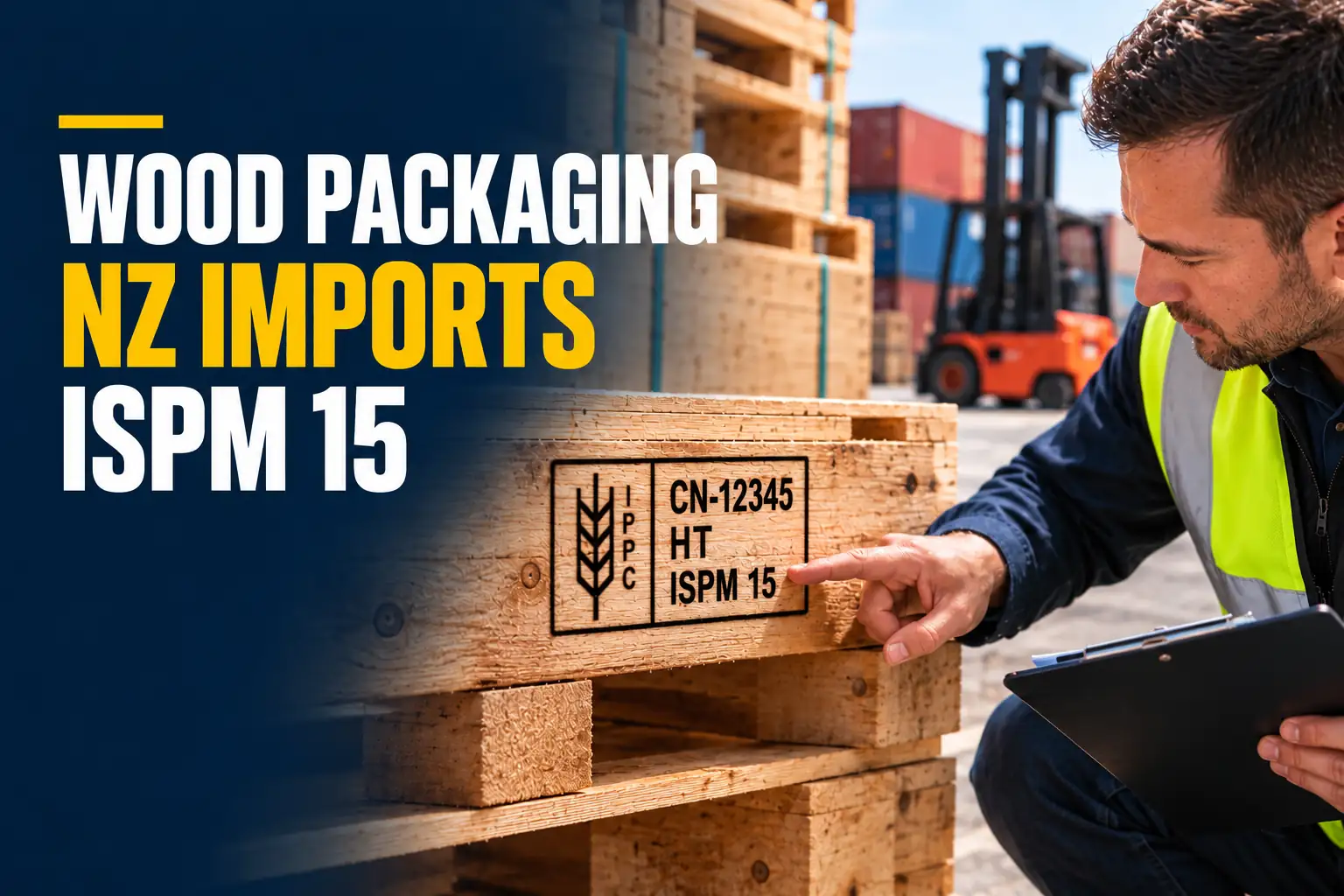
ISPM 15 uses an internationally recognised mark to identify wood packaging that has received an approved treatment.
The mark needs four components:
- IPPC symbol: The recognised plant protection symbol.
- Country code: The two-letter code for the country responsible for the certification.
- Producer or treatment-provider code: The code assigned under that country’s certification system.
- Treatment code: The abbreviation identifying the approved treatment.
Common treatment codes include HT for heat treatment, DH for dielectric heating, MB for methyl bromide and SF for sulphuryl fluoride.
For packaging certified in China, the country code is CN. However, a pallet exported from China could have been certified elsewhere. The country code identifies the certification country, not necessarily the shipment’s origin.
Check the actual mark, not just the supplier’s statement
The mark must be legible, durable and visible when the packaging is in use. It cannot be hand-drawn.
Ask the supplier for a close-up photograph showing the complete mark on each relevant packaging unit. Also request an overall photograph showing which pallet or crate carries that mark.
ISPM 15 recommends placing marks on at least two opposite sides where possible. This improves visibility, although two-sided marking is not an absolute requirement.
Keep the photographs with the shipment records. They help you check the supplier’s evidence, but photographs do not replace official certification.
Do you need a fumigation certificate?
Not necessarily. MPI recognises a compliant ISPM 15 mark as evidence of approved treatment. A separately issued fumigation certificate is not normally required for correctly marked packaging.
MPI also recognises certain official certificates. These include an NPPO-endorsed treatment certificate or a phytosanitary certificate that records the required treatment details.
NPPO stands for National Plant Protection Organisation. It is the authority responsible for plant health certification in the exporting country.
MPI’s import guidance specifically instructs importers to obtain a phytosanitary certificate when their wood packaging does not already carry an ISPM 15 mark.
Therefore, do not accept a generic factory-issued fumigation document without checking its status. Have your customs broker confirm the acceptable documentation before the supplier dispatches unmarked solid wood packaging.
Check bark, pests and contamination
An ISPM 15 mark confirms an approved treatment process. It does not guarantee that the packaging remained clean afterwards.
Inspect the visible condition of the timber before dispatch. Look for soil, insects, plant debris and other signs of contamination.
If you find evidence of live pests or contamination, ask the supplier to resolve it before shipping. Do not assume the original treatment mark makes the condition acceptable.
How much bark is allowed?
ISPM 15 requires wood packaging to use debarked wood. However, the standard allows limited pieces of remaining bark.
Separate bark pieces can remain if they meet either of these conditions:
- Each piece is less than 3 cm wide, regardless of length.
- If a piece is wider than 3 cm, its individual surface area is less than 50 cm².
These limits come from ISPM 15 Annex 1. Large patches of bark should be raised with the supplier before dispatch.
Do not confuse a small amount of permitted bark with dirt or pest contamination. The packaging still needs to meet the other applicable biosecurity requirements.
Reused and repaired pallets
A previously treated and marked pallet can remain compliant during its service life. If nobody has altered it, ISPM 15 does not automatically require fresh treatment.
Repairs are different. Replacement solid wood needs compliant treatment, and added treated components need the appropriate individual marks.
ISPM 15 distinguishes repairs from remanufacturing. Replacing more than approximately one-third of a unit’s components counts as remanufacturing.
Remanufactured packaging requires the previous marks to be removed, followed by compliant retreatment and new marking.
Multiple marks on a pallet do not automatically mean it is non-compliant. However, they can make its treatment history harder to establish.
If the supplier cannot explain the repairs or provide suitable evidence, ask for compliant replacement packaging before shipping.
Check dunnage and last-minute packing changes
Dunnage means material used to support, separate or secure cargo. Solid timber dunnage needs the same attention as pallets and crates.
For example, a supplier might prepare a compliant pallet but use additional timber blocks to support a heavy product. Those blocks must also satisfy the applicable wood-packaging requirements.
ISPM 15 has specific marking guidance for dunnage. Cutting marked timber into smaller pieces can leave some pieces without a complete mark.
Ask the supplier to confirm the final dunnage and support materials. If they add timber after the original packing photographs, request updated evidence.
Also confirm whether the final packing method has changed. A new pallet, crate or timber base can alter the shipment’s gross weight and dimensions.
Those changes matter when preparing a freight quote. Use the Prestige Sourcing freight volume calculator to check the final packed volume in cubic metres.
Pre-export wood packaging checklist for Chinese suppliers
Send your supplier this checklist before approving dispatch.
- Confirm the materials. Ask whether the shipment uses solid timber pallets, crates, skids, dunnage, braces or spacers.
- Identify any exemptions. If the packaging uses plywood or other processed wood, confirm whether solid timber supports are also present.
- Confirm the number of packaging units. Record the pallet and crate count against the packing list.
- Request treatment evidence. Obtain clear ISPM 15 mark photographs or the appropriate official certificate.
- Check the mark details. Confirm the IPPC symbol, country code, producer or treatment-provider code and treatment code are visible.
- Inspect visible condition. Look for soil, insects, plant debris and bark that may exceed the permitted limits.
- Check reused or repaired timber. Ask about replacement boards and any changes to previously certified packaging.
- Confirm the final dunnage. Make sure additional timber supports are not overlooked.
- Record final shipping measurements. Get the packed length, width, height and gross weight, including pallets or crates.
- Save the records. Keep the packing photographs and applicable certificates with your shipping documents.
Complete these checks while the supplier still has control of the packaging. Do not wait until the goods have reached the freight warehouse to ask what timber was used.
Biosecurity compliance is separate from packing strength. For more on protecting the goods during transport, see our guide to export quality cartons from China.
What if the supplier cannot prove compliance?
If the supplier cannot show a compliant mark or acceptable documentation, do not approve dispatch without resolving the issue.
First, confirm whether the packaging actually falls within ISPM 15. Qualifying processed wood may not require the same treatment and marking.
For regulated solid wood packaging, consider these options:
- Ask the supplier to replace it with properly marked, compliant packaging.
- Arrange suitable treatment and certification through an authorised provider in the exporting country.
- Ask your customs broker to confirm the documentation route if the packaging does not carry a mark.
Do not apply a new ISPM 15 mark yourself. Treatment and marking must operate under the authority of the relevant NPPO.
Resolving the issue before export also avoids relying on corrective action after arrival in New Zealand. MPI can require action when packaging fails to meet its import requirements, and the importer can face associated costs.
Arrange China to New Zealand freight after confirming the packaging
Once your supplier has confirmed the packaging materials, documentation and final dimensions, you can arrange the freight.
Wood-packaging compliance does not replace any requirements for the actual goods. Your product may have separate New Zealand Customs, MPI or other regulatory obligations.
For the broader process, read our guide to importing from China to New Zealand.
Prestige Sourcing helps businesses coordinate freight from suppliers in China to New Zealand. This includes working through shipment details, warehouse delivery or collection arrangements, international transport and the agreed delivery scope.
Planning a shipment with wooden pallets or crates? Send us the supplier location, product description, packing list, final dimensions, gross weight and any available packaging photographs.
We can help organise the freight arrangements while you confirm the necessary biosecurity documentation with your supplier and customs broker.
Visit our China to New Zealand freight forwarding service to request a quote.