
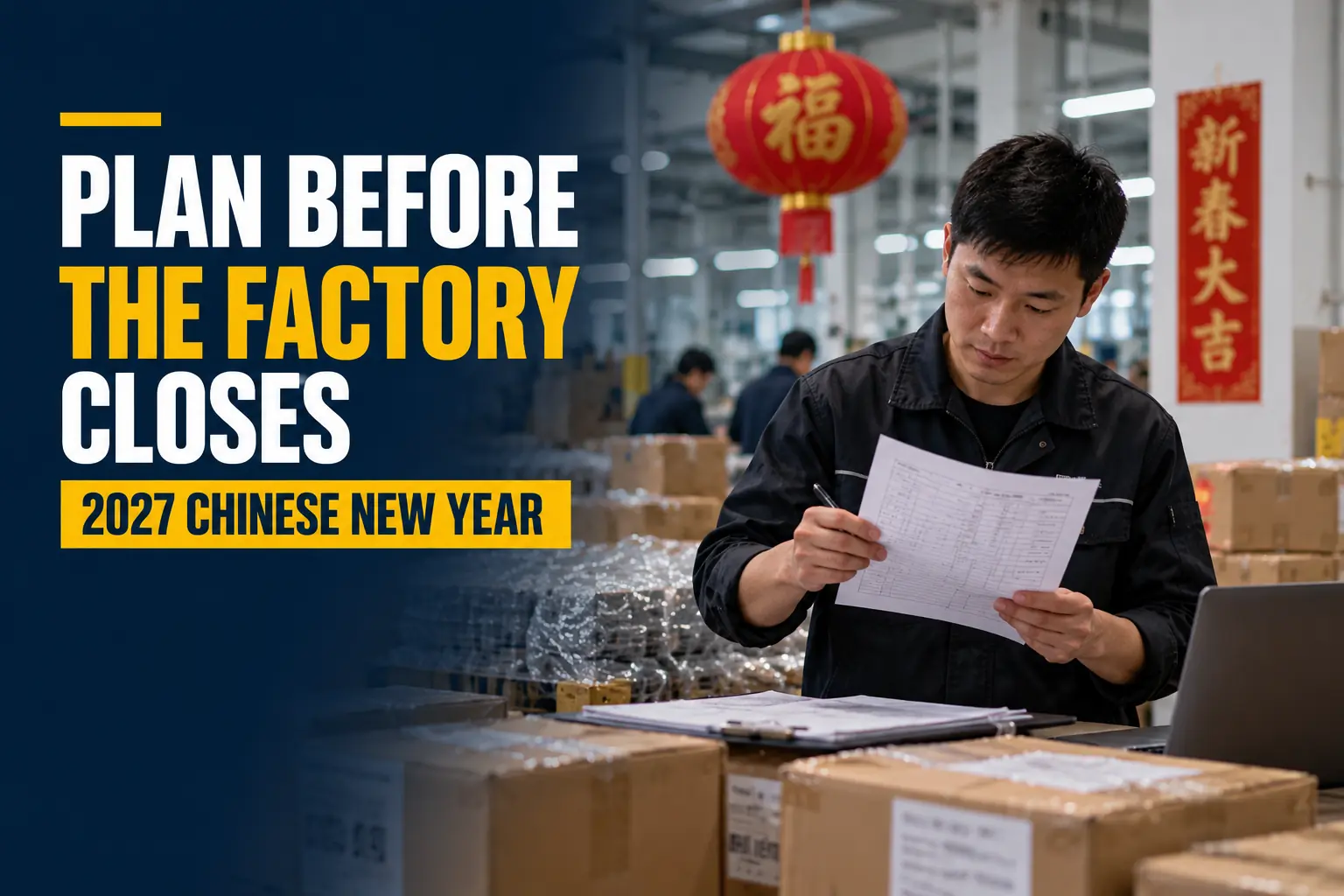
For Chinese New Year 2027 imports, the key date is not just the holiday itself. It is the date each factory stops accepting realistic production commitments. Chinese New Year falls on Saturday 6 February 2027, but shutdowns and restart dates vary by supplier.
Plan backwards from the date your stock must arrive. Confirm each factory’s shutdown, production queue, inspection window and freight handover dates. A generic holiday calendar cannot tell you whether your order will leave China on time.
Chinese New Year 2027 dates are only the starting point
Under China’s current national holiday rules, Spring Festival has four statutory public-holiday days. They cover Lunar New Year’s Eve and the first three days of the new lunar year. Adjusted working days can create a longer national break.
However, statutory holidays do not equal factory shutdown dates. A factory may slow earlier as workers travel home. Suppliers can also reopen on different dates, then take time to return to normal output.
For 2027, Lunar New Year’s Eve falls on Friday 5 February. Chinese New Year begins on Saturday 6 February. Treat these as calendar anchors, not universal factory deadlines.
Planning Chinese New Year 2027 imports starts with each factory
Ask every supplier for its own schedule. Do not rely on a general statement that “China closes for Chinese New Year”. One supplier may still be producing while another has already stopped.
At a minimum, confirm:
- last date the factory will accept new orders before the holiday
- final date for approving samples, artwork and packaging
- planned factory shutdown date
- last realistic cargo-ready date before shutdown
- when production staff expect to return
- when normal production capacity should resume
- final workable date for inspection and rework
- whether key material suppliers have different shutdown dates
Get these dates in writing and update them as the holiday approaches. In practice, plans can change as order volumes rise or upstream suppliers close.
Do not assume your normal production lead time still applies
A supplier that normally quotes 30 days may not have 30 days of usable capacity left. Its lines could already be committed to other buyers. Material suppliers may have their own queues too.
Pre-holiday capacity is not always first-come, first-served. Factories may prioritise larger, higher-volume or long-standing customers when production lines fill. Smaller buyers can therefore lose their preferred slot even when the quoted lead time looks workable.
A confirmed production slot matters more than a generic lead-time promise. Ask when your order enters production, not only when the factory expects to finish it.
Build the reorder plan backwards from your stock requirement
Start with the date you need saleable stock in New Zealand. Then work backwards through destination clearance, freight, inspection, production and sample approval.
Your plan should have five separate milestones:
- Stock-required date: when the goods need to be available for sale or distribution.
- Freight handover date: when the forwarder needs the cargo and final documents.
- Inspection release date: when the order must pass inspection or complete agreed rework.
- Production completion date: when the factory must finish and pack the order.
- Production start date: when materials, approvals and line capacity must be ready.
A practical October-to-February planning cycle
Late October and November: forecast demand and reserve capacity
Review stock on hand, expected sales and open purchase orders. Decide which products cannot wait until after the holiday cycle.
Next, ask each supplier for its expected shutdown and restart plan. If you expect a reorder, discuss it early enough for the factory to reserve capacity and materials.
Also finalise specifications. A late product change can reset sampling, material purchasing or packaging approval.
November and December: approve samples and place critical orders
Do not place a bulk order against an unresolved sample. Once you approve the correct version, keep a clear record of the specification the factory must reproduce.
Our guide to product samples from China explains why sample approval should happen before bulk production. That matters even more before Chinese New Year because recovery time is limited.
January: monitor production instead of waiting for the finish date
By January, important pre-holiday orders should have clear production milestones. Check material readiness, production start, work-in-progress status, packing progress and the expected inspection date.
A weekly “everything is on schedule” message is not enough. Ask for evidence that matches the claimed production stage. The goal is to find slippage while there is still time to act.
Our guide to production monitoring in China covers practical checkpoints buyers can use to keep orders moving.
Before shutdown: leave room for inspection and rework
Do not schedule inspection for the final afternoon before the factory closes. If the order fails, the factory needs time to sort defects, rework goods and present them again.
Confirm final carton dimensions and gross weights before freight booking. Once packing is final, the freight volume calculator can help you check shipment volume.
Freight needs its own Chinese New Year milestone
Production completion does not mean the shipment has left China. The factory still needs to release the cargo, provide documents and hand the goods to the forwarder.
Before the holiday rush, confirm the forwarder’s cargo cut-off and latest workable handover date. Sea freight depends on the actual sailing and consolidation schedule.
Leave a buffer between inspection release and freight handover. Otherwise, one day of rework can become a much longer delay after a missed departure.
What New Zealand importers should prepare before the factory closes
Chinese New Year affects production in China, but New Zealand import requirements still apply when the cargo arrives. Prepare the compliance and document side before supplier staff leave.
The New Zealand Customs Service states that all imported items must clear Customs. For commercial imports worth more than NZ$1,000, Customs says importers generally need a client code and supplier code.
Importers can also lodge documents before the goods arrive. Check the current Customs import-entry requirements before shipment rather than waiting for cargo to reach New Zealand.
MPI requirements may apply as well. Importers must check whether their products fall under an import health standard or other biosecurity controls. MPI states that sea containers arriving in New Zealand must go to a transitional facility for unpacking.
Review the current MPI importing process for your product. For wooden pallets, crates or dunnage, also check MPI’s rules for wood packaging and ISPM 15 material.
These checks matter before Chinese New Year because missing supplier documents can become harder to fix during shutdown. Request the commercial invoice, packing list and any required product or treatment documents before relevant staff leave.
Plan for the restart, not just the shutdown
Many importers focus on getting goods out before Chinese New Year. The post-holiday restart also needs planning.
A factory reopening does not guarantee that every worker, component supplier and production line is ready on day one. Ask when your specific order can restart and when normal capacity should return.
If you plan to order after the holiday, confirm whether the factory can hold materials in advance. Also check whether pricing, component availability or minimum order requirements need reconfirmation.
Use milestones, not hope, for Chinese New Year orders
The strongest plan starts with the stock requirement, then works backwards through freight, inspection and production. Most importantly, it uses the real schedule of each factory.
Need closer follow-up on a critical pre-holiday order? Let’s talk about China Production Monitoring and the milestones your supplier needs to meet.