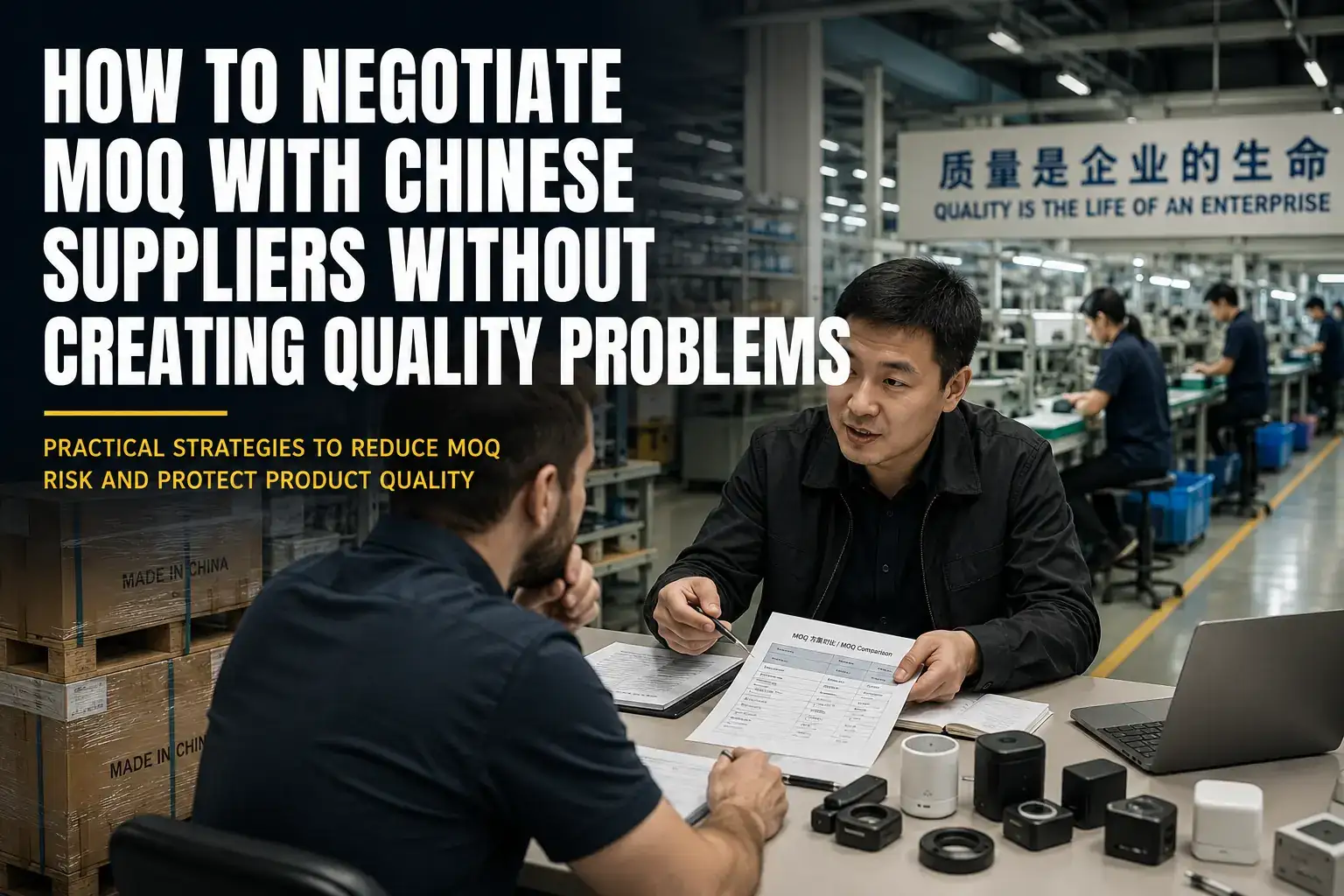
Learning how to negotiate MOQ with Chinese suppliers can reduce the money tied up in an initial order. However, a lower minimum order quantity is only a good result when the supplier keeps the approved materials, components, workmanship, packaging and quality-control standards unchanged.
A supplier can make a smaller order workable by charging more per unit, reducing the number of variations or fitting the order into a compatible production run. Those can be reasonable compromises. Quietly substituting cheaper materials or reducing quality checks is not.
How to negotiate MOQ with Chinese suppliers without lowering quality
When buyers push hard for both a lower quantity and the lowest possible price, the supplier has less room to recover its setup and production costs. Some suppliers will refuse. Others may agree, then recover their margin through changes that are difficult to see from a quotation.
These changes can include thinner materials, cheaper internal components, mixed raw-material batches, weaker cartons or less time spent checking the finished goods.
Therefore, the goal is not simply to make the MOQ number smaller. The goal is to reduce the order quantity while keeping the product specification and inspection standard intact.
Negotiate quantity before pushing down the price
Start by negotiating the order quantity. Once the supplier confirms a workable quantity, ask them to quote that quantity using the same specification as the approved sample.
Do not ask for a major MOQ reduction and the supplier’s absolute lowest price in the same message. This creates pressure at both ends of the deal. It also increases the risk that the supplier will make the product cheaper rather than make the production process more efficient.
A higher unit price for a smaller first order can be commercially sensible. Compare the additional unit cost with the risk of holding too much unproven stock, discounting slow-moving products or discovering a problem across a much larger batch.
Ask for separate quotations for:
- Your preferred trial quantity
- An intermediate quantity
- The supplier’s standard MOQ
Require all three quotations to use the same materials, components, accessories, packaging and workmanship requirements. Prestige Sourcing’s China supplier negotiation and quote review service can help compare these details before you approve an order.
Do not let the specification become vague
A supplier may agree to the lower quantity while making the product description less specific. For example, a named component can become an “equivalent component”, or a defined material can become “factory standard material”.
Those changes create room for the supplier to choose whichever option is cheapest or easiest during production.
Your written order information should confirm:
- Product dimensions and weight
- Material type, grade and thickness
- Named components or an agreed bill of materials
- Colour, coating and surface finish
- Functions and performance requirements
- Included accessories and spare parts
- Logo, labels and instruction requirements
- Retail packaging and export-carton specifications
- The approved sample or reference version
- Inspection requirements and defect limits
Where the product is being developed or modified, use an organised sample process before bulk production. Prestige Sourcing’s product development and sample coordination support can help record product details, sample changes and final supplier instructions.
Use an approved sample as the production reference
A sample gives the supplier a physical production reference. However, the supplier must know exactly which sample has been approved.
Keep clear photos, measurements, specifications and identifying details. If several sample versions were produced, label them so the factory cannot confuse an earlier version with the final approved version.
Also confirm whether the bulk order will use the same production method, materials and components as the sample. Some suppliers produce an excellent sample using extra care, then treat bulk production differently.
The approved sample should not replace a written specification. Use both. The sample shows the intended result, while the written specification records the details that need to be repeated.
Watch for cheaper material and component substitutions
Material substitution is one of the main quality risks when a supplier agrees to a lower MOQ or price. A replacement can look similar but perform differently after regular use.
Examples include:
- Thinner plastic or metal
- Lower-density foam
- Cheaper fabric or stitching thread
- Weaker adhesives
- Lower-grade electrical components
- Reduced coating thickness
- Less protective inner packaging
- Cheaper accessories or fittings
Require written approval before the supplier changes any material, component, process or subcontractor. The supplier should not treat a lower order quantity as permission to change the product.
For electrical goods, children’s products, food-contact materials, safety equipment and other regulated products, a substitution can also affect testing or compliance. Confirm the destination-market requirements with the relevant authority, laboratory or compliance specialist before production.
Be careful with leftover and mixed-batch materials
A factory may use leftover materials to make a small run commercially workable. This is not always a problem. However, it becomes risky when the materials come from different batches or do not match the approved specification.
Mixed batches can create differences in colour, texture, hardness, dimensions or finish. The variation may be obvious across the order, even when each item appears acceptable on its own.
Ask whether the reduced order will use new materials, existing stock or leftover materials. If existing stock will be used, require the supplier to confirm that it meets the agreed specification and is consistent across the production batch.
Do not accept undeclared subcontracting
Small production runs can be inconvenient for a busy factory. As a result, the supplier may pass the order to a smaller workshop or subcontractor without telling the buyer.
This creates several risks:
- The subcontractor may not have the same equipment.
- Workers may follow different production methods.
- The supplier may have less control over materials.
- Your approved sample may not reach the actual production site.
- The factory you assessed may not produce your goods.
Your order terms should require approval before production is moved to another site. For orders where factory capability matters, consider verifying the supplier before payment. The guide on how to check a Chinese supplier before paying covers supplier identity, factory claims and common warning signs.
Keep packaging quality in the negotiation
Suppliers can reduce packaging quality because it is easier to change than the product itself. A thinner carton, less foam or fewer protective inserts can reduce costs without affecting how the product looks in a factory photo.
However, weak packaging can lead to crushed retail boxes, scratched products, broken components and unsellable stock after international freight and local delivery.
Confirm the retail packaging, inner protection and export cartons as part of the product specification. Do not leave packaging decisions until the order is almost finished.
For more detail, read the guide to export-quality cartons for shipping from China.
Monitor the order before final inspection
A pre-shipment inspection is important, but it takes place near the end of the order. By then, widespread production problems can be expensive and slow to correct.
For higher-risk or technically detailed orders, use production follow-up to confirm that the factory has started, the agreed materials are available and key milestones are being met.
Prestige Sourcing’s China production monitoring and order follow-up can help track supplier progress, deadlines and shipment readiness while the order is underway.
This does not replace a final inspection. It gives the buyer an earlier opportunity to identify delays, specification confusion or supplier changes.
Inspect the order before paying the balance
After you negotiate MOQ with Chinese suppliers, the inspection standard should remain unchanged. A smaller order can still contain incorrect components, widespread defects, inconsistent finishes or poor packaging.
A common payment structure is a 30% deposit, followed by the 70% balance after the pre-shipment inspection has passed and before the goods are released for shipment. The final structure depends on the supplier, order and agreed commercial terms. Avoid paying the full balance while important quality problems remain unresolved.
A pre-shipment inspection can check:
- Order quantity
- Visible defects and workmanship
- Product dimensions and appearance
- Basic functions where practical
- Components and accessories
- Labels, barcodes and instructions
- Retail packaging and export cartons
- Whether the goods match the approved sample
Prestige Sourcing can arrange China quality control and product inspections before the balance is paid or the goods leave the supplier.
MOQ negotiation warning signs
Take extra care when:
- The supplier accepts a major MOQ reduction immediately without explaining how.
- The price falls while the product specification becomes less detailed.
- The supplier refuses to identify important materials or components.
- The approved sample cannot be used as the production reference.
- The supplier says inspection is unnecessary because the order is small.
- The goods will be produced at a different location without a clear explanation.
- The supplier asks for full payment before the goods can be checked.
- Materials or packaging change after the deposit is paid.
A fast agreement is not automatically a good agreement. Ask what will change, what will stay the same and how the supplier will control quality across the reduced production run.
A practical MOQ quality-control message
“We would like to reduce the first order from 1,000 units to 400 units. Please quote this quantity using the same materials, components, workmanship, accessories and packaging as the approved sample.
Please confirm that no materials, components, processes or production locations will change without our written approval.
The bulk order must match the approved sample and written specification. The order will be inspected before the balance is paid and before shipment.”
Replace the example quantities with your actual numbers. The important point is to connect the MOQ agreement directly to the approved product and inspection requirements.
Lower the quantity, not the quality standard
The safest way to negotiate MOQ with Chinese suppliers is to separate the order quantity from the quality standard. You can accept a higher unit price, simpler production planning or a longer agreed lead time. You should not accept weaker materials, vague components, undeclared subcontracting or reduced inspection.
Prestige Sourcing are based in Shenzhen and can represent buyers on the ground in China, communicate with suppliers, review quotations, coordinate samples, monitor production and arrange inspections. Contact us before you accept a reduced MOQ or pay a supplier deposit.