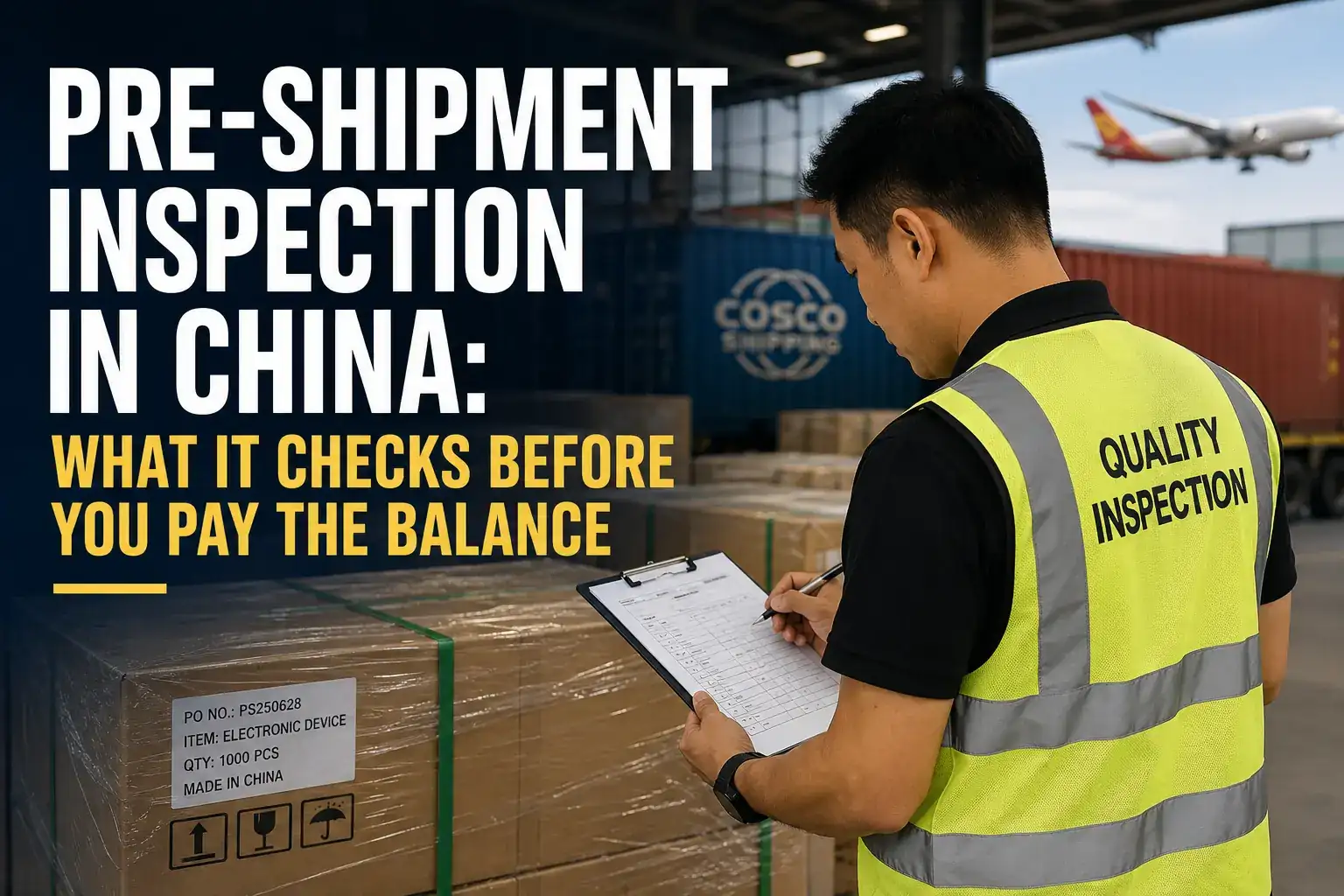
A pre-shipment inspection in China checks the finished order before you pay the supplier balance and approve the goods for shipping. It shows you what the factory has actually produced, packed and prepared for collection.
Prestige Sourcing recommends a 30/70 payment structure for many China orders. Pay a 30% deposit to begin production, then release the remaining 70% before shipment only after the inspection has passed and the supplier has resolved any material problems.
An inspection cannot remove every risk. However, it can identify wrong quantities, visible defects, missing accessories, poor packaging and specification problems while the supplier can still correct them.
Why a pre-shipment inspection in China matters
Supplier photos and messages do not prove that the full order meets your requirements. A factory may show a few good units while other cartons contain defective products, missing parts or the wrong variations.
Once you pay the full balance, your position becomes weaker. In addition, repairs and replacements become harder after the cargo enters freight. Returning defective stock to China will also cost time and money.
A pre-shipment inspection helps you decide whether to:
- Approve the order and release the final payment.
- Ask the supplier to repair or replace defective goods.
- Request missing products, parts or accessories.
- Correct labels, retail packaging or carton markings.
- Arrange another inspection after the supplier completes the work.
- Hold payment while the supplier resolves a serious problem.
Use the 30/70 payment structure with inspection
For many manufactured orders, Prestige Sourcing recommends paying a 30% deposit and retaining the remaining 70% until the finished goods pass a pre-shipment inspection.
The deposit gives the supplier funds to buy materials and begin production. Meanwhile, the unpaid balance gives the buyer leverage if the finished order does not match the agreed requirements.
Do not release the final 70% simply because the supplier says production is complete. Instead, review the inspection report, photos and test results first.
If the inspector finds important defects, missing goods or packaging problems, require the supplier to complete the agreed corrections before payment. Where the problems are serious or difficult to confirm remotely, arrange a reinspection.
The exact payment terms will depend on the supplier, product, order value and commercial agreement. However, buyers should avoid paying 100% before production or releasing the full balance without evidence that the finished goods meet the order requirements.
When should you arrange the inspection?
Arrange the inspection after the factory completes the bulk order and packs enough units for the inspector to review the packaging. However, complete it before you pay the remaining balance or allow the supplier to release the cargo.
Do not schedule the inspection on the planned collection date. Instead, leave enough time for sorting, repairs, replacements, repacking or corrected labels.
For new, custom or delayed orders, China production monitoring can help confirm whether the factory is approaching completion before you book the inspector.
What does a pre-shipment inspection check?
The inspection scope depends on the product and your written instructions. A request to “check the quality” does not give the inspector enough detail.
Therefore, provide the purchase order, approved specifications, sample photos, packaging requirements and test instructions. The inspector can then compare the finished order against clear requirements.
Product quantity and assortment
First, the inspector checks the finished quantity and carton count against the purchase order and packing information. The inspector can also review the mix of colours, models, sizes or SKUs.
For example, the total quantity might be correct while the colour breakdown is wrong. Likewise, the supplier may have packed too many units of one size and too few of another.
Appearance and workmanship
Next, the inspector selects products from different cartons and checks them for visible defects. Common problems include:
- Scratches, dents, stains or surface marks.
- Loose threads, poor stitching or uneven seams.
- Colour differences between units.
- Weak assembly or loose components.
- Rough edges or poor finishing.
- Incorrect logo placement or uneven printing.
- Cracked, bent or damaged parts.
However, not every defect carries the same risk. A small mark on an export carton matters less than a fault that affects function, safety or the product’s saleable appearance.
Product specifications
The inspector compares selected units with the approved sample, reference photos and confirmed specifications. Depending on the product, the checks can cover dimensions, weight, colour, materials, finish, components, printing and logo position.
Document these requirements before production begins. Otherwise, the inspector cannot enforce a detail that you never confirmed with the supplier.
Basic function tests
For suitable products, the inspector can perform simple function checks. For example, the inspector might switch a unit on, assemble it, connect it to power or test an agreed feature.
Give the inspector clear test steps and the expected result. As a result, the report can show whether the product passed a defined test rather than simply stating that someone tested it.
However, a normal factory inspection does not replace laboratory testing. Electrical safety, chemical content, load performance, waterproofing and durability can require specialist equipment and formal testing.
Accessories and included parts
The inspector should also confirm that the supplier included the required accessories and components. These may include:
- Cables and power adaptors.
- Screws, brackets and mounting parts.
- Manuals and instruction sheets.
- Chargers and batteries.
- Spare components.
- Retail inserts and promotional materials.
A missing low-cost part can make the main product difficult or impossible to use. Therefore, accessory checks should form part of the written inspection brief.
Retail packaging and export cartons
Good products still need suitable packaging. The inspector should review both the retail packaging and the outer export cartons.
Packaging checks can include:
- Protective bags, foam, inserts and dividers.
- Product placement inside the retail box.
- Retail box condition and print quality.
- Barcode, SKU and product labels.
- Warning labels and instructions.
- Carton strength, sealing and condition.
- Carton markings and product identification.
- Packing consistency between cartons.
In particular, private label products need careful packaging checks. Incorrect barcodes, spelling errors or poor print quality can make completed stock difficult to sell.
For more detail on outer packaging, see our guide to export-quality cartons for shipping from China.
Carton measurements and shipment details
The inspector can record carton dimensions, weights and quantities. These details can then be compared with the supplier’s packing list.
This step matters because carton size and weight affect freight charges. In addition, incorrect shipment details can create problems when the freight provider books space or prepares shipping documents.
You can also use the freight volume calculator to estimate the cubic volume of cartons before requesting a freight quote.
Does the inspector check every product?
Most pre-shipment inspections check a sample rather than every unit. The inspector should select products from different cartons and different parts of the finished stock.
The supplier should not choose all the samples. Otherwise, the factory could present only its best products.
For higher-risk orders, you can request a larger sample or a full-unit inspection. Even so, a full visual check cannot reveal every hidden defect or replace formal product testing.
What information should you send the inspector?
A clear inspection brief produces a more useful report. Therefore, send:
- The purchase order and total quantity.
- The final product specifications.
- Approved sample photos or reference details.
- The colour, size, model and SKU breakdown.
- Packaging artwork and carton requirements.
- Barcode, label and shipping mark files.
- A list of accessories and included parts.
- Clear function tests and expected results.
- Photos of known defects or previous problems.
- Any quality rules agreed with the supplier.
Also explain which issues matter most. For example, a cosmetic mark may be minor for an industrial component but serious for a premium retail product.
What does an inspection not cover?
A pre-shipment inspection checks the finished order. It does not confirm that the supplier is legitimate, financially stable or capable of producing future orders.
Use China supplier verification before paying a deposit when you need to check the company behind the quotation.
For a wider supplier risk check, read how to check a Chinese supplier before paying.
An inspection also does not confirm compliance with every safety standard, import requirement, labelling rule or marketplace policy. Therefore, confirm the relevant requirements before production with the appropriate authority, laboratory, customs broker, lawyer or compliance adviser.
What should you do when the inspection finds problems?
Do not rely only on a “pass” or “fail” result. Instead, read the defect details, photos, sample size and test results.
- Separate safety and function problems from cosmetic and packaging issues.
- Confirm how many inspected units showed each defect.
- Ask the supplier for a written correction plan and completion date.
- Request repairs, replacements, sorting or repacking where needed.
- Ask for clear evidence after the supplier completes the work.
- Arrange another inspection when remote evidence is not enough.
- Release the final 70% only after the supplier meets the agreed requirements.
Some suppliers may offer a discount or promise compensation on the next order. However, that does not fix defective or unsaleable goods in the current shipment.
Final checks before paying the remaining 70%
- The report covers the correct supplier and purchase order.
- The factory completed the order before inspection.
- The quantities and product variations match the order.
- You understand the defects and function test results.
- The inspector checked accessories, labels and packaging.
- The carton count matches the packing information.
- The supplier completed and proved all required corrections.
- The inspection passed before you released the remaining balance.
- The supplier has not released the goods before your approval.
Arrange a pre-shipment inspection in China
Prestige Sourcing can help prepare the inspection scope, communicate with the supplier, coordinate the inspection and review the findings before you release the final balance.
We can also connect the inspection with China quality control, supplier verification, packaging checks and production monitoring. As a result, you can address problems before the goods leave China rather than after they arrive.
Let’s Talk before you pay the supplier balance or approve the shipment.