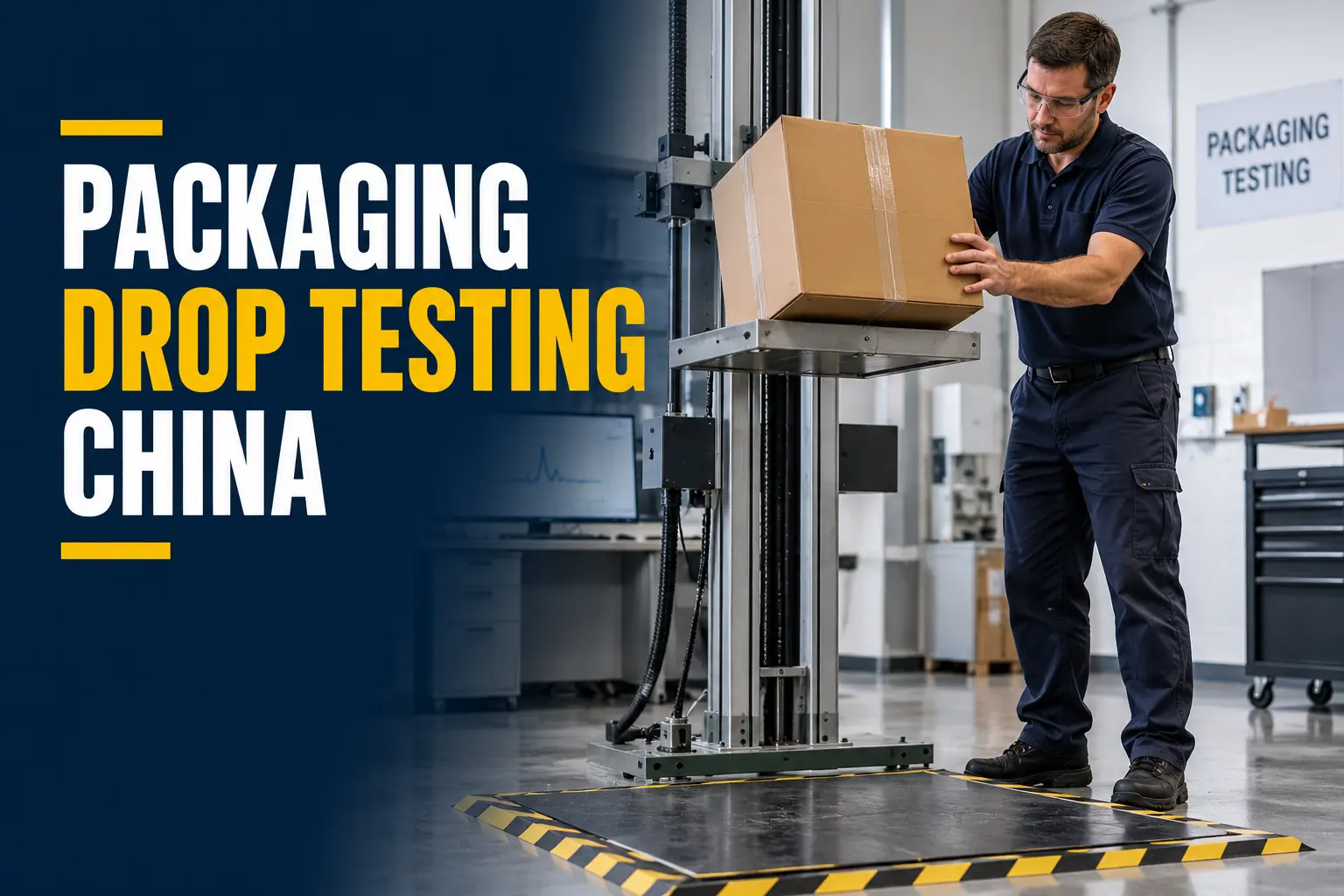
Packaging drop testing China: the right test depends on the journey your packed goods will take, not a drop height chosen by the factory. A single drop test checks impact. It cannot assess every risk from warehouse handling, road transport, sea freight or final courier delivery. Before booking a test, map the route and agree what counts as a pass.
For importers, the key decision is whether you need an early packaging check or a broader transport simulation. Ask a packaging laboratory to recommend the procedure once it knows the shipment, product and final delivery method.
Packaging drop testing China: start with the route
Write down each stage between the factory and the final receiver. Include the handling that happens before international departure and after arrival, not just the ocean or air leg.
- Factory to warehouse: Will the supplier deliver loose cartons or a wrapped pallet?
- China-side handling: Will a consolidation warehouse unload, count, repack or palletise the cartons?
- International freight: Will the goods move by air, courier, LCL sea freight or a full container?
- Destination handling: Will a warehouse receive an intact pallet or unload individual cartons?
- Final delivery: Will a courier take individual parcels to customers, or will a truck deliver a complete pallet?
Mark every point where someone changes the load configuration. For example, a pallet may travel securely through international freight, then break down into individual parcels at a third-party warehouse. The final parcels face hazards that the original pallet does not.
Give this route summary to the laboratory. If you have not selected the final delivery service, explain the options rather than pretending the route is fixed.
Choose a test for the handling system
ISTA procedures cover different distribution systems. ASTM methods offer other ways to assess packaging performance. Neither organisation provides one universal test that suits every shipment from China.
Individual parcels and courier delivery
ISTA 3A is a general simulation procedure for eligible individual parcels moving through parcel delivery systems. It can be relevant when customers receive individual packed products by courier.
However, do not assume it covers an entire China-to-NZ or China-to-Australia journey. The parcel’s weight, dimensions, handling route and any carrier requirements all affect the choice. A laboratory should confirm whether 3A fits the job.
If a retailer or courier specifies its own test procedure, send that requirement to the laboratory. Passing another test does not automatically meet the buyer’s conditions.
Loose cartons in mixed freight
Mixed loads can pass through several warehouses and freight terminals. Staff may handle cartons separately during consolidation, loading, unloading and delivery.
ISTA 3B addresses less-than-truckload road freight, known as LTL. It does not automatically apply to ocean LCL shipments. LCL means less than container load, and that describes a different freight arrangement.
For an LCL shipment, tell the laboratory about the sea movement, any truck legs, consolidation handling and the destination receiving process. It can then recommend the appropriate test sequence instead of treating LTL and LCL as interchangeable.
Palletised or unitised freight
If cartons remain together as a palletised load, individual parcel drops may not represent the main hazards. Compression, vibration, load stability and mechanical handling may be more relevant.
ISTA 3E specifically addresses unitised loads of similar packaged products travelling through full-truckload distribution. It is not a default standard for every pallet or ocean container.
Ask the laboratory to assess both the pallet and the individual cartons if the receiver will break down the load for onward delivery.
Early screening versus fuller simulation
ISTA 1-Series procedures are useful for early integrity screening. They challenge the package and product combination but do not simulate the complete delivery route.
ASTM D5276 is a free-fall drop test method for loaded packages such as boxes, bags and sacks. It helps assess impact performance or compare package designs. It does not, by itself, simulate vibration, stacking and every other distribution hazard.
ASTM D4169 offers a broader framework for performance testing against a sequence of distribution hazards. A laboratory should choose the appropriate distribution cycle and test levels for the actual shipment.
Use these standards as a shortlist for discussion, not as a menu where you select the cheapest familiar name.
Decide what the test must prove
Before requesting a quotation, agree the purpose. Are you comparing two cushioning designs, checking whether a finished pack survives courier distribution, or meeting a retailer’s written requirement?
A basic screening check may answer a packaging development question. However, a customer requirement may call for a particular procedure, laboratory or reporting format. Confirm that requirement before your supplier sends samples anywhere.
Do not ask only for a “one metre drop test”. That instruction leaves out the drop orientations, test sequence, packaged weight and acceptance criteria. Let the laboratory select the conditions required by the agreed method.
Write the pass criteria before testing
A report that says “PASS” is only useful when you know the agreed limits. ISTA guidance calls for product damage tolerances and packaging degradation allowances before a test starts.
Separate the product condition from the packaging condition. The outer shipping carton may show marks without the goods failing. A retail box that customers see may need a stricter appearance standard.
- Product: Specify unacceptable cracks, dents, leaks, breakages or movement.
- Function: List the checks the product must pass after testing, such as operating a switch or fitting an assembled part.
- Retail packaging: State whether creases, torn artwork, crushed corners or broken seals are acceptable.
- Shipping packaging: Define acceptable scuffing, deformation and closure condition.
- Contents: Confirm that accessories, inserts and loose parts must remain in their intended places.
Make these limits specific to your product and customer. A laboratory can record the outcome, but the importer and customer need to agree what constitutes unacceptable damage.
Test the same pack the factory will actually ship
The laboratory needs a representative packed product. A carefully prepared sample proves little if the production team later uses different cushioning or a different packing quantity.
Confirm that the sample reflects the intended production arrangement:
- Finished product, accessories and retail packaging.
- Correct inserts, dividers, void fill and protective material.
- Actual units per export carton.
- Agreed carton dimensions and packed weight.
- Production tape, closures, straps and seals.
- Pallet wrap and unitisation, if the test covers a pallet.
Photograph and identify the packaging revision before dispatch to the laboratory. Make sure the sample arrives without accidental damage from its journey to the test site. ISTA also advises against using samples that have already undergone testing.
Once you approve a packaging version, keep a clear reference for production. The same revision discipline applies to the product itself, as explained in our guide to product samples from China.
Send the laboratory a brief it can quote properly
Give the laboratory enough information to choose the procedure and quote the correct scope. An unclear request can lead to the wrong test or a result that your customer will not accept.
- Product description and any fragile components.
- Packed dimensions, gross weight and units per carton.
- Photos or drawings of the complete packing arrangement.
- Planned route, transport modes and handling points.
- Whether goods travel loose, palletised or both.
- Any retailer, marketplace or carrier test instructions.
- Written product and packaging pass criteria.
- Required report format and whether independent or certified testing evidence is necessary.
Ask the laboratory to confirm the exact method, edition, test sequence, levels, sample quantity and total scope before you authorise the work. Also ask what changes would require a new test.
Check the report before releasing production goods
Match the laboratory report to the sample you approved. A passing result for an earlier packaging revision should not be used as evidence for a changed production pack.
Check the report for the product identification, sample configuration, packed dimensions and weight, test procedure, test conditions, observations and pass or fail outcome. Ask for before-and-after photographs where they help explain damage.
Read any deviations or exclusions. If the laboratory skipped a stage, changed a test level or could not complete the specified procedure, clarify what the result actually demonstrates.
A laboratory report is not automatically the same thing as formal ISTA certification. Where a customer requires certification, confirm the relevant programme and laboratory status before testing.
What to do if the packaging fails
Do not immediately instruct the supplier to use thicker cardboard. First, identify what failed and when. Did the product move inside the pack, did a closure open, or did cushioning fail at an edge?
Ask the laboratory and supplier to record the damage and identify a corrective action. Changes could involve internal support, cushioning, pack fit or the sealing method. Keep the failed version separate from the revised one.
After a relevant change to the product, packaging or packing process, arrange retesting under the applicable procedure. ISTA’s guidance calls for retesting when those elements change. Do not rely on a previous pass for a materially different pack.
Finally, confirm the factory uses the approved arrangement during the actual production run. A laboratory result is useful only when the dispatched goods match what the laboratory evaluated.
Factory checks, laboratory testing and China quality control
If a factory performs an informal drop check, treat it as an early warning tool. Without a defined method, recorded conditions and agreed pass criteria, it is not a substitute for a formal test report.
An independent packaging laboratory should select and conduct the formal test where your customer or specification requires one. Separately, someone must check that production packaging matches the tested version and follow up when the supplier changes it.
Prestige Sourcing’s China quality control service covers packaging checks, supplier communication and issue follow-up before goods leave China. It can help connect approved packaging requirements with production checks, without treating a visual inspection as laboratory testing.
If independent laboratory testing is necessary, we can also look into suitable testing options based on your requirements. Send us the product details, supplier location, packaging specification and intended shipping route. We can review which China-side checks are practical before dispatch.