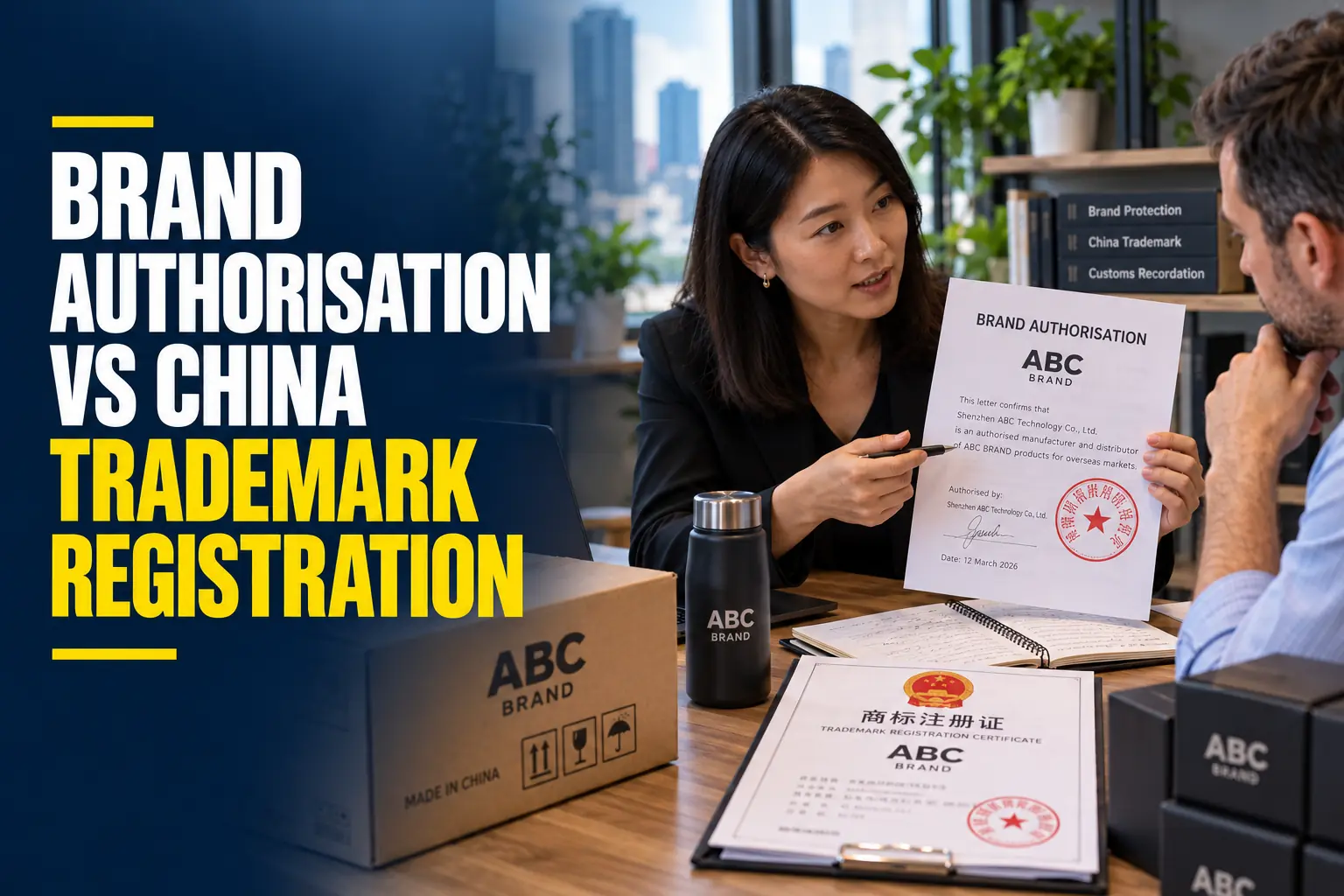
Brand authorisation vs China trademark registration can become confusing once a factory starts asking whose logo it should print. The same problem appears when a freight company, marketplace or Customs authority asks for evidence relating to a brand.
However, these documents do not all prove the same thing. Permission to use a brand is different from owning trademark rights. Customs recordation is another separate step again.
Before production starts, identify who owns the brand and where you plan to sell the goods. That usually tells you which issue you actually need to solve.
Brand authorisation vs China trademark registration: what is the difference?
At a basic level, brand authorisation deals with permission. Trademark registration deals with legal rights in a particular jurisdiction.
Customs recordation serves a different purpose. It can help a rights holder use Customs procedures to protect intellectual property at the Chinese border.
| Issue | What it helps establish | What it does not automatically establish |
|---|---|---|
| Brand authorisation | The brand owner permits another party to use its brand within an agreed scope | Ownership of the trademark |
| China trademark registration | Trademark rights in China for the registered mark and relevant goods or services | Trademark rights in New Zealand, Australia or every other market |
| China Customs recordation | Information that helps China Customs identify and protect recorded intellectual property rights | Trademark ownership by itself |
In practice, a business may need one, two or all three. Another importer may need none of them for a particular shipment.
Start with one question: whose brand is it?
The fastest way to understand the paperwork is to start with brand ownership. Most sourcing projects fall into one of four situations.
Scenario 1: it is your own brand
You may have created the name, logo and packaging yourself. A Chinese factory then manufactures products carrying that branding.
In this situation, the bigger question usually concerns trademark protection rather than permission from another brand owner. China generally operates on a first-to-file principle, so timing can matter when you plan to build a brand around Chinese manufacturing.
A registration in New Zealand or Australia does not automatically create equivalent rights in China. Likewise, a China trademark registration does not automatically protect your brand in your destination markets.
If China forms an important part of your supply chain, consider trademark strategy before committing heavily to packaging, tooling and inventory. Prestige Sourcing can assist businesses through our China Trademark Registration Support service.
Scenario 2: you are using somebody else’s brand
You might be an authorised distributor, licensee or importer for an established brand. In that case, registration and authorisation answer different questions.
The trademark may belong to the brand owner. Your paperwork should instead establish whether that owner permits your intended use.
For example, permission may need to cover manufacturing in China, export, distribution or the use of branded packaging. The exact scope depends on the commercial arrangement.
A generic email saying that you can “sell the products” may not answer every question. It may say nothing about manufacturing, appointing a Chinese factory or applying the logo to new goods.
Scenario 3: a Chinese supplier offers you third-party branded goods
This situation deserves much more scrutiny. A supplier may claim that it can provide genuine branded stock, authorised overruns or products from another brand’s supply chain.
Do not treat the supplier’s claim as proof. Instead, establish where the goods came from and why the supplier has the right to sell them.
An invoice from a Chinese trading company also does not prove that the brand owner authorised the transaction. The same applies to screenshots, marketplace listings and photographs of genuine-looking products.
Before paying a substantial deposit, verify the supplier and the commercial chain behind the goods. Our guide to supplier verification, factory audits and product inspections explains the different checks available.
Destination-country rules can create another issue. Some markets treat parallel imports differently, so genuine goods do not automatically mean unrestricted resale everywhere.
Scenario 4: you are buying a white-label product
White-label sourcing creates a different situation again. The factory already makes a generic product, and you apply your own branding to it.
Therefore, you are not asking for permission to use the factory’s brand. You are creating a branded version under your own name or logo.
This makes your trademark position more important, not less important. Before printing thousands of cartons, check whether your intended brand creates obvious conflicts in the markets that matter to you.
Ordering product samples from China first can also help you confirm the physical product before committing to branded packaging.
What should brand authorisation actually cover?
There is no universal authorisation letter that every shipment must carry. The right evidence depends on who owns the mark and why another party needs to use it.
Where written authorisation makes sense, it should clearly identify the commercial relationship. A vague letter can create more questions than it answers.
Useful details may include:
- the legal name of the trademark or brand owner;
- the company receiving permission;
- the brand or trademark covered;
- the products covered by the permission;
- the permitted countries or territories;
- whether manufacturing in China is allowed;
- whether a factory or other supplier can apply the branding;
- the period of authorisation; and
- an appropriate signature or company execution.
However, an authorisation letter cannot create rights that the issuing party does not own. It also cannot fix an unauthorised supply chain.
For larger projects, a proper licence, distribution agreement or manufacturing agreement may provide stronger evidence than a simple letter. The correct structure depends on the relationship.
What China trademark registration actually changes
A China trademark registration gives its owner registered rights in China within the scope of that registration. It does not simply prove that a logo exists.
For importers building their own brands, this distinction matters because production often starts long before the brand becomes large. Packaging, moulds, supplier relationships and sales may already depend on the name.
Waiting until a dispute appears can leave you with fewer options. Filing earlier lets you address the trademark question before more money depends on the brand.
That does not mean registration guarantees complete protection. Disputes can still arise, and the exact scope of protection depends on the mark and the goods or services covered.
Registration also does not automatically solve every manufacturing problem. You still need suitable supplier agreements, quality controls and control over packaging files, artwork and production assets.
Where China Customs recordation fits
China Customs operates a separate intellectual property recordation system. Rights holders can record information about protected intellectual property, authorised use and legitimate goods.
This can help Customs identify potentially infringing imports or exports. However, Customs recordation is not the same as trademark registration.
First, you establish the underlying intellectual property right. Recordation then gives Customs information relating to that right.
You also should not assume that every ordinary branded shipment requires Customs recordation. Businesses generally consider it as an enforcement tool when border protection matters to their intellectual property strategy.
The reverse is equally important. Holding a trademark registration does not mean Customs will automatically understand your supply chain, authorised manufacturers or legitimate exporters.
China trademark rights and destination-country rights are separate
Trademark rights are territorial. Therefore, China and your destination market need separate consideration.
A New Zealand business might own its trademark in New Zealand but have no equivalent registration in China. Another company might hold a China registration but have no registered rights in Australia.
International filing systems can make multi-country applications easier. However, each designated territory still applies its own trademark law when deciding protection.
For importers, this means you should think about two sides of the transaction:
- China: where the product is manufactured, branded and exported.
- Your sales markets: where you advertise, distribute and sell the finished goods.
A China trademark strategy therefore does not replace protection in your main sales markets. Instead, it addresses a separate part of the supply chain.
What if Customs or a freight company questions the brand?
Do not immediately assume that you need to register a new trademark or produce a generic authorisation letter. First, find out exactly what the other party wants to establish.
For example, they may want evidence that:
- you own the brand;
- the trademark owner authorised you to use it;
- the Chinese exporter may ship the branded goods;
- the factory may manufacture products carrying the mark; or
- the goods are genuine rather than counterfeit.
Those are different questions. Sending the wrong document can delay the discussion without solving the underlying issue.
Once you understand the concern, trace the ownership and permission chain from the trademark owner through to the factory, exporter and importer.
Do not let the factory decide your trademark strategy
A factory can tell you what it needs to manufacture your order. It should not decide whether your brand has adequate legal protection.
Some suppliers will print almost any logo a buyer provides. That willingness does not confirm that the buyer owns the mark.
Others may ask for authorisation before accepting branded production. That can be sensible, but their internal requirement is not the same as trademark registration.
In practice, importers should resolve ownership and permission questions before bulk production. Doing so also reduces the chance of discovering a problem after packaging has been printed.
A practical pre-production trademark checklist
Before approving branded production in China, work through the following questions.
- Who legally owns the brand or trademark?
- Are you using your own brand or somebody else’s?
- If it belongs to somebody else, what exactly have they authorised?
- Does the permission cover manufacturing in China?
- Can your chosen factory apply the branding?
- Which countries will receive or sell the goods?
- What trademark protection exists in China?
- What protection exists in your destination markets?
- Does the Chinese exporter have a clear connection to the authorised supply chain?
- Would China Customs recordation support your enforcement strategy?
Complete these checks before paying for large quantities of branded packaging. Changes become more expensive once factories start printing cartons, labels and product markings.
When should you discuss China trademark registration?
Not every importer needs a China trademark registration. However, the conversation becomes much more relevant when China plays an ongoing role in your branded supply chain.
You should consider it early when you are developing your own private-label brand, ordering repeated production or investing in custom packaging. The same applies when several Chinese suppliers work with the same brand assets.
It is also worth reviewing when your sales volumes start growing. At that point, the value tied to the name often becomes much greater than the first production order.
Prestige Sourcing can help businesses assess the China side of the process and coordinate China Trademark Registration Support. Starting the discussion before bulk production gives you more room to address problems before the brand becomes tied to stock, packaging and suppliers.
Frequently asked questions
Does every branded shipment from China need a brand authorisation letter?
No. There is no universal rule that every branded shipment must carry the same authorisation letter. The required evidence depends on brand ownership, the commercial arrangement and who is requesting proof.
Is brand authorisation the same as trademark ownership?
No. Authorisation gives another party permission within an agreed scope. It does not transfer trademark ownership unless a separate legal arrangement actually does so.
Does a China trademark registration protect my brand in New Zealand or Australia?
No. Trademark rights are territorial. China registration addresses China, while New Zealand, Australia and other markets require their own protection strategy.
Does China trademark registration guarantee that nobody can copy my brand?
No. Registration strengthens the rights holder’s legal position, but it does not prevent every infringement from occurring. Businesses still need to monitor and enforce their rights where necessary.
Is Customs recordation the same as registering a trademark in China?
No. China Customs recordation is a separate border-protection mechanism. It relies on an underlying intellectual property right rather than replacing registration.
Can I put my own brand on a white-label product without China trademark registration?
A factory may agree to print your brand without seeing a China trademark certificate. However, the ability to manufacture something does not answer who owns the trademark rights.
If you plan to build a lasting brand around Chinese production, review that position before committing heavily to stock and packaging.
Protect the brand before the order gets expensive
Brand authorisation, China trademark registration and Customs recordation solve different problems. Treating them as interchangeable can leave important gaps in your supply chain.
Start by confirming whose brand appears on the product. Then check where the goods will be manufactured, exported and sold.
If you are building your own brand around products made in China, it makes sense to address the China trademark question early. Prestige Sourcing offers China Trademark Registration Support for businesses that want help managing this part of their China sourcing strategy.