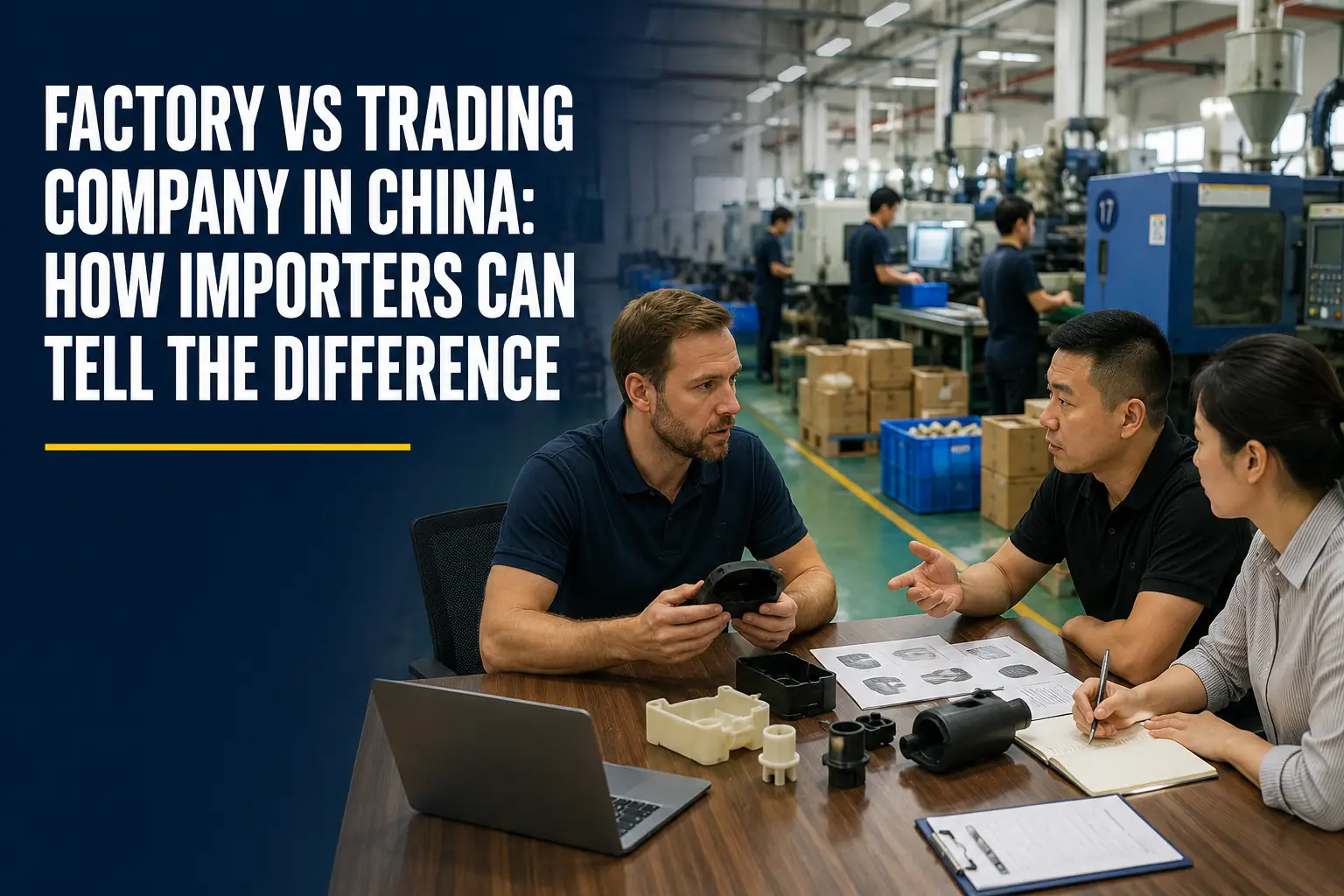
Comparing a factory vs trading company in China is not about deciding that every factory is reliable and every trader should be avoided. The real issue is understanding who will manufacture your goods, who controls production and who will be responsible when something goes wrong.
A factory may offer stronger technical access and production control. Meanwhile, a capable trading company may provide smaller order quantities, easier communication and access to several manufacturers. Either structure can work, provided the supplier is honest about its role and can deliver the required product.
Factory vs trading company in China: what is the difference?
A factory manufactures products at its own or controlled production premises. It may still outsource components, specialist processes, packaging or finishing work. However, it should understand the manufacturing process and be able to explain where each stage takes place.
A trading company purchases products from one or more factories and resells them to overseas buyers. Some trading companies specialise in a narrow category and have strong control over their manufacturers. Others are general resellers with limited technical knowledge or influence over production.
Hybrid structures are also common. A company may manufacture one product range while trading others. A factory may use a separate mainland export company or Hong Kong company to handle international sales and payments.
Therefore, do not judge the supplier from one label alone. Establish who is selling the goods, who is making them and how those businesses are connected.
Why the supplier structure matters
The choice between a factory vs trading company in China can affect pricing, minimum order quantities, technical communication, customisation and quality control.
A factory may be the better option when you need:
- Custom tooling, moulds or engineering work.
- Technical product changes.
- Stable repeat production.
- Direct access to production staff.
- Specific machinery or manufacturing processes.
- Closer production monitoring.
A trading company may be useful when you need:
- Several related products from different factories.
- Lower quantities than a large factory will accept.
- One contact to coordinate several suppliers.
- Better export communication and documentation.
- Access to factories that do not sell directly overseas.
- Consolidation of products from multiple manufacturers.
Neither supplier type removes the need for verification, samples, written specifications and product inspections.
Start with the registered Chinese company name
Ask for the supplier’s full registered Chinese company name and Unified Social Credit Code. These details are more useful than the English name shown on Alibaba, a website or an email signature.
For mainland Chinese companies, the controlling registered name is the Chinese-character name shown on the business licence. The English version used for overseas business is normally a translation, transliteration or trading style.
It does not need to match the Chinese name word-for-word. In fact, the same business may use slightly different English translations across its website, quotations and bank records.
Compare the underlying Chinese details across:
- The business licence.
- The Unified Social Credit Code.
- The Chinese company chop.
- The purchase agreement.
- The pro forma invoice.
- The payment instructions.
A payment beneficiary may appear in English, pinyin or an abbreviated bank format. The important question is which registered company owns the account and how that company relates to the supplier.
For example, a factory may use a related export business or Hong Kong company to receive overseas payments. That is not automatically suspicious. However, the relationship should be explained before you transfer money.
Prestige Sourcing can review available company, document and payment information through our China supplier verification service.
Do not treat an Alibaba profile as proof of a factory
Alibaba and similar platforms are useful for finding potential suppliers. However, a supplier badge, paid membership or polished company profile does not prove that the seller owns the factory shown on the page.
Some trading companies use copied, borrowed, outdated or carefully selected factory photographs to present themselves as manufacturers. Others may photograph a partner factory without clearly explaining that they do not own it.
Even a genuine factory may display machinery, production lines or products that are not relevant to your particular order.
Use online profiles to create a shortlist. Do not use them as the final evidence behind a deposit payment.
Always request a live factory video call
Ask the supplier to arrange a live video call from the claimed production site. Do not accept only a recorded promotional video.
During the call, ask the salesperson to walk through the premises rather than remaining in a meeting room or using a fixed background.
Ask to see:
- The factory entrance and company signage.
- The surrounding road, building or industrial park.
- Production areas operating in real time.
- Machinery relevant to your product.
- Workers completing manufacturing processes.
- Raw materials and work-in-progress goods.
- The specific product or model being quoted.
- Finished goods, packaging and quality-control areas.
Ask questions while they move through the facility. A genuine manufacturer should normally be able to identify the machinery, explain the production stages and show where the quoted product is made.
A live video call is still not absolute proof. A trading company may visit a partner factory for the call. However, it is much harder to rely entirely on copied photographs when the buyer requests a live, unscripted walkthrough.
Warning signs include refusing the call, repeatedly postponing it, showing only an office, avoiding the factory entrance or being unable to locate the quoted product anywhere on site.
Test the supplier’s manufacturing knowledge
Ask questions that require production knowledge rather than a general sales response:
- Which processes are completed in-house?
- Which components or stages are subcontracted?
- What machinery is required?
- What creates the minimum order quantity?
- Which defects occur most often?
- How are incoming materials checked?
- How are finished products tested?
- What happens when a batch fails inspection?
A salesperson may need to consult an engineer. That is normal. The concern is repeated vague answers or an inability to involve anyone who understands the product.
Check whether the product range makes sense
A focused catalogue can support a factory claim. By contrast, a supplier selling electronics, clothing, furniture, cosmetics and machinery from the same account is more likely to be a trading company or sourcing intermediary.
However, this is not conclusive. Some large manufacturers produce several categories. Some specialist trading companies focus on one product sector.
Ask which products are manufactured at the claimed facility and which are obtained from other factories. A transparent supplier should be able to explain the difference.
Arrange an on-site factory audit when the risk justifies it
A live video call is a useful screening step. For a high-value, customised or long-term order, an independent site visit provides stronger evidence.
A China factory audit can review the premises, machinery, workforce, production activity, workflow and apparent capability against an agreed scope.
The visit should check whether the factory’s location, equipment and current activity match the supplier’s claims. It should also identify access restrictions or inconsistencies that require further explanation.
An audit does not guarantee future quality. It reviews the supplier and operation. A separate product inspection should still be arranged for the actual order.
Check who controls quality and corrective work
The company selling the goods must be able to manage defects, rework and replacements. A capable trading company may have more influence over its manufacturers than a poorly managed direct factory.
Ask who approves materials, monitors production, checks finished goods and authorises corrective work. Also confirm whether independent inspection is accepted before the final balance is released.
Our China quality control service can help check the finished order before it leaves the supplier. Supplier verification and product inspection answer different questions.
Warning signs that should delay payment
- The supplier will not provide its registered Chinese company details.
- The payment company has no explained relationship to the supplier.
- The claimed production address keeps changing.
- The supplier relies on generic photographs but refuses a live walkthrough.
- Staff provide conflicting answers about manufacturing.
- The quoted product cannot be shown at the factory.
- The supplier claims to make many unrelated products.
- A factory visit is repeatedly blocked without a practical explanation.
- The supplier refuses reasonable independent inspection.
One inconsistency may have a reasonable explanation. Several unresolved issues should stop the payment until the structure is clear.
Choose the supplier that fits the order
A factory is not automatically the best option, and a trading company is not automatically a poor one. Compare the supplier’s honesty, capability, communication, quality controls and commercial value.
For a wider checklist, read how to check a Chinese supplier before paying.
Prestige Sourcing can review supplier details, investigate factory claims and arrange an on-site assessment where required.
Need help checking the business behind a quotation? Request a Quote before paying the supplier deposit.