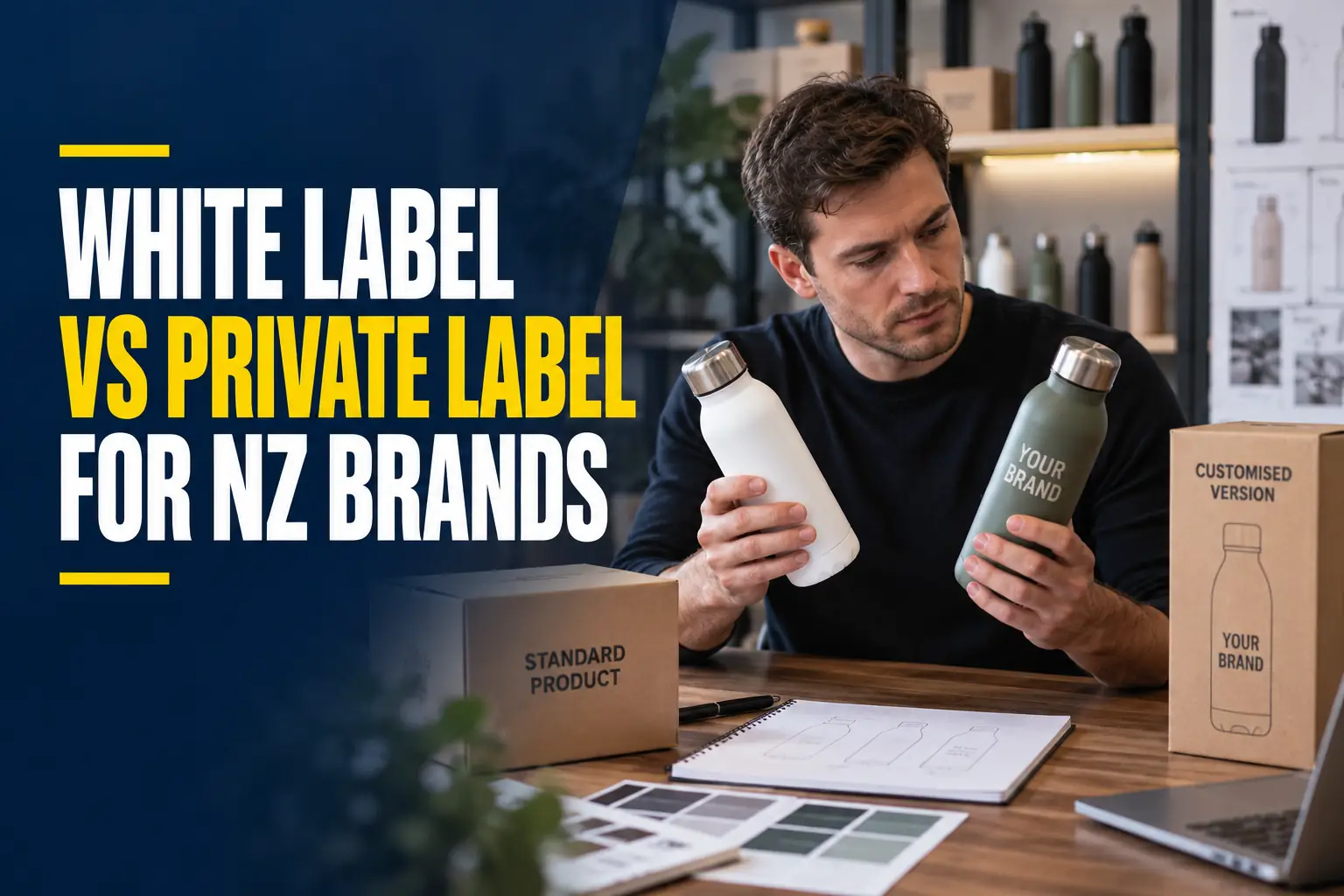
Choosing between white label vs private label is really a decision about how much control your brand needs over the product. The terminology can be confusing because suppliers do not always use it consistently. One factory may call a lightly modified stock product “private label”, while another calls the same arrangement “OEM”.
Instead of relying on the label, define exactly what the factory will change. That includes the product itself, branding, colour, materials, accessories and other agreed specifications.
For many New Zealand brands, the practical choice falls into three levels: a standard white label product, a modified existing product, or a more customised private label product. Each level changes your workload, supplier options and launch risk.
White label vs private label: what is the difference?
A white label product is generally an existing product that a factory already manufactures. Multiple businesses may buy essentially the same item and sell it under different brands.
Your main changes usually relate to branding rather than the underlying product. As a result, development can be faster and the factory has fewer new specifications to manage.
A private label product usually gives your business more control. You may start from an existing factory product but change parts of it to create a version specifically for your brand.
Those changes might involve the material, colour, size, component selection, included accessories or another functional detail. However, the exact meaning depends on the supplier. Therefore, the written specification matters more than the terminology.
Think about three levels of product customisation
White label and private label are often presented as two completely separate models. In practice, there is usually a middle ground.
| Product model | What the factory changes | Level of control | Main trade-off |
|---|---|---|---|
| White label | Mainly branding or other simple presentation changes | Low | Faster and simpler, but easier for competitors to source something similar |
| Modified existing product | Selected product features plus branding | Medium | More differentiation without developing everything from the beginning |
| Custom private label | A broader set of product specifications for your brand | High | More control, but more development work and more opportunities for mistakes |
You do not need to choose the most customised option simply because it sounds more professional. The right model depends on what customers actually value.
For example, changing a hidden internal component may add cost without improving the offer. In contrast, a small functional change could solve a common customer complaint and give your brand a useful point of difference.
When does white label make sense?
White label can work well when speed, simplicity and market testing matter more than product exclusivity.
A factory already understands the existing product. It has usually produced it before, so you avoid introducing unnecessary changes into the first order. That can make the sourcing process more straightforward.
White label can suit:
- new brands testing whether customers want a product;
- retailers adding an established product category;
- businesses where branding, marketing or service creates most of the differentiation;
- buyers that do not yet need unique product features; and
- brands that want to launch before investing in deeper development.
However, white label does not mean risk-free. You still need to assess the supplier, product quality and consistency before placing a commercial order.
Also, another buyer may be able to purchase a very similar product. If your whole competitive advantage depends on the product being unique, basic white labelling may not provide enough differentiation.
When is private label the better model?
Private label becomes more useful when the product itself needs to support your brand positioning.
Perhaps competing products have a problem you want to fix. You may also need a specific material, size, colour combination or feature set for your market. In those situations, accepting the supplier’s standard specification can limit the business.
Private label can make sense when:
- you have clear evidence that customers value particular product changes;
- the standard factory product does not meet your requirements;
- you want stronger differentiation from competing sellers;
- you expect enough volume to justify additional development work; or
- you already understand the category and want more control over the finished product.
More customisation also creates more decisions. Every new requirement gives the supplier another detail to interpret, price and manufacture correctly.
That is why private label development needs a clear product brief. Prestige Sourcing’s eCommerce & Private Label sourcing service can help brands define requirements, communicate with factories and manage the sourcing process in China.
Do not choose a model based on the supplier’s terminology
A common mistake is asking a supplier, “Do you offer private label?” and treating a yes as a complete answer.
That question tells you very little. One supplier may simply add your logo to its standard item. Another may allow substantial changes to the same product.
Instead, ask the supplier to confirm each requested change individually.
For example:
- Which parts of the current product remain unchanged?
- Which specifications can you modify?
- Are there restrictions on colours, materials or components?
- What minimum order quantity applies to each change?
- Does a modification change the unit price?
- Are there separate development or setup costs?
- How will the final agreed version be identified on the quotation or specification?
This approach turns a vague product label into a defined manufacturing scope.
Customisation can change the supplier terms
A factory may quote one minimum order quantity for its standard product and another for a customised version. The difference can be significant because the supplier may need to purchase materials or components specifically for your order.
Colour changes can also affect minimum quantities. So can specialised finishes, components or other non-standard requirements.
Before approving a customised version, ask what each change does to:
- minimum order quantity;
- unit cost;
- development charges;
- production lead time;
- component availability; and
- future reorder requirements.
Do this before you become committed to a particular supplier. Otherwise, a product that looked commercially attractive at the beginning may become harder to justify once all the conditions appear.
More customisation does not automatically create a better product
Adding changes can feel like progress. However, every modification should have a reason.
Some brands try to customise too much on their first order because they want the product to feel unique. That approach can create additional cost and complexity before the business has proved demand.
Instead, separate changes into three groups:
- Essential: the product cannot meet your requirements without the change.
- Commercially useful: the change gives customers a meaningful reason to choose your product.
- Optional: the change is nice to have but does not materially improve the offer.
Start by protecting the essential requirements. Then decide whether the commercially useful changes justify their additional cost or minimum quantities.
This often leads to a stronger first-order specification than simply customising everything the factory allows.
Keep the first-order budget in perspective
The product price is only part of a private label launch budget. More development can introduce extra sampling, setup and production costs before freight and importing expenses enter the calculation.
However, there is no useful rule saying that white label is always cheap or private label is always expensive. Product category, quantity and the changes you request matter more.
For an early-stage brand, the key question is whether the level of customisation matches the amount of capital you can sensibly commit to proving the product.
A first order should leave enough room to deal with freight, importing, marketing and unexpected costs. Do not consume the entire launch budget simply to make the product more customised.
Packaging and product development are separate decisions
Your product model does not automatically determine your packaging model. A standard white label product can still use branded packaging, while a highly customised product may initially use relatively simple packaging.
Keep those decisions separate so you can see what each change costs and what value it creates. Our guide to private label packaging in China covers the packaging side in more detail.
Likewise, product customisation makes physical verification more important. Once you have agreed the specification, you need a reliable way to confirm what the supplier actually produced.
For the sampling process itself, see our guide to product samples from China.
Write down exactly what you are buying
The biggest practical lesson in the white label vs private label decision is simple: do not rely on the label alone.
Your records should make it clear which product the supplier will manufacture and which details it will change. Attach specifications, reference photos or other agreed information where they help remove ambiguity.
Before placing the order, confirm:
- the exact base product or model;
- every approved modification;
- materials and components that matter to performance;
- colour and finish requirements;
- included accessories;
- branding requirements;
- quantity and supplier minimums; and
- any costs linked specifically to customisation.
Once those points are clear, the commercial label becomes much less important. You know what the factory has agreed to supply.
Which model should an NZ brand choose?
Choose the lowest level of customisation that gives your brand the product it actually needs.
If an existing product already meets the core requirement, white label may provide a faster route to market. You can test demand without creating development work that customers may not value.
If specific changes make the product meaningfully better for your target market, a modified or private label approach can provide more control. However, those changes should solve a real commercial problem.
Established brands may eventually move from a standard product to progressively deeper customisation. You do not need to make every change on the first production run.
How Prestige Sourcing can help
Prestige Sourcing works with eCommerce sellers, private label brands, wholesalers and other importers sourcing products from China.
We can help clarify what you need from the product, communicate those requirements to suppliers and compare manufacturing options. We can also support supplier checks, production follow-up, quality inspections and freight coordination as the order progresses.
That gives you one sourcing process rather than treating product development, suppliers and shipping as unrelated steps.
If you are deciding between a standard factory product and a more customised version, see our eCommerce & Private Label sourcing service and send us the product requirements you are considering.